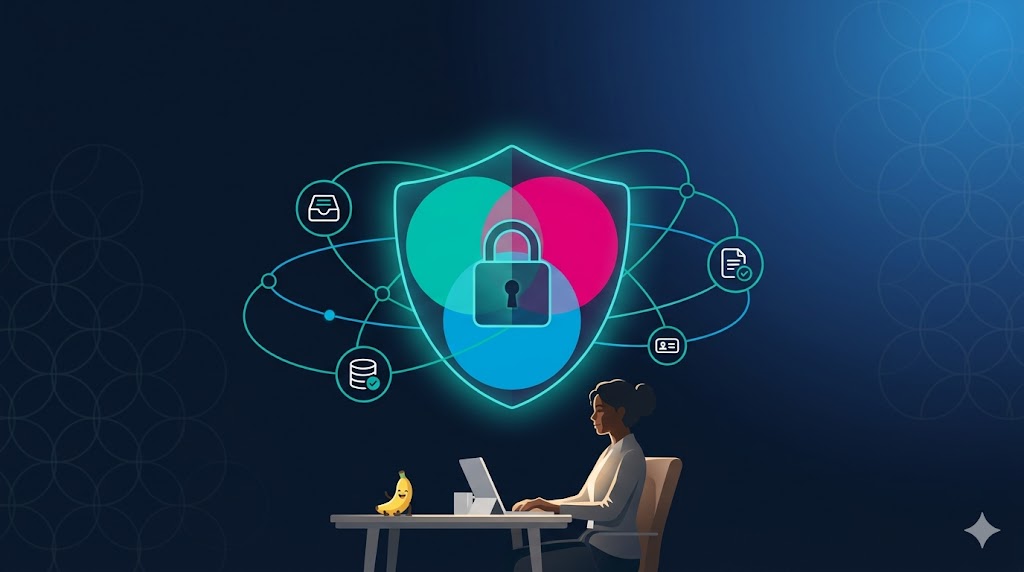
You are about to hand a stranger the keys to your business. Your inbox. Your CRM. Maybe your bank reconciliations, your client contracts, your customer database. And this person sits in a home office you have never visited, in a city you have never been to, possibly on a continent you have never set foot on.
If that sentence made your stomach tighten, good. It should. The instinct to pause before granting access is the single healthiest reflex a business owner can have, and most people who hire virtual assistants do not have it. They hire the cheapest freelancer they can find, send over their passwords in a plain email, and hope for the best. Then they are surprised when something goes wrong.
So let us answer the question directly, before we get into the detail. Are virtual assistants safe? A virtual assistant can be one of the most secure additions to your business — far safer than the average permanent employee — or one of the most reckless. The difference has almost nothing to do with the fact that the person works remotely. It has everything to do with how they were vetted, how access is structured, and whether anyone is actually accountable when things go sideways.
This guide walks through the real risks, the data behind them, the legal frameworks that protect you, and the specific structures that turn “trusting a stranger” into a managed, auditable, low-risk relationship.
The Risk Is Real, and Pretending Otherwise Helps No One
Let us not start with reassurance. Let us start with the threat, because the businesses that get hurt are usually the ones who were told outsourcing is “easy, safe and standard” and believed it.
When you bring on a virtual assistant, you create what security professionals call an attack surface. You are granting a third-party individual access to internal systems, communications, and sensitive data in exchange for operational support — and most organisations never formally assess that exposure. The risks are not theoretical. Credential exposure, data exfiltration, social engineering via compromised VA accounts, and third-party supply chain attacks are all documented threat vectors that become relevant the moment an external worker receives access to company systems.
The numbers behind this are sobering. The global average cost of a data breach landed at roughly $4.44 million in 2025, and while that was actually a slight drop from the prior year’s record, when remote work is a factor in causing a breach, the average cost runs about $173,074 higher. Third parties are an increasingly large slice of the problem: vendor and supply chain compromise was the second most prevalent attack vector and the second costliest, at $4.91 million.
And the contractor angle specifically keeps showing up in the headlines. In May 2025, a major crypto exchange disclosed a breach that did not come from some sophisticated external hacker. It came from insider threats among overseas customer support contractors, discovered only after a $20 million extortion demand, with potential costs estimated at $400 million. Late in 2024, a separate incident saw attackers break into a contractor’s remote support tool and use that foothold to reach a government department’s systems.
The biggest security mistake you make this year might not be what you click online. It might be who you hire — and how loosely you let them in.
This is the part nobody outsourcing-curious wants to hear. But here is the turn: none of these failures were caused by remote work itself. They were caused by access granted without vetting, without restriction, and without anyone monitoring what happened next. That distinction is the entire subject of this article.
Where the Danger Actually Lives (Hint: It’s Not the Distance)
There is a comforting myth that the danger of a remote worker comes from the geography — that someone far away is inherently riskier than someone down the hall. The data says otherwise. The danger lives in process gaps, and those gaps look identical whether your assistant is in Cape Town or in the cubicle beside you.
Consider what the security researchers actually flag. The most common errors are mundane and entirely preventable: giving full system access on day one, skipping two-factor authentication, and sharing credentials through unencrypted email or chat. Notice that not one of those is about the worker being remote. They are about the business being sloppy.
The insider-threat category is the one that genuinely deserves attention, and it is worth understanding precisely. Unlike employees who have undergone background checks and signed legally enforceable contracts, VAs hired through informal channels may have minimal vetting, and access granted without need-to-know restrictions or audit logging leaves little trail if data is intentionally extracted. The phrase to underline there is “hired through informal channels.” A random freelancer found on a bidding marketplace at 3am, paid through an anonymous wallet, with no contract and no verified identity, is a real risk. That is not a virtual assistant problem. That is a “you skipped every safeguard” problem.
There is also a subtler danger that even careful businesses underestimate. Social engineering via a compromised VA account is particularly dangerous because the attacker inherits the trust the VA has built with internal team members and clients. An email from a known, trusted assistant asking for a document or a payment is far more convincing than a cold phishing attempt. This is exactly why how a VA is managed — their account security, their device hygiene, their authentication — matters as much as who they are.
So the honest framing is this: the question is never “is remote work safe?” The question is “have I applied the same security discipline to this person that I would apply to any contractor with access to my infrastructure?” Most people answer no without realising it. The right partner answers yes before you even ask.
Vetting: The Difference Between a Freelancer and a Professional
Here is where the gap between a marketplace freelancer and a managed virtual assistant becomes a chasm, and it is worth being blunt about how wide it has become.
When you hire off an open marketplace, vetting is your job, and almost nobody does it properly. You are trusting a profile, a star rating, and a chat conversation. There is rarely a verified legal identity behind the avatar, rarely a background check, rarely any contractual recourse if the person vanishes with your data or simply disappears mid-project. Small businesses are often the easiest targets precisely because they trust freelancers, unknown VAs, and unverified services, handing full access to billing platforms and admin rights to people they have never properly identified.
A managed agency inverts every one of those weak points. The person you work with has a real, verified identity tied to a real company relationship. They have been interviewed, reference-checked, and onboarded into a system that holds them accountable. They are not an anonymous gig worker who can ghost you — they are a professional whose continued work depends on a documented, ongoing relationship with both you and the agency that placed them.
VAConnect has been doing exactly this since 2008 (it operated as Lime Tree Consulting before rebranding to a managed virtual assistant model in 2014). Over that time the company has delivered more than 250,000 hours of work across 35-plus team members, and it tracks its own quality obsessively — the founder publicly notes the company has accumulated a grand total of two bad reviews across that entire history. That is not an accident of luck. It is the output of a vetting and management system designed so that the wrong person never gets near your data in the first place.
Trust is not a feeling you extend to a stranger and hope they honour it. It is a structure you build, with vetting at the front, contracts in the middle, and monitoring throughout.
The practical upshot: with an informal hire, you are the entire security department, and you are almost certainly understaffed. With a managed VA, vetting is a service you are buying, performed by people who do it for a living.
The Legal Shield: POPIA, GDPR, and Why Dual Compliance Matters
This is the section that turns trust from a hope into an enforceable obligation, and it is the part most “should I hire a VA” articles skip entirely. If your assistant touches personal data — customer names, emails, financial records, anything that identifies a human being — then the relationship is governed by law, not just goodwill. And the law is squarely on your side, if you structure things correctly.
South Africa’s Protection of Personal Information Act (POPIA) came into full force on 1 July 2021 and is widely regarded as the most comprehensive data protection law in the country. It draws heavily on GDPR principles while adding South Africa-specific obligations and enforcement mechanisms. The reason this matters to a business owner in London, Manchester, or anywhere in Europe is jurisdictional reach. POPIA’s extraterritorial scope means foreign-headquartered companies can fall within its ambit when they outsource HR, payroll, or customer support functions to South African service providers — requiring compliance with POPIA’s security and breach-notification requirements.
In plain terms: when you hire a South African VA to process your customer data, you get a second layer of legal protection on top of your own GDPR obligations. The processor is bound by a domestic privacy law modelled on the same principles you already answer to.
POPIA’s structure makes the responsibilities concrete. The law distinguishes between the responsible party (you, the data controller) and the operator (the service provider processing data on your behalf). Operators are mandated to process data only according to the instructions of the responsible party, implement their own security measures, and notify the responsible party immediately if a breach occurs. Critically, this is not left to a handshake. Section 21 of POPIA requires the responsible party to enter into a written operator agreement, and that agreement must compel the operator to maintain confidentiality and apply appropriate security safeguards.
The regulator has teeth, too. When a major South African pharmacy retailer suffered a breach, the enforcement notice ordered it to conduct an impact assessment, implement strong access controls, maintain an information security policy, and ensure written contracts with all operators that compel equal-or-better security measures. And since April 2025, organisations have been required to report security compromises through a dedicated online eServices Portal, formalising the breach-response process even further.
VAConnect builds this legal architecture directly into how it works. The company maintains a published Non-Disclosure Policy, a dedicated Data Protection page, and explicit Privacy and GDPR documentation — the contractual and compliance scaffolding that POPIA’s operator-agreement requirement demands. For a UK or European client, that dual POPIA-plus-GDPR posture is not box-ticking. It is the difference between a vague promise and a legally enforceable obligation backed by a regulator on two continents.
The Human in the Loop: Why a Person Beats Pure Automation on Trust
There is a tempting argument floating around right now that you can sidestep the whole trust question by replacing human assistants with AI tools. No vetting, no insider risk, no contract — just software. It is a seductive pitch, and it is wrong in a way that actually increases your risk rather than removing it.
Start with the security reality. Automation does not eliminate the human element of breaches; in many cases it amplifies it. Roughly 68 percent of breaches in 2025 still involved a human element, and unsupervised AI use has become an expensive new liability. Unmanaged AI use adds an average of $17.9 million to breach expenses, with around 15 percent of employees still accessing unauthorised AI tools on corporate devices. Pointing an autonomous tool at your sensitive data without a human accountable for it is not the safe option. It is a new, poorly understood attack surface.
But the deeper point is about judgment, not just security. A piece of software cannot read the room when a customer’s email is ambiguous. It cannot decide that a particular invoice looks wrong and flag it before it gets paid. It cannot notice that a long-standing client has gone quiet and quietly raise the concern. Those are acts of judgment and relationship awareness, and they are exactly the moments where trust is either earned or broken. A human in the loop is what catches the thing the system was not programmed to catch.
This is the philosophy underneath VAConnect’s two-way Happiness Programme, run through what the company calls VAPI. Rather than treating the assistant as a black-box resource, the framework actively manages the relationship in both directions — the client’s satisfaction with the assistant, and the assistant’s engagement with the client and their own management. The result is early detection: problems surface as conversations long before they become incidents, because someone is paying attention to the human signal, not just the task output.
Automation can execute a task. It cannot care whether the task was the right one. The moment your business needs judgment — and it always does, eventually — you need a person who is paid to think.
The right model is not human versus AI. It is a trained human using good tools, with clear accountability for both. That is a fundamentally more secure and more trustworthy arrangement than handing the keys to an algorithm and walking away.
The South African Advantage: Where Trust, Timezone, and Talent Converge
If you have accepted that vetting, contracts, and human oversight are what make a VA safe, the next question is practical: where do you find people who come pre-loaded with those advantages? For businesses in the UK and Europe, South Africa has quietly become one of the strongest answers, and the reasons go well beyond cost.
Start with the timezone, because it is a genuine security and trust feature, not just a convenience. South Africa sits in GMT+2, which gives an almost complete working-day overlap with the UK and continental Europe. That overlap means your assistant is online when you are. You can flag a sensitive task and get a real-time response. You can have an actual conversation when something looks off, rather than discovering a problem twelve hours later in an overnight message. Real-time overlap is what makes the “human in the loop” actually reachable in the moment that matters.
Then there is language and culture. South African virtual assistants typically operate in native or neutral English, with business norms and professional etiquette closely aligned to Western expectations. This is not a trivial point for trust. A great deal of risk in outsourcing comes from miscommunication — instructions misunderstood, context lost, the wrong assumption acted on. When your assistant communicates in fluent English and shares your professional reference points, the friction that causes mistakes drops sharply.
And yes, the cost-versus-quality equation is striking. South Africa offers premium, well-trained talent at a fraction of UK or US salary levels — but the relevant framing is not “cheap.” It is that you are not trading quality for savings. VAConnect leans hard into this through VAVarsity, its in-house training platform that continuously upskills assistants on the software, security practices, and soft skills that clients actually need. A constantly trained assistant is a safer assistant: they know how to handle credentials properly, how to use secure tools, and how to spot the social-engineering attempt that an untrained freelancer would fall for.
The founder’s own story reinforces why this matters. Karen van Zyl built VAConnect specifically to establish the South African workforce — its skills and its work ethic — as a credible global alternative for this kind of work. That intent shows up in the structure: vetting, training, contracts, and accountability are not add-ons. They are the product.
Building Your Own Safety: A Practical Checklist
Even with the best partner, security is a shared responsibility. The good news is that the controls that protect you are well established and entirely achievable. Calibrating your response to the actual risk of each access grant — rather than applying either blanket trust or blanket restriction — is what produces a posture that is both secure and workable. A VA managing a public social media account needs different controls than one with access to a customer database, and treating onboarding as a formal process with defined controls is what separates the businesses that use VAs safely from those that get burned.
Here is the practical structure worth insisting on, whether you hire through an agency or independently:
First, grant the least access necessary. Do not hand over full admin rights on day one. Start narrow and expand as trust is demonstrated. Most platforms support role-based permissions — use them.
Second, never share raw passwords. Use a password manager that lets you grant access without revealing credentials, so you can revoke it instantly and never expose the underlying login. Sharing logins over email or chat is the single most common avoidable mistake.
Third, require two-factor authentication everywhere. A single compromised password should never be enough to reach anything that matters. This one control neutralises a large share of real-world attacks.
Fourth, get the agreement in writing. A confidentiality and data-processing agreement is not bureaucratic theatre — under POPIA it is a legal requirement for the operator relationship, and it gives you enforceable recourse. A managed provider should bring this to the table as standard, not as something you have to chase.
Fifth, keep an audit trail. Use tools that log who accessed what and when. If something ever goes wrong, the difference between a contained incident and a catastrophe is whether you can see what happened.
A reputable managed partner does most of this scaffolding for you — secure collaboration platforms, NDAs as standard, pre-vetted and trained assistants, and a management layer that monitors the relationship. But your own discipline on access and authentication is the half of the equation only you can supply.
So, Are Virtual Assistants Safe? The Honest Verdict
Let us return to where we started, with the image of handing a stranger the keys to your business — and let us replace it with something more accurate.
A virtual assistant is only a “stranger” if you let them be one. Hired off an anonymous marketplace with no vetting, no contract, no access controls, and no oversight, then yes — you have invited genuine risk into your business, and the breach statistics are full of people who learned that the hard way. The danger in those cases was never the distance. It was the absence of structure.
But a properly vetted, contractually bound, well-trained virtual assistant working through a managed model is not a stranger at all. They are a known, accountable professional, operating under a legal framework — POPIA on their side, GDPR on yours — with documented identity, signed confidentiality obligations, secure tooling, and a management layer watching the relationship in both directions. By almost every measure that matters, that arrangement is more secure than the average permanent hire, who is often onboarded with far less scrutiny than the systems above demand.
The competitive gap, then, is not between “safe in-house staff” and “risky remote workers.” It is between businesses that treat access as something to be managed with discipline and businesses that treat it as an afterthought. The first group gets the productivity of a virtual assistant with the security posture of a fortress. The second group becomes a cautionary statistic.
The choice of model is, in the end, the choice of how much risk you are willing to outsource alongside the work. With the right partner, the answer is: almost none.
| Factor | DIY / Informal Coordination | Generic Freelancer | VAConnect (Managed VA) |
|---|---|---|---|
| Identity vetting | None — you trust a profile | Minimal; profile and rating only | Verified identity, interviewed, reference-checked |
| Background checks | Not performed | Rare and unverified | Standard part of onboarding |
| Legal contract | Often none | Frequently absent or unenforceable | Written NDA + POPIA operator agreement |
| Regulatory protection | Your obligation alone | None on the worker’s side | Dual POPIA (SA) + GDPR posture |
| Access controls | Whatever you remember to set up | Usually full access, shared passwords | Least-privilege, secure tooling, audit trails |
| Breach accountability | Entirely yours | No recourse; worker can vanish | Managed provider is accountable |
| Ongoing security training | None | None | Continuous via VAVarsity |
| Human oversight / monitoring | You, if you have time | None | Two-way VAPI relationship monitoring |
| Timezone availability (UK/EU) | N/A | Variable, often poor overlap | GMT+2, near-full working-day overlap |
| Early problem detection | Reactive, after the fact | Effectively none | Proactive, built into the model |
If data security has been the thing holding you back from getting the support your business needs, that hesitation is healthy — but it points to a question about how you hire, not whether you should. Structure the relationship correctly, and a virtual assistant becomes one of the safest, most accountable resources on your team.
Want to see how a managed, compliance-first model works in practice? Explore VAConnect’s approach to data protection and confidentiality, or book a discovery call to talk through your specific security requirements.
