
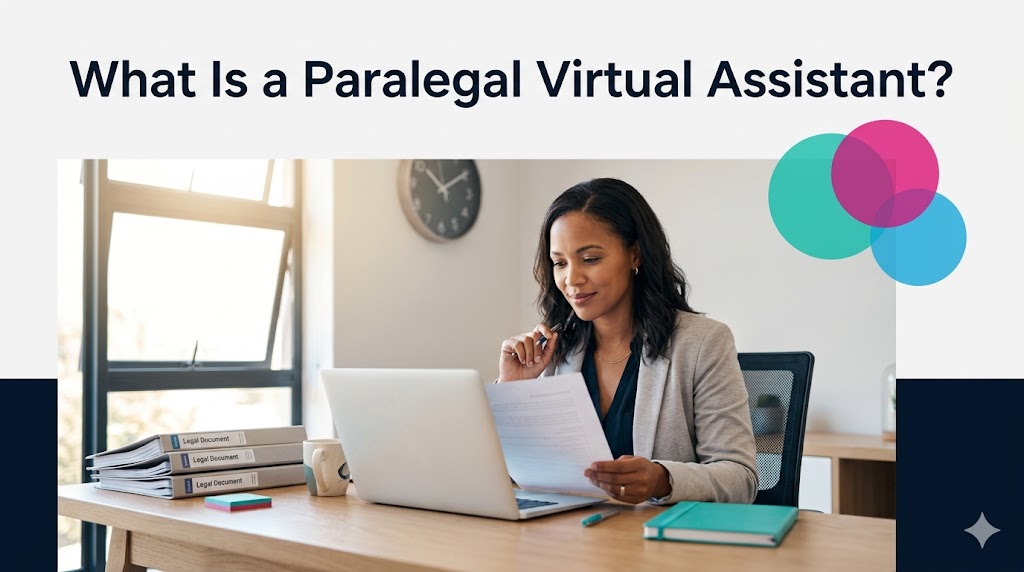
It is 7:40 on a Tuesday evening. The last client left two hours ago. The court filing is due tomorrow morning, and the actual legal thinking — the part you went to law school for, the part clients pay you for — took you forty minutes. The other four hours? Chasing a signature. Re-formatting a bundle. Cross-checking exhibit references. Calling a process server who didn’t pick up. Updating a matter file nobody will read until something goes wrong.
If that scene feels familiar, you are not lazy and you are not bad at your job. You are simply doing two jobs at once: the lawyer, and the unpaid administrator behind the lawyer. And the gap between the firms that have solved this and the firms that haven’t has become almost embarrassing to look at up close.
A growing number of solo practitioners, boutique firms, and in-house legal teams have quietly fixed the problem by hiring a paralegal virtual assistant — a trained legal support professional who works remotely, takes the document-heavy and administrative weight off the qualified lawyer, and does it at a fraction of the cost of a local hire. This guide explains exactly what that role is, what it can and cannot legally do, where the real risks sit, and why the firms getting this right are pulling away from the ones still trying to do everything alone.
What a Paralegal Virtual Assistant Actually Is (and Isn’t)
Start with the plain definition. A paralegal virtual assistant is a remote legal support worker who handles substantive and administrative legal tasks under the supervision of a qualified, practising lawyer. They are not a lawyer. They do not — and legally cannot — give legal advice, represent clients, or practise law. What they do is everything that surrounds the practice of law: the research, the drafting, the file management, the chasing, the formatting, the scheduling.
It helps to separate two overlapping roles that get blurred constantly. A virtual legal assistant tends to focus on administrative work — scheduling appointments and meetings, managing client communications, billing, and managing contacts. A remote paralegal takes on more substantive legal work that is specifically assigned and supervised by a licensed lawyer. A paralegal is a legal professional with the skills and experience to take on substantive legal work specifically assigned and supervised by a licenced lawyer. In practice, many paralegal VAs do both, scaling between admin and substance depending on what the matter needs that week.
The model is no longer fringe. It used to be that a freelance or virtual paralegal was a niche, slightly suspect option — the thing you did when you couldn’t afford a “real” hire. That framing is gone. A 2024 report by Thomson Reuters projects a 20% year-over-year increase in legal process outsourcing due to the rising demand for legal services and staffing shortages. Outsourcing legal support has moved from cost-cutting experiment to mainstream staffing strategy, and the firms treating it that way are the ones with their evenings back.
The truism that paralegals must sit down the hall to add value has been quietly overturned. The evidence now points the other way — and it puts a number on the cost of clinging to the old model.
What Can You Actually Hand Over? A Realistic Task List
The honest answer is: more than most lawyers expect, but not everything. The boundary is set by one rule — a paralegal cannot practise law, and an attorney must supervise the work. Attorneys must supervise all paralegals since paralegals can’t practice the law. Inside that boundary, the room to delegate is enormous.
The tasks that move off your desk first tend to be the document-heavy ones. Legal research into case law, statutes, and precedents. Drafting memoranda, briefs, and routine procedural motions. Document review. Preparing and answering interrogatories. Summarising depositions. Then the administrative layer: managing the matter calendar, chasing signatures and documents, organising exhibit bundles, handling first-line client correspondence, billing, and contact management.
Why does this matter so much in hard numbers? Because the average lawyer is spending shockingly little of the day on the work that actually bills. The newest Legal Trends Report research found that the average lawyer completes just 2.9 hours of billable work per day. The rest evaporates into exactly the kind of work a paralegal VA exists to absorb. And the firms that make the shift see it land on the bottom line: law firms report 40% more billable hours and 60% less admin workload after outsourcing.
There is also a sanity argument that the numbers tend to hide. The legal profession has a well-documented mental health problem, and the relentless administrative grind is part of the engine driving it. The “death by inbox” feeling — buried under unfinished work, pushed-aside obligations, and good intentions — is not a personal failing. It is a structural one. Handing the grind to someone trained to do it well is not an indulgence; for a lot of solo practitioners it is the difference between a sustainable career and a short one.
The “Human in the Loop” Problem: Why You Cannot Just Use AI for This
Here is where a lot of 2026 advice goes badly wrong. The obvious-sounding answer to “I’m drowning in legal admin” is “use AI.” And for some narrow tasks, AI genuinely helps. But the legal profession has just spent two years learning, in public and at great cost, exactly where unsupervised automation breaks.
The numbers are genuinely startling. There have been an estimated 712 legal decisions written about hallucinated content in court cases around the world, with about 90% of those decisions written in 2025, according to a database maintained by Paris-based researcher and law lecturer Damien Charlotin. That figure has only grown since — the same tracker has identified well over 1,500 cases. These are not hypothetical risks. They are real filings, with real fake citations, in front of real and increasingly irritated judges.
And the consequences are escalating fast. AI-hallucinated case citations have moved from novelty to a core challenge for the courts, prompting complaints from judges that the issue distracts from the merits of the cases in front of them. Courts have stopped being lenient. Courts are escalating responses beyond warnings to real sanctions: monetary fines, mandatory training, bar referrals, and public reprimands. In one California appellate matter, a lawyer was sanctioned $10,000 and referred to the state bar for fabricated, AI-generated citations.
The deeper lesson is the one DISCO’s analysts put well: the answer is not to ban the technology but to build verification into every step, with a human who is accountable for the output. It’s building verification into every workflow and choosing technology partners who make accuracy checks seamless, not burdensome. That human is exactly what a trained paralegal virtual assistant provides. A machine that confidently invents a precedent does not feel the professional dread of a bar referral. A trained person checking that citation against Westlaw does.
An AI tool will hand you the perfect-looking precedent that does not exist, and feel no shame about it. A trained paralegal knows that a citation no one can verify is a career risk — and treats it like one.
This is the whole argument for the “human in the loop” model, and it is why VAConnect built its support structure around people who are continuously trained rather than around raw automation. The firm’s VAVarsity programme exists precisely to keep that human judgment sharp — its remote professionals are upskilled continuously in the software, platforms, and the soft skills that AI cannot supply. AI can draft. Only a person can be responsible.
The South African Advantage: Why Geography Suddenly Matters
This is the part most UK and European firms underestimate until they try it. When you outsource legal support, the single biggest practical headache is usually time zones — the eight-hour gap that turns a simple “can you confirm before the 3pm filing?” into a next-day problem. South Africa quietly removes that headache.
South Africa runs on GMT+2. That means a Johannesburg or Cape Town paralegal’s working day overlaps almost completely with the UK, the rest of Europe, and a good chunk of the US East Coast. There is no waiting overnight for a response. When your court deadline is 4pm in London, your paralegal VA is at their desk, awake, and working the same hours you are. For a profession run entirely on deadlines, that overlap is not a nice-to-have — it is the whole game.
Then there is language and culture. South African legal support professionals work in native or neutral English, in a legal and business culture closely aligned with British norms — unsurprising, given the shared legal heritage. Client-facing correspondence reads the way your clients expect it to read. There is no awkward translation layer, no tonal mismatch on a sensitive client email.
And then there is the cost-versus-quality equation, which is where the gap becomes almost uncomfortable to look at. For context on the market rates firms are paying elsewhere: specialized legal research or paralegal tasks range $25–$45/hour. South African talent delivers comparable quality at a meaningful discount to UK and US rates — not because the work is cheaper in quality, but because the cost base is lower. You are not trading down on skill. You are arbitraging a currency and cost-of-living gap while keeping the standard high.
The firms that have figured out South African legal support aren’t saving on quality to save on cost. They’re getting Western-standard work, in their own time zone, in their own language — and paying less for it. That combination shouldn’t exist. It does.
The Risk Most Firms Get Wrong: Confidentiality and Compliance
If you are a regulated lawyer, this is the section that should make you sit up. Outsourcing legal work does not outsource your professional responsibility. The point is blunt and worth tattooing on the inside of every COLP’s eyelids: delegating responsibility, however, does not delegate accountability under the SRA and GDPR. You remain on the hook. So the question is never “is outsourcing risky?” — it is “is this provider set up to protect me?”
The regulatory weather has turned sharply. In 2025 alone, the SRA received over 2,300 reports of data breaches and cyber security incidents affecting solicitor practices. And the rules around third parties have tightened. Under the Economic Crime and Corporate Transparency Act, firms are now being told to extend contractual terms with outsourced providers to include fraud prevention obligations, and — the line that matters most — that reliance on trust alone will not be a defence. Vague good intentions about your offshore helper will not survive a regulatory review.
The architecture that protects you is well understood. It runs on least-privilege access — the principle that a person should only ever touch the files their specific task requires. As one UK cyber-security guide put it plainly: a paralegal handling conveyancing should not have access to the HR director’s salary files. On top of that sit signed NDAs, encrypted and cloud-based communication channels rather than credentials emailed around in plain text, and proper onboarding rather than day-one full access.
This is exactly where a managed agency pulls ahead of a freelancer you found on a marketplace. VAConnect operates with published Non-Disclosure, Data Protection, and Privacy & GDPR policies, signed NDAs as standard, and secure channels built into the workflow. With a random freelancer, the compliance burden is entirely yours to construct, audit, and defend. With a managed provider, the framework already exists — and that is precisely the “reasonable procedures” a regulator now expects you to be able to point to.
Managed VA vs Freelancer vs Doing It Yourself: The Real Comparison
Once a lawyer accepts that the admin has to go somewhere, the choice narrows to three options, and they are not equal. Doing it yourself is the default, and the most expensive in the way that doesn’t show up on an invoice — it shows up in lost billable hours, missed deadlines, and burnout. A boutique New York securities firm learned this the hard way: it missed two SEC comment deadlines one winter, not for lack of legal skill, but because its only paralegal resigned and the replacement search dragged on. A single point of failure with no backup is a structural risk, not bad luck.
The freelancer route fixes the cost problem but reopens the risk one. You get a cheaper hourly rate, but you also inherit every compliance obligation, every onboarding decision, every “what happens when they go on holiday mid-matter” gap. The supervision, the security architecture, the continuity cover — all of it becomes your unpaid second job again.
The managed model is built specifically to close those gaps. The matching is done on culture and need, not just availability. The training is continuous. The compliance scaffolding is already standing. And there is backup cover so a single resignation doesn’t blow up a deadline. VAConnect’s “Managed, Not Matched” approach — a strategy-first onboarding, a culture-fit match, and a two-way accountability programme (VAPI) that monitors satisfaction on both sides — is designed precisely to remove the single-point-of-failure problem that wrecks DIY and freelance arrangements.
How to Actually Get Started Without Creating a New Problem
The mistake firms make is treating a paralegal VA like a tap you turn on and walk away from. The firms that succeed treat the first month as a deliberate build. Start by writing down where your hours actually go for one week — most lawyers are shocked by how little is legal work and how much is chase-and-format. Hand over the highest-volume, lowest-judgment tasks first: the bundling, the scheduling, the first-draft research. Keep the supervision tight at the start and loosen it as trust builds. And insist on the compliance basics — NDA signed, least-privilege access, secure channels — before the first matter touches their screen, not after.
Done this way, the ramp is fast. Virtual paralegals have become a potent weapon, providing on-demand legal assistance during busy times without the burden of full-time employment. You scale support to the caseload instead of carrying a fixed cost through the quiet months. The trial cycle hits, you scale up. It calms down, you scale back. The flexibility is the point.
The Competitive Gap Has Become Too Wide to Ignore
Step back and look at the whole picture. On one side: a lawyer doing 2.9 billable hours a day, drowning in admin, carrying the entire compliance and security burden alone, one resignation away from a missed deadline, and tempted by AI tools that will cheerfully hand them a fabricated citation and a bar referral. On the other: a lawyer who has handed the document-heavy grind to a trained, supervised, time-zone-aligned professional, kept a human firmly in the loop on every output, and built the compliance scaffolding into the arrangement from day one — at a fraction of a local hire’s cost.
That is not a small efficiency difference. It is a structural one. The firms that have made the shift are recovering 40% more billable hours and shedding 60% of their admin load while the firms that haven’t are still answering emails at 7:40 on a Tuesday. The gap compounds every single week.
The paralegal virtual assistant is not a luxury for big firms or a desperate measure for failing ones. In 2026 it is simply how the firms that have their evenings back choose to operate. The only real question left is how much longer the firms still doing it alone can afford the difference.
Ready to see what handing over the grind actually looks like? Explore VAConnect’s services or book a strategy-first discovery call with the team — and find out which tasks should leave your desk first.
Comparative Table: Three Ways to Handle Legal Support
| Factor | DIY Coordination | Generic Freelancer | VAConnect Paralegal VA |
|---|---|---|---|
| Cost | Hidden cost in lost billable hours | Low hourly rate | Up to ~60% less than a local hire, managed |
| Billable hours recovered | None — you are the admin | Some, if managed well | Up to 40% more billable hours |
| Admin load | 100% on you | Reduced, but you manage them | Up to 60% lower; fully managed |
| Human in the loop | Yes, but it’s you (burning out) | Variable, unsupervised | Trained, supervised, VAVarsity-upskilled |
| AI hallucination risk | High if you rely on AI alone | Variable | Verification built into trained workflow |
| Time-zone overlap (UK/EU) | N/A | Pot luck | Full GMT+2 overlap with UK/Europe |
| Language & culture fit | Native | Variable | Native/neutral English, Western-aligned |
| Compliance (POPIA/GDPR/SRA) | Entirely your burden | Entirely your burden | Published NDA, Data Protection & GDPR policies |
| Data security | Your setup | DIY, often weak | Least-privilege access, secure channels, NDAs |
| Continuity / backup cover | None — single point of failure | None | Pre-briefed backup cover |
| Onboarding & matching | N/A | Self-managed | Strategy-first, culture-fit “Managed, Not Matched” |
| Accountability | Self-policed | Minimal | Two-way VAPI / Happiness programme |