
Tag: Case Studies

  • What to Look for in a Virtual Assistant (Before You Trust Someone With Your Inbox)

    What to Look for in a Virtual Assistant (Before You Trust Someone With Your Inbox)

    Here is a scene that plays out in thousands of small businesses every month. A founder, drowning in admin, finally decides to hire help. They post a job, get forty replies in two days, and feel a small surge of hope. Then the real work begins: sifting through near-identical cover letters, scheduling interviews across mismatched time zones, squinting at portfolios that may or may not be the candidate’s own, and trying to guess — from a thirty-minute video call — whether this person will actually show up on Monday and do good work.

    The average business owner spends somewhere between eleven and fourteen hours vetting candidates for a single virtual assistant role on a marketplace platform. That is nearly two full working days spent not running the business, but auditioning people to help run it. And the cruel twist is that all that effort buys surprisingly little certainty. The person who aced the interview is not always the person who shows up for day one.

    So before you spend those fourteen hours, it is worth getting clear on what you are actually screening for. Most hiring guides hand you a generic list — “good communication, attention to detail, reliability” — as if those words mean the same thing to everyone. They do not. The difference between a virtual assistant who saves you ten hours a week and one who costs you ten hours a week in re-explaining, correcting, and apologising to clients comes down to a handful of qualities that are easy to name and surprisingly hard to verify.

    This is a guide to spotting them — and to understanding why the smartest move might be to not do the spotting yourself at all.

    Start With the Trait That Predicts Everything Else: Communication

    If you only screen for one thing, screen for communication. Not because the others do not matter, but because communication is the trait that exposes the others. A virtual assistant who communicates clearly will tell you when they are stuck, flag a problem before it becomes a crisis, ask the clarifying question instead of guessing, and give you the status update you did not know you needed. One who communicates poorly will leave you wondering, every single day, what is actually happening with your work.

    This is not a soft, feel-good observation. Research from the University at Buffalo found that communication skills predict job performance more consistently than technical competencies do. Think about what that means in practice. A VA who is a brilliant bookkeeper but goes silent for three days is a liability. A VA who is a solid-but-not-spectacular bookkeeper who tells you exactly where things stand every morning is an asset you can build a business around.

    When you delegate important business operations, you need confidence that your assistant has the right skills. Hiring someone without them does not just produce errors — it produces a slow, grinding erosion of trust that burns out the very founder who was trying to buy back their time.

    What does strong communication actually look like when you are screening? It shows up in the small things. Does the candidate respond to your initial message promptly and in full, or do they answer one question out of three? Are their emails clear and free of the kind of errors that suggest carelessness? On a video call, do they listen and ask questions, or do they wait for their turn to talk? The way someone communicates during the hiring process is the single best preview you will get of how they will communicate once they are inside your business.

    There is a flip side worth naming. Vague, sweeping claims are a communication red flag in disguise. A candidate who says “I’m experienced with all tools” and “I can do anything you need” is telling you less than one who says “I’m strong in Asana and Google Workspace, I’ve used HubSpot but I’d need a few days to get fluent, and I’ve never touched Salesforce.” Specificity — including honest admissions of where the gaps are — is the mark of someone who actually knows their own work. Universal expertise is the mark of someone who does not.

    Reliability Is a Skill, Not a Personality Trait

    Every founder says they want a “reliable” VA, and almost none of them know how to test for it. Reliability is not a vibe you pick up in an interview. It is a track record, and the only way to assess it is to look backwards and to test forwards.

    Looking backwards means references — real ones, contacted directly. This is the step most people skip because it feels awkward, and it is also the step that separates a careful hire from a hopeful one. Contact at least two previous clients and ask specific questions: Was the work delivered on time? How did they handle a mistake or a tight deadline? Would you hire them again? Generic references, or a reluctance to provide any contacts at all, should raise immediate concern. A virtual assistant who has done good work for other people will have people happy to vouch for them. One who deflects with “my clients value their privacy” may be hiding a thinner history than their resume suggests.

    There is also a quieter reliability signal in someone’s work history: job-hopping. A candidate who has changed clients every couple of months is not necessarily a bad worker, but the pattern deserves a direct question. Sometimes it reflects a freelancer’s natural rhythm. Sometimes it reflects someone who keeps getting let go, or who leaves the moment things get demanding. You want to know which.

    Looking forward means a trial. We will get to that in its own section, because it is the most important screening tool you have and the one most worth doing well.

    Technical Skill: Verify It, Do Not Take Its Word For It

    The 2026 virtual assistant is expected to do more than answer email. The role has expanded to include project management fluency, basic digital marketing, data handling, and increasingly, comfort working alongside AI tools rather than being replaced by them. The in-demand VA today pairs traditional strengths — time management, organisation, written communication — with working knowledge of the platforms that actually run modern businesses: Slack, Trello, Asana or ClickUp for project flow, a CRM like HubSpot or Salesforce, Canva for quick design, and the full Google Workspace and Microsoft Office suites.

    Here is the catch. Anyone can list these on a resume. A candidate who claims “advanced Excel” and “CRM expert” has told you nothing you can rely on. The only way to know is to test, and testing is easier than most founders assume.

    The principle that experienced recruiters use is simple: build a small, real-world task that mirrors the actual job, and grade it against a clear rubric. If the role involves administrative work, ask the candidate to draft a sample reply to a tricky customer email. If it involves social media, ask for three post concepts for your industry. If it involves bookkeeping, hand over a short list of mock transactions and ask them to reconcile and flag any inconsistencies. For CRM-heavy roles, ask them to record or update sample client data in your system. These tests reveal actual capability in a way that no interview answer can — and they expose the gap between someone who says they know a tool and someone who can actually navigate it under realistic conditions.

    Score what comes back on accuracy, timeliness, attention to detail, and how clearly they communicate about the work. A standardised rubric matters here, because it strips out the gut-feel bias that leads to so many bad hires. You are not asking “do I like this person?” You are asking “did they do the work well?”

    Under-skilled assistants do not save money. The time you spend correcting mistakes, re-explaining tasks, and fixing the downstream mess almost always outweighs whatever you saved on a lower rate. Cheap is the most expensive option there is.

    Confidentiality and Trust: The Quality You Cannot Afford to Get Wrong

    When you bring on a virtual assistant, you are handing a near-stranger the keys to your business. Inbox access. Calendar access. Often customer records, financial documents, contracts, and login credentials. This is not a detail to sort out later. It is central to who you should be willing to hire at all.

    Confidentiality is consistently named as one of the most important qualities in a virtual assistant, and for obvious reasons. A trustworthy VA treats sensitive information with care, asks for access only to the systems a task actually requires, and understands instinctively that client data is not theirs to discuss, store carelessly, or carry off to the next gig. The screening signals here are concrete. Is the candidate willing to sign a non-disclosure agreement and a proper contract? A legitimate professional treats this as routine. Refusal — especially dressed up as “my other clients never needed that” — is a serious warning sign.

    There is a security dimension too, particularly when hiring through open marketplaces. The flip side of legitimate hiring is the world of scams: candidates who are not who they say they are, or arrangements that quietly expose you to data breaches and fraud. As a baseline, verify that the person and any company they cite actually exist — a few minutes on Google and LinkedIn goes a long way. And follow the principle of least access: a VA should only be granted entry to the tools and accounts the specific task demands, nothing more. The convenience of handing over a master password is never worth the risk.

    The Trial Period: Your Single Most Honest Screening Tool

    If references are how you look backwards and skill tests are how you probe specific competencies, the trial period is where you find out the truth. It is, by a wide margin, the most telling part of the entire hiring process — and the one founders most often rush or skip.

    The mechanics are straightforward. Before committing to a monthly arrangement, run a paid trial — somewhere between a few focused hours and ten to twenty hours of real work, depending on the role. Assign tasks that genuinely reflect the day-to-day job, not contrived puzzles. Then watch what actually happens: How do they handle the work? Do they follow instructions or improvise in unhelpful ways? Do they ask good questions? Do they hit deadlines? Do they fit your working rhythm, or does every handoff feel like friction?

    A non-negotiable point: the trial should be paid. Unpaid trials are not only ethically off — they also tilt your candidate pool toward the desperate and away from the genuinely good, who have other options and will not work for free. Paying for a short trial respects the assistant’s time and, more selfishly, gets you a far more honest picture of what a real working relationship would feel like. It is the cheapest insurance you will ever buy against a bad long-term hire.

    The reason the trial matters so much is that so few hiring failures are actually about raw skill. As one analysis of common hiring mistakes put it, most failures happen because of missing systems, unclear expectations, and poor onboarding — not because the assistant lacked ability. A trial period surfaces exactly these issues while the stakes are still low. You discover, in week one and on a small budget, the misalignment that would otherwise cost you three months and a damaged client relationship to learn.

    The Quiet Problem: Even a Great Hire Fails Without Management

    Here is the part of the hiring conversation that almost nobody wants to say out loud. You can screen for communication, verify the skills, check the references, and run a flawless trial — and the placement can still fall apart. Not because you picked the wrong person, but because hiring a virtual assistant is only half the job. The other half is managing one.

    The single most common reason virtual assistant relationships fail is not a lack of talent. It is a lack of management. Without standard operating procedures, a new assistant has to guess how you want things done. You end up repeating instructions, feeling like a broken record, and getting work that is brilliant one day and unusable the next. The ramp-up drags. You start paying for hours that produce little value. And the founder who outsourced specifically to claw back time finds themselves more burned out than before — now stressed about managing a hire instead of doing the work themselves.

    This is the trap hiding inside every “how to hire a VA” checklist. The checklists implicitly assume that once you have found the right person, the hard part is over. In reality, finding the person is the easy part. The hard part is the ongoing structure: clear role definition, documented processes, defined communication channels, performance check-ins, and a plan for what happens when someone is sick, on leave, or simply not working out. Most solo founders do not have the time or the systems to provide any of that — which is precisely why so many of them cycle through assistant after assistant, blaming the talent each time, when the real gap is the management layer that was never there.

    Outsourcing rarely fails for lack of talent. It fails for lack of management. The businesses that get the most from virtual assistants are not the ones who hired the best person — they are the ones who built the structure around them.

    Once you see this clearly, the entire hiring question reframes itself. The smart thing to look for in a virtual assistant might not be a person at all. It might be a system that already includes the person, the management, and the safety net.

    The South African Advantage — and Why Geography Quietly Decides So Much

    Where your virtual assistant sits on the map matters far more than most first-time hires expect. Time zone alignment is not a nice-to-have; it is the difference between real-time collaboration and the slow, async guessing game of leaving a message tonight and getting a reply tomorrow afternoon. This is where South African talent has become quietly, structurally compelling for businesses in the UK and Europe.

    South Africa sits in the GMT+2 zone, which overlaps with the United Kingdom and most of Europe for nearly the entire working day. A founder in London can have a morning conversation with an assistant in Cape Town and see the work land before lunch — not at midnight, not the next day. That single fact eliminates the largest source of friction in remote work: the coordination lag that turns a simple back-and-forth into a forty-eight-hour relay.

    The advantage runs deeper than the clock. South African virtual assistants are typically university-educated, fluent and articulate in English, and culturally aligned with British and European business norms. There are no scripts, no language barriers, no awkward translation of tone — the things that quietly undermine client-facing work when it is outsourced to the wrong region. And the cost-to-quality ratio is genuinely hard to beat: businesses commonly see meaningful savings against the cost of a local in-house hire, without the drop in communication quality that usually comes with cheaper offshore options.

    This combination — same working hours, shared business culture, strong English, and real cost efficiency — is why South Africa has moved from an alternative to a first choice for a growing number of UK and European operators. It is the rare case where the cheaper option is also, on the dimensions that matter most, the better one.

    What “Managed, Not Matched” Actually Solves

    Everything covered so far — the vetting hours, the skill tests, the reference checks, the trial period, the management layer, the time-zone calculus — describes a problem with a name. The open marketplace model hands you access to talent and then leaves you alone to do all the hard parts yourself. You become the recruiter, the skills assessor, the reference-checker, the onboarder, the manager, and the contingency plan, all at once, on top of running your business.

    This is the gap a managed agency is built to close, and it is worth understanding the distinction precisely. A marketplace offers breadth: thousands of profiles, endless gigs, and the full burden of choosing well. A managed agency offers depth: rigorous vetting, cultural-fit assessment, ongoing quality assurance, and genuine accountability. The difference is not cosmetic. It is the difference between buying access to a labour pool and buying a working relationship that someone else is responsible for keeping healthy.

    VAConnect, founded by Karen van Zyl and running since 2008, was built around exactly this insight: businesses do not actually want access to talent. They want the right talent, matched to their specific needs, working reliably from day one. The “managed, not matched” model is the practical expression of that idea — and it maps almost point-for-point onto the screening checklist this article has worked through.

    Consider how each thing you would otherwise have to screen for is handled before a single CV reaches you. Candidates pass through three distinct personality and aptitude tests before they even reach the interview stage, followed by personal evaluation from senior staff — that is your communication and skills verification, done at depth. Every assistant is sourced and pre-screened through a dedicated talent platform, with skills testing, background checks, and cultural-fit assessment built into the pipeline — that is your reference-checking and trust verification, done before shortlisting. Each VA is upskilled through VAVarsity, a proprietary training platform, before they touch a client’s systems — that is your technical-skill gap, closed in advance.

    Then comes the part marketplaces never offer at all: the management layer. VAConnect does not hand you a person and walk away. Performance reviews, regular check-ins, workload and wellbeing monitoring, and backup cover are part of the arrangement — the structure that the research says actually determines whether an assistant succeeds. The result of building that scaffolding is what the agency reports as 98% client retention over 14 months, verified from VAConnect’s invoice records, with a replacement guarantee if a placement is not performing: if something is not working, they manage the full rematch and transition at no extra cost, and your onboarding investment is protected. And because the talent is South African, the time-zone and cultural advantages come built in rather than negotiated.

    The honest summary is this. The fourteen hours of vetting, the awkward reference calls, the skill tests you have to design and grade, the trial you have to run, the management systems you do not have time to build, and the gnawing risk that the whole thing falls apart in month three — that is the real cost of doing it yourself. A managed model does not just find you a better assistant. It removes the entire apparatus you would otherwise have to become.

    So, What Should You Actually Look For?

    Strip away the noise and the list of what to look for in a virtual assistant is short and specific. Look for clear, prompt, honest communication — and treat the hiring process itself as the audition. Look for verifiable reliability, established through real references and a paid trial rather than assumed from a confident interview. Look for skills you have actually tested, not skills that were merely claimed. Look for someone who treats confidentiality and your data as seriously as you do. And look for someone willing to prove themselves on a small, paid trial before either of you commits.

    But the deeper lesson, the one that separates founders who get years of value from a virtual assistant from those who churn through three in a year, is this: the person is only half the equation. Without management, structure, and a safety net, even an excellent hire will struggle — and you will be the one absorbing the cost. That is why the most important thing to look for might be a model that includes all of it: the vetting, the training, the management, the replacement guarantee, and the time-zone fit, bundled into something you can simply use rather than build.

    If you would rather skip the fourteen hours and the guesswork, that is exactly the gap VAConnect was built to fill. See how the managed model works and find out what it looks like to get the right assistant — already vetted, trained, and managed — working reliably from day one.


    How the Three Hiring Routes Actually Compare

    What you are screening forDIY / Marketplace HireGeneric FreelancerVAConnect (Managed)
    Who does the vettingYou — 11–14 hrs per roleYou, with limited infoDone for you: 3 aptitude/personality tests + interviews before shortlist
    Skills verificationYou design and grade your own testsSelf-reported on a profileSkills-tested + upskilled via VAVarsity before client contact
    Reference & background checksYour responsibility, often skippedRarely availableBuilt into the pipeline as standard
    Trial periodYou set up and run it yourselfAd hoc, if offeredStructured onboarding with custom SOPs
    Ongoing managementNone — entirely on youNoneCheck-ins, performance reviews, workload & wellbeing monitoring
    If it does not work outRestart from scratch, weeks lostRestart from scratchFree rematch; onboarding investment protected
    Time-zone fit (UK/Europe)Pot luck across many zonesPot luckGMT+2 — overlaps the full working day
    Communication & culture fitUnknown until after hireVariable; possible language gapsUniversity-educated, English-fluent, culturally aligned
    RetentionCycle through hires; no dataTypically high turnover98% client retention over 14 months, verified from VAConnect’s invoice records
    Your real costHours lost + risk of a bad hireLow rate, high hidden costFlat, all-in — talent + management + safety net

    This article references industry vetting research and recruiter guidance (DDIY, VettedVAs, ClearDesk), reporting on why VA relationships fail (Stealth Agents, Remms), University at Buffalo research on communication and job performance, and VAConnect’s own published model and case studies. Figures attributed to VAConnect reflect the company’s stated practices and reported results.

  • What Is a Data Entry Virtual Assistant? The Honest Guide for Busy Business Owners

    What Is a Data Entry Virtual Assistant? The Honest Guide for Busy Business Owners

    You started the company to build something. To close deals, design the product, see your clients’ faces light up when the thing you made actually works. Nobody opens a business because they dream of retyping invoice numbers off a crumpled PDF at 11pm.

    And yet here you are. Or here your team is. Somebody is sitting in front of a spreadsheet, copying figures from one window to another, fighting the urge to check their phone, making the occasional typo that won’t surface until a client queries an invoice three weeks later. The work feels small. The cost of getting it wrong is not.

    This is the quiet tax on growing businesses. The data piles up faster than anyone planned for — orders, leads, receipts, contact lists, CRM records, supplier catalogues — and someone has to get it all into the right system, in the right format, accurately. Usually that someone is you, or a person you’re paying far too much to be doing keyboard work.

    A data entry virtual assistant fixes that. But “fix” can mean a lot of things, and the gap between the worst version of this arrangement and the best version is wider than most people realise. So let’s walk through exactly what a data entry VA is, what they actually do, where the real money leaks out when you get it wrong, and why the way you source one matters more than almost any other decision you’ll make about it.

    What a Data Entry Virtual Assistant Actually Does

    At the simplest level, a data entry virtual assistant is a remote professional who handles the input, organisation, and maintenance of your business data so you and your team don’t have to. They work from their own setup, log into your systems, and turn raw, messy, scattered information into clean, structured, usable records.

    That covers a lot of ground. The day-to-day usually includes things like:

    • Entering sales orders, invoices, and receipts into accounting or ERP software
    • Updating and cleaning CRM records — fixing duplicate contacts, filling missing fields, tagging leads correctly
    • Transcribing information from PDFs, scanned forms, business cards, or handwritten notes into spreadsheets or databases
    • Building and maintaining product catalogues for e-commerce stores
    • Compiling mailing lists and verifying email addresses
    • Converting files between formats — PDF to Excel, image to text, paper to digital
    • Doing light web research and logging the results in a structured sheet
    • Quality-checking existing databases for errors, gaps, and inconsistencies

    The throughline is consistency and accuracy under repetition. A good data entry VA does the same careful thing the four-hundredth time as they did the first, which is precisely the thing humans find hardest and precisely why offloading it to a dedicated, trained person beats squeezing it into the margins of someone else’s job.

    It’s worth being clear about something here, because it shapes everything that follows. Data entry is often described — even by the people who do it — as tedious. One blunt small-business write-up on the subject put it about as plainly as anyone can, calling the work “boring, boring, boring” and arguing that the smartest move is simply to let someone who’s good at it take it off your plate. That’s not a knock on the work. It’s the whole point. The tedium is exactly the reason it should leave your desk and land with someone whose entire focus is doing it well.

    Data entry doesn’t fail because people are careless. It fails because it’s repetitive, low-stimulation work wedged into the cracks of someone’s “real” job — and the human brain was never built for that.

    The Hidden Cost of Doing It Yourself (Or Letting Your Team Do It)

    Here’s where the numbers get uncomfortable.

    Manual data entry has an error rate. That’s not a maybe — it’s a measured, repeatable fact. Across the research, the rule of thumb lands at roughly a 1% human error rate for straightforward data entry, climbing as high as 4% when there’s no verification step in the process at all. Studies of spreadsheet work specifically have found that even careful people average around 95% accuracy on small spreadsheets. One analysis comparing methods put human data entry accuracy somewhere between 96% and 99%, meaning that across 10,000 entries, a human team would typically make between 100 and 400 mistakes.

    Sit with that for a second. If your customer service rep processes 1,000 orders, you can statistically expect around 10 of them to be wrong. Each of those becomes an investigation, a correction, an apology, and sometimes a lost customer.

    And the errors don’t cost the same depending on when you catch them. There’s a well-known principle in quality management — the 1-10-100 rule — which holds that it costs roughly a dollar to prevent an error at the point of entry, ten dollars to correct it once it’s in the system, and a hundred dollars or more once it’s flowed downstream and started causing damage. One commonly cited estimate pegs the average cost of a single data entry error at $50 to $150, depending on how far it travels before someone notices. Now multiply that by fifty errors a month.

    A misplaced decimal point isn’t a typo. It’s a customer you have to win back, an invoice you have to reissue, or — in one real case — a young man who got accidentally paid €20,000 and spent it in three weeks before anyone caught the mistake.

    Then there’s the time cost, which is even larger and almost entirely invisible. Research on teams that handle information manually has found they spend somewhere between 15% and 50% of their working time managing data by hand. Half. When your operations person, your bookkeeper, or — worst of all — you are spending that much of the week pushing data around, real-time visibility into your own business becomes practically impossible, because the data is always behind.

    So the “free” option of doing it yourself isn’t free. You’re paying for it in errors you haven’t found yet, in downstream cleanup, and in the highest-value hours of your most expensive people being spent on the lowest-value work in the building.

    “But Can’t AI Just Do This Now?” — The Human in the Loop

    This is the question on everyone’s mind in 2026, and it deserves a straight answer rather than a sales pitch in either direction.

    Yes, automation has come a long way. Optical Character Recognition (OCR) and AI-powered document tools can read invoices, extract fields, and dump structured data into your systems at speeds no human can touch — anywhere from 10,000 to 15,000 keystrokes per hour for a human versus near-instant for software, with automated accuracy on clean, structured inputs reported as high as 99.9%. If your data arrives in tidy, predictable, machine-readable formats, automation should absolutely be doing the heavy lifting. Anyone telling you otherwise is selling you labour you don’t need.

    But — and this is the part the automation marketing tends to skip — most real business data is not tidy. By various industry estimates, over 80% of enterprise data is unstructured: emailed PDFs, photographed receipts, handwritten forms, supplier price lists in twelve different layouts, contracts with tables and footnotes. And this is exactly where the machines stumble. OCR struggles badly with handwriting, faded scans, skewed images, multi-column layouts, and lookalike characters — confusing a lowercase “l” with the number “1,” or an “O” with a zero. Industry reporting suggests traditional OCR can misinterpret a meaningful share of characters in low-quality or complex documents, and that manual verification is still required on a large proportion of OCR-processed files.

    In other words: automation handles the volume; humans handle the judgment, the exceptions, and the verification. The credible position in the industry now isn’t “automate everything” or “do it all by hand” — it’s a hybrid model, where software does the fast, repetitive lifting and a trained human checks the output, catches what the machine got wrong, and handles everything that doesn’t fit the template. As one data-services provider put it, for any sensitive or regulated data, adding a trained specialist to verify the output is “a requirement, not a choice.”

    Automation is brilliant at doing the same thing a million times. It’s useless at noticing when the thing it’s doing is wrong. That noticing — that’s the human in the loop, and it’s the part you can’t afford to skip.

    A good data entry VA isn’t competing with AI. They’re using it. The best ones bring the software to the table themselves, run your data through it, and then apply the human eye that turns 95%-accurate output into something you can actually trust. That combination — fast tools plus accountable human judgment — beats either one alone, every time.

    The South African Advantage

    If you’re going to hand your data to someone remote, where they sit matters more than people expect. And on this front, South Africa quietly outperforms most of the alternatives.

    Start with time. South Africa runs on GMT+2, which lands it in an unusually convenient overlap with the UK, Europe, and the US East Coast. For a UK or European business, that means your VA is awake and working through your full business day — not asleep when you need them, not replying at 3am to a message you sent at lunch. The difference between a VA in your working hours and one twelve time zones away is the difference between real-time collaboration and a constant game of overnight email tag. You ask a question at 10am and have an answer by 10:15, not the next morning.

    Then there’s language and culture. South African professionals are typically university-educated, articulate, and native or near-native English speakers, with a business culture closely aligned to British and European norms. For data entry specifically — where you’re trusting someone to read your customers’ names, addresses, and financial details and transcribe them faithfully — this matters enormously. There are no scripts, no awkward language barriers, no second-guessing whether the person understood the nuance of the instruction. They simply get it.

    And finally, the part everyone wants to know: cost. South African talent offers genuine cost efficiency against UK, European, and US in-house rates — often substantially so — without the quality trade-off that “commodity offshore labour” usually implies. You’re not choosing between cost-effective and good. You’re getting professionals who write and think like your in-house team would, at a fraction of what a local hire would cost you once you’ve added salary, software, equipment, office space, and management overhead.

    That combination — same working hours, no language friction, real cost savings, genuine quality — is hard to find anywhere else on the map. It’s the reason a growing number of UK and European businesses have stopped looking domestically for this kind of support and started looking south.

    Why “Where You Hire” Matters More Than “Who You Hire”

    Now for the decision that quietly determines whether this whole thing works: how you source the VA in the first place.

    There are essentially three ways to get a data entry VA, and they are not remotely equal.

    The first is the freelance marketplace — your Upwork, Fiverr, and the like. You post a job, sift through dozens of bids, pick someone based on a profile and a rating, and hope. Sometimes it works. Often it doesn’t. The person you hired vanishes mid-project, or turns out to be juggling fifteen other clients, or simply isn’t as good as the profile suggested. There’s no backup if they get sick. There’s no quality control beyond your own checking. And critically, there’s nobody managing them but you — which means the time you were trying to buy back gets eaten up managing a freelancer instead.

    The second is hiring directly — finding and employing someone yourself. Better continuity, but now you’re carrying recruitment, training, equipment, the cost of cover when they’re away, and the management load. For a function as foundational-but-tedious as data entry, that’s a lot of overhead to take on.

    The third is the managed model, which is where VAConnect operates. This is the difference VAConnect describes as “Managed, Not Matched.” You’re not handed a name from a database and left to fend for yourself. You get a trained, vetted VA, plus the entire apparatus behind them — recruitment, onboarding, ongoing performance management, quality oversight, and backup cover if your VA is ever unavailable. One point of contact, output you can rely on, and none of the management burden landing back on your desk.

    For data entry specifically — where accuracy and consistency are the entire value, and where a missing person mid-week can stall your operations — that managed layer isn’t a nice-to-have. It’s the thing standing between you and the exact problem you were trying to escape.

    What Sets VAConnect Apart for Data Entry Work

    VAConnect has been doing this since 2008, which in remote-staffing years is a very long time. Over those 17-plus years the company evolved deliberately from a simple placement model into a fully managed agency — built, in the founders’ own framing, by entrepreneurs for entrepreneurs. That history matters, because data entry done badly is invisible right up until it’s catastrophic, and the systems that prevent “badly” only come from years of refining them.

    A few things are worth knowing specifically for data-entry buyers:

    Every VAConnect VA is upskilled through VAVarsity, the company’s proprietary, continuously-running training platform, before they ever touch a client’s systems. For data work, that means verified competence with the tools — spreadsheets, CRMs, accounting software, document conversion — rather than a stranger learning on your dime.

    Accountability is engineered in, not assumed. Programmes like VAPI and the company’s “Two-Way Happiness” approach exist to keep VAs motivated, accountable, and performing — which is exactly what you want for repetitive work where attention is the whole game. The company reports 98% client retention over 14 months, verified from VAConnect’s invoice records, which for you translates into continuity: the person who learned your data quirks in month one is still the person handling them in month twelve.

    Security and confidentiality are handled formally. VAConnect maintains published NDA, data protection, and privacy/GDPR documentation — not an afterthought when your VA is going to be handling customer details, financial records, and other sensitive information all day. For UK and European clients especially, having a provider with a clear, documented compliance posture removes a real source of risk.

    And the “invisible team” structure means you can scale. If your data volume spikes, you’re not back on a marketplace recruiting from scratch — you give one brief and get the output of multiple coordinated VAs through a single point of contact.

    You didn’t build your business to manage a freelancer who manages your spreadsheets. The managed model exists so that the time you buy back stays bought back.

    How to Know If You Need One Right Now

    You probably don’t need a survey to answer this. A few honest questions usually settle it:

    Are you, or someone whose time is worth real money, spending hours a week on data entry? Have you caught errors in your records that cost you — a wrong invoice, a duplicated customer, a missed lead because the CRM was a mess? Is your data always slightly out of date, so you can never quite trust your own dashboards? Are tasks like updating the catalogue or cleaning the contact list permanently at the bottom of the to-do list because nobody has time?

    If you’re nodding, the maths has already made the decision for you. The cost of a dedicated data entry VA is almost always a fraction of what you’re currently losing to errors, cleanup, and the misallocation of your best people’s time. The only real question is how you source one — and that’s the question this whole guide has been pointing at.

    The Bottom Line

    Data entry is the kind of work that’s easy to underrate right up until it costs you a customer or a clean set of books. It’s repetitive, it’s error-prone in human hands, and it quietly consumes an astonishing share of the time you’d rather spend growing the business. Automation helps, but it can’t be trusted alone — the messy, unstructured reality of real business data still needs a human in the loop to verify, correct, and handle the exceptions.

    A data entry virtual assistant gives you that human. And a South African data entry VA gives you one who works your hours and speaks your language. But the thing that decides whether you actually get your time back — rather than just trading one headache for another — is the managed model. Trained talent, quality oversight, backup cover, documented compliance, one point of contact. Managed, not matched.

    The businesses pulling ahead aren’t the ones working harder on their data. They’re the ones who stopped touching it themselves and handed it to someone built to do it right.


    Ready to take data entry off your plate for good? Explore VAConnect’s services or book a discovery call to find out exactly how much time — and money — a dedicated, managed data entry VA could give back to your business.


    DIY vs Marketplace Hire vs VAConnect: The Real Comparison

    FactorDIY / In-HouseGeneric Freelancer (Upwork/Fiverr)VAConnect Data Entry VA
    Accuracy / error control1–4% human error rate, no formal QA layerVariable; quality depends entirely on the individualTrained VAs + accountability programmes; human-in-the-loop verification
    Time you get backNone — it stays on your deskPartial, eaten up by managing the freelancerMaximised — fully managed, minimal oversight needed
    Cost (true total)Highest-value hours on lowest-value workLow headline rate, hidden cost in churn & reworkCost-efficient SA talent, no recruitment/equipment/management overhead
    Continuity & backupYou’re the single point of failureNone — if they vanish, you start overBackup cover guaranteed; 98% client retention over 14 months, verified from VAConnect’s invoice records
    TrainingSelf-taught, ad hocWhatever they happened to learn elsewhereContinuous upskilling via VAVarsity before touching your systems
    Timezone (UK/EU)N/AOften mismatched (Asia-based common)GMT+2 — real-time overlap with UK, EU & US East Coast
    Language & culture fitNativeHit or missUniversity-educated, native/near-native English, British-aligned
    Data security / complianceInformalRarely any NDA or GDPR posturePublished NDA, data protection & GDPR/privacy documentation
    Management burdenAll on youAll on youHandled — one point of contact
    Ability to scaleHire & train from scratchRe-recruit each time“Invisible team” — one brief, output of many
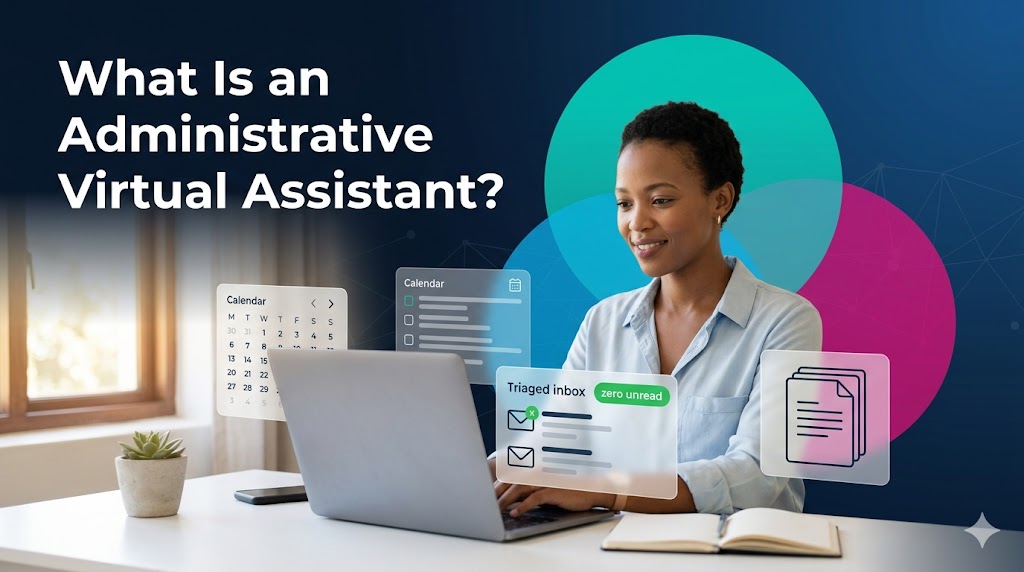
  • What Is an Administrative Virtual Assistant? The Role Quietly Running the Modern Business

    What Is an Administrative Virtual Assistant? The Role Quietly Running the Modern Business

    There’s a particular kind of exhaustion that has nothing to do with the actual work you set out to do. You sit down at 8 a.m. with a clear plan. By noon, you’ve answered forty-one emails, rescheduled two meetings because someone’s flight got moved, chased an invoice, booked a courier, filled in a spreadsheet that someone else should probably own, and watched your “important strategic thinking” block get eaten alive by a hundred small interruptions. The plan is still sitting there, untouched. And you’re tired anyway.

    If that sounds familiar, you’re not disorganised and you’re not bad at your job. You’re just doing two jobs at once — the one that grows the business and the one that keeps the lights on administratively — and the second one is silently strangling the first.

    This is the gap an administrative virtual assistant is built to close. Not by being a generic “extra pair of hands,” and not by being a chatbot that drafts your emails, but by being a trained remote professional who takes ownership of the operational machinery so you can get back to the work only you can do. In this guide we’ll walk through exactly what an administrative VA is, what they do, who actually needs one, what it costs you to keep doing it all yourself, and why the model you choose — solo freelancer, generic platform, or a managed partner like VAConnect — matters more than most business owners realise until it goes wrong.

    What an Administrative Virtual Assistant Actually Is

    An administrative virtual assistant is a remote professional who handles the recurring operational tasks that keep a business running: calendar and inbox management, document preparation, data entry, scheduling, basic bookkeeping support, client communication, travel coordination, and the endless small follow-ups that fall between the cracks. Industry definitions are consistent on this point — an administrative VA handles essential business operations like scheduling, inbox management, data entry, and document organisation so you stay focused on growth without the cost of an in-house hire.

    The word “administrative” is doing a lot of quiet work here. It distinguishes this role from the more specialised VAs that have multiplied over the last few years — marketing VAs, sales VAs, executive VAs, paralegal VAs. The administrative VA is the foundation layer. They’re the one who makes sure the basics never slip: the meeting that doesn’t double-book, the report that’s formatted and ready before the deadline, the client email that gets a same-day reply instead of dying in an overstuffed inbox.

    It helps to be precise about why this role exists in 2026 rather than 2006. The role has evolved well beyond basic clerical work; administrative support is still the single most outsourced VA function — by one 2025 industry count it accounted for roughly 34% of all delegated assignments, more than any other category. The reason is simple. Administrative work is the most universal pain in business. Every founder, every consultant, every agency owner, every clinic and law firm and e-commerce store has an inbox, a calendar, and a pile of documents. Almost none of them want to spend their best hours managing those things.

    The most outsourced task in the entire virtual assistant industry isn’t anything glamorous. It’s administration — roughly a third of everything businesses hand off. The work everyone has, and almost no one wants to do themselves.

    A useful way to think about it: a specialist VA helps you do a specific thing better. An administrative VA gives you back the time to do everything better. They’re the difference between a business that runs on its owner’s frantic energy and one that runs on systems.

    What an Administrative Virtual Assistant Does All Day

    The honest answer is “whatever is eating your time and doesn’t require you specifically to do it.” But that’s not very useful when you’re trying to decide whether to hire one, so let’s get concrete. Across the industry the core responsibilities cluster into a handful of areas.

    Calendar and scheduling. This is usually the first thing people hand over and the first thing that transforms their week. A good administrative VA owns your calendar: scheduling appointments, confirming meetings, coordinating across time zones, preventing the double-bookings and overlaps that quietly drain your day, and managing the reschedules so you never have to do the awkward email tennis yourself.

    Inbox management. Not just reading your email — running it. Sorting and triaging, flagging what genuinely needs you, drafting routine responses, applying labels and folders, and making sure nothing important sits unanswered for three days because it slipped below the fold. This matters more than people admit, and we’ll come back to just how much time the inbox actually steals.

    Document preparation and file management. Drafting, editing, and formatting reports, presentations, agendas, and correspondence. Maintaining clean, version-controlled digital filing systems so the right document is findable in ten seconds rather than ten minutes. Keeping CRM records and databases up to date so the data you make decisions on is actually current.

    Data entry and record-keeping. The unglamorous backbone: updating spreadsheets, logging entries into CRM systems, reconciling lists, and maintaining the databases that everything else depends on.

    Coordination and follow-up. Recording meeting minutes, tracking action items, chasing the people who owe you things, conducting online research, compiling data, and handling the travel and logistics planning that turns a simple trip into a half-day administrative project. As one industry breakdown puts it, the common thread across every one of these tasks is the ability to absorb time-consuming administrative work so the business owner can focus on growth and strategy.

    The list goes on — invoicing support, basic bookkeeping, customer enquiries, light social media scheduling — but you can see the shape of it. None of these tasks is hard. That’s exactly the problem. They’re not hard, they’re just relentless, and relentless is what burns people out.

    The Hidden Maths: What Doing It Yourself Actually Costs

    Here’s where the case for an administrative VA stops being a “nice to have” and starts looking like simple arithmetic. The cost of doing your own admin isn’t the time the tasks take. It’s the time they take plus everything they break around them.

    Start with the inbox, because it’s the worst offender. McKinsey’s well-known finding is that knowledge workers spend around 28% of their working day reading and answering email. Other workplace studies put the figure even higher — one analysis found that 23% of the day disappears just dealing with low-value email, and that the average person spends roughly 2.5 hours a day managing their inbox, of which around 1.8 hours is communication that’s entirely irrelevant to them. Whichever number you trust, the conclusion is the same: a meaningful slice of every working day is gone before you’ve done anything that grows your business.

    Then there’s the part most people never count: the cost of switching. Administrative work doesn’t arrive in a neat block. It interrupts. And interruptions are catastrophically expensive for focused work. A widely cited University of California, Irvine study found it takes an average of around 23 minutes to fully regain focus after a significant interruption. Harvard Business Review research estimates knowledge workers toggle between applications more than 1,200 times a day, and a synthesis of these findings concludes that context switching quietly consumes somewhere between 45 and 90 minutes of usable output every single day — not from one big disruption, but from hundreds of tiny recoveries.

    A single interruption costs about 23 minutes of refocus time. The hidden tax of context-switching alone burns up to 90 minutes of real output a day. That’s not laziness — that’s the maths of trying to do focused work and admin in the same brain at the same time.

    Stack those together and a picture emerges. When you handle your own administration, you’re not losing the 30 minutes it took to reschedule three meetings. You’re losing those 30 minutes plus the 23-minute refocus penalty each time the task yanked you out of deep work, plus the cognitive drain of holding all of it in your head. Research on heavy multitasking suggests it can temporarily reduce effective IQ by up to 10 points and is strongly associated with elevated stress and burnout — roughly 68% of employees reported experiencing burnout in a recent year, with inflexible, fragmented schedules making it markedly worse.

    The flip side is the upside. Businesses that delegate this work consistently report reclaiming serious time. Providers and studies in the space commonly cite anywhere from 10 to 20-plus hours a week recovered once administration is properly handed off, and research on routine-task automation and delegation points to several hours per week freed and significant performance gains on the high-value work that’s left. That’s not a marginal efficiency. That’s the difference between a business that can grow and one that’s permanently maxed out at its founder’s personal capacity.

    The Human in the Loop: Why AI Hasn’t Killed This Role

    It would be reasonable, in 2026, to ask the obvious question: why hire a person to manage my inbox and calendar when AI can draft emails, summarise threads, and schedule meetings? It’s a fair question, and the honest answer is more interesting than either the AI evangelists or the AI sceptics will tell you.

    AI is genuinely good at the mechanical layer of administration. It can draft a serviceable reply, transcribe a meeting, pull data into a spreadsheet, and suggest calendar slots. Around 40% of VAs themselves now use AI tools inside their workflows precisely because it speeds up the repetitive parts. Nobody serious is arguing you shouldn’t use these tools.

    But administration isn’t really a mechanical job. It looks like one until you watch it go wrong. The value of a great administrative assistant lives almost entirely in judgement — the things that aren’t in the prompt. Which of these forty emails actually matters today, and which can wait until Thursday. That this client’s tone has shifted and the situation needs a careful human reply, not a cheerful template. That the “urgent” meeting request is from someone who always says urgent, while the genuinely time-sensitive one is buried and polite. That a supplier’s invoice is wrong and shouldn’t be paid. AI can generate text; it cannot reliably own an outcome, read a relationship, or notice the thing nobody told it to look for.

    There’s also a quieter point about tone. When AI writes for a brand at scale, the output tends to converge on the same smooth, slightly generic register — and your clients can feel it. A human assistant who knows your business, your voice, and your customers writes communication that sounds like you, not like everyone. In a world where more and more outbound communication is automated, the businesses that still sound human have an advantage that’s getting more valuable, not less.

    AI can draft the email. It can’t tell you which email matters, read the relationship behind it, or be accountable when the judgement call goes wrong. The mechanics got automated. The judgement didn’t.

    This is exactly why the smartest model isn’t “AI instead of a person” or “a person instead of AI.” It’s a trained human using AI as a tool — keeping a human in the loop on every decision that involves judgement, tone, or accountability, while letting automation absorb the genuinely repetitive grind. That’s the model VAConnect builds around: its assistants are continuously upskilled through VAVarsity, the company’s free internal training platform, precisely so that the human layer stays sharp on the things that matter while the tools handle the things that don’t. The point of training a VA in 2026 isn’t to make them faster typists. It’s to make them better decision-makers in the gaps AI leaves wide open.

    The South African Advantage: Why Location Is a Hidden Superpower

    That mental model is outdated, and South Africa is the reason why.

    Start with the time zone, because it’s the part people underestimate most. South Africa runs on GMT+2. That puts it just one or two hours ahead of the UK depending on the season, and squarely inside the European working day. The practical effect is enormous: your South African administrative VA is online and working while you are. When you flag something at 10 a.m., it gets handled by lunchtime — not overnight, not “tomorrow your time.” For a role that’s fundamentally about real-time responsiveness — triaging today’s inbox, fixing today’s calendar clash — that overlap isn’t a nice-to-have. It’s the whole game. An assistant in a wildly different time zone can only ever manage your admin retrospectively. A South African one manages it live.

    Then there’s language and culture. English is one of South Africa’s primary business languages, and South African professionals typically speak it with a neutral, internationally legible accent and a strong command of written business English. Industry data underlines how much this matters — roughly half of cross-border clients now name language fluency and cultural nuance as a key differentiator when choosing a VA. South Africa’s business culture is also closely aligned with British and European norms around professionalism, punctuality, and communication style, which means far less friction and far less “lost in translation” than businesses fear from offshore support.

    And then, yes, the cost. South African talent delivers genuine first-world professional quality, Berlin, or New York. But the framing matters. This isn’t commodity labour — it’s a favourable exchange rate meeting a genuinely skilled, English-fluent, time-zone-aligned workforce. You’re not trading quality for price. You’re getting both, which is precisely the combination that’s been hard to find anywhere else. South Africa’s emergence as a serious VA hub — now hosting a measurable and growing share of the global VA workforce — is built on exactly this trifecta: overlap, fluency, and value.

    Managed, Not Matched: Why How You Hire Decides Whether It Works

    Here’s the part that trips up most first-time delegators. They get the idea — “I need an admin VA” — right, and then they get the model wrong, and the whole thing falls apart in month two.

    There are broadly three ways to get administrative support, and they are not equivalent.

    The first is DIY — you keep doing it yourself, maybe with some apps and automations bolted on. We’ve already covered why this is the most expensive option of all, because the cost is hidden in your lost focus and your missed growth rather than showing up on an invoice.

    The second is the generic freelancer or platform route — you find someone on a global marketplace, you interview them, you hire them, and now you own a second job: managing them. You write the briefs. You build the training. You notice when quality slips. You scramble to find a replacement when they vanish or take on a bigger client. Platforms match you to a person and then step back. If it works, great. If it doesn’t — and a stark number of these arrangements quietly don’t — that’s your problem to solve, alone, again.

    The third is the managed model, which is the distinction VAConnect is built around: “Managed, Not Matched.” You’re not handed a name and left to it. You get an assistant who has been vetted, trained, and is continuously supported by an agency that stays in the loop. There’s a real onboarding process — VAConnect starts with a strategy-first conversation about fit and what you actually need, not a CV dump. There’s ongoing training through VAVarsity. There’s an accountability and engagement layer (the company runs an internal programme, VAPI, focused on remote-team culture and accountability) so the relationship doesn’t quietly drift. And critically, there’s continuity: if something goes wrong, you have a company standing behind the role rather than a profile that’s gone dark.

    “Matched” means you’re handed a stranger and wished good luck. “Managed” means someone is accountable for the outcome alongside you. For a role built entirely on trust and reliability, that difference is everything.

    Founder Karen van Zyl built the model specifically to make South African talent a credible, reliable alternative to the global staffing market, with the structure to back it up — published NDA, data protection, and privacy policies included, which matters when you’re handing someone access to your inbox and client data.

    The point isn’t that freelancers are bad people. Plenty are excellent. The point is that for a role whose entire value is reliability, continuity, and trust, the structure around the person determines whether you get those things consistently — or only until the day it breaks.

    Who Actually Needs One — and How to Know You’re Ready

    Not every business needs an administrative VA, so it’s worth being honest about the signals. You’re probably ready if: you regularly work past the point of usefulness on tasks that don’t require your specific expertise; things are starting to slip through the cracks — missed follow-ups, late replies, double-booked calls; you can’t remember the last time you had a genuinely uninterrupted block of focused work; or you’ve caught yourself thinking “I’d grow this business if I just had the time,” while spending that time on data entry.

    The founders who benefit most tend to be the ones whose own time is worth dramatically more than the administrative work consuming it — consultants, agency owners, solo professionals, small-business owners, and executives whose calendars and inboxes have outgrown their capacity to manage them by hand. If an hour of your focused work is worth far more than an hour of admin, then every hour you spend on admin is a bad trade you’re making with yourself, repeatedly, all day.

    The readiness test is simple. Spend one week writing down every task you do that someone else could do with the right brief and training. Total the hours. If the number frightens you — and it usually does — you have your answer, and you have your first delegation list.

    The Bottom Line: The Gap Is Wider Than You Think

    What’s genuinely striking, looking at the numbers, is how large the gap has become between businesses that have solved their administrative layer and those still grinding through it manually. This isn’t a small efficiency tweak. When you add the hours lost to the inbox, the 23-minute refocus penalty paid hundreds of times a week, the up-to-90-minutes of daily output that context-switching quietly eats, and the strategic work that simply never happens because there’s no room for it — the difference between a business with a great administrative VA and one without isn’t 10% or 20%. It’s the difference between a business that can scale and one that’s permanently capped at one exhausted person’s capacity.

    The role itself is unglamorous. Nobody puts “got my calendar under control” on a pitch deck. But the businesses quietly pulling ahead are, more often than not, the ones that figured out the boring thing first: that you cannot build the future of a company while personally drowning in its present-day admin. An administrative virtual assistant — a trained human, using the best tools, in your time zone, backed by a structure that keeps them accountable — is how you stop drowning and start building.

    The question isn’t really whether you can afford one. It’s whether you can afford to keep being your own.

    DIY vs Marketplace Hire vs VAConnect: The Real Comparison

    FactorDIY CoordinationGeneric Freelancer / PlatformVAConnect Administrative VA
    Who owns the workYou — on top of your real jobThe freelancer, looselyA trained, supported professional
    Who manages the personN/A (it’s you)You — it becomes a second jobVAConnect (managed, not matched)
    Time-zone overlap (UK/EU)N/AOften poor / overnightGMT+2 — live, same-day overlap
    OnboardingNoneMinimal; you build it yourselfStrategy-first fit & needs session
    TrainingNoneWhatever they arrived withContinuous via VAVarsity
    Quality consistencyDeclines as you burn outVariable; no safety netBacked by systems & processes since 2008
    What happens if it breaksYou absorb itYou restart the search, aloneAgency provides continuity & cover
    Accountability layerNoneNoneVAPI engagement & accountability programme
    Data protectionAd hocDepends entirely on the individualPublished NDA, data protection & privacy policies
    Use of AI toolsUp to you to set upInconsistentHuman-in-the-loop, AI-assisted, judgement-led
    Real costHidden — lost focus & lost growthLow rate, high management overheadFirst-world quality at favourable value
    Best forAlmost no one, long-termRisk-tolerant, one-off tasksOwners who want reliability and to grow

    Ready to get your time back? VAConnect pairs you with a trained, managed administrative virtual assistant who works in your time zone and is backed by a real support structure — not just a profile and a wish of good luck. Explore VAConnect’s services or book a discovery call to map out exactly what you should delegate first.

  • What Is a Sales Virtual Assistant? The Role That Quietly Decides Whether You Win Deals

    What Is a Sales Virtual Assistant? The Role That Quietly Decides Whether You Win Deals

    A lead fills in your contact form at 9:14 on a Tuesday morning. They’ve just compared three suppliers, they’re in a buying mood, and right now they want to talk to someone. By the time anyone on your team notices the notification — buried under invoices, a supplier query, and a half-finished proposal — it’s mid-afternoon. The lead has already booked a call with the competitor who replied in four minutes.

    That gap, the silence between “interested” and “answered,” is where most small and mid-sized businesses quietly bleed revenue. Not because their product is worse. Not because their pricing is wrong. Because nobody was watching the top of the funnel while the founder was busy doing everything else.

    A sales virtual assistant exists to close that gap. And once you understand what the role actually involves — and how much measurable money sits inside it — it becomes hard to see the modern sales function the same way again.

    What a Sales Virtual Assistant Actually Does

    Let’s get the definition out of the way, because the term gets used loosely. A sales virtual assistant is a remote professional who handles the time-consuming, repeatable parts of the sales process so that your closers can spend their time closing. They are not a magic “AI sales bot,” and they’re not a generic admin who occasionally sends an email. They live inside your pipeline.

    In practice, the work falls into a handful of recurring buckets. A sales virtual assistant is capable of assisting the sales department through lead generation, appointment scheduling, CRM management, follow-ups, data entry, and client communications. The strongest ones go further than that, owning the entire top-of-funnel motion. A lead generation virtual assistant is a remote professional who specializes in sourcing, qualifying, and nurturing sales leads using digital research, outreach, and CRM tools, and unlike general virtual assistants, lead gen VAs focus exclusively on building healthy, profitable sales pipelines.

    If you want the concrete day-to-day, it tends to look like this:

    • Prospect research and list building — compiling targeted lists of decision-makers that match your ideal customer profile by industry, location, company size, and role.
    • Contact verification — finding and checking email addresses, phone numbers, and LinkedIn profiles so your outreach doesn’t bounce or hit dead ends.
    • Outreach execution — sending personalised cold emails and LinkedIn messages using your scripts, your tone, and your sequence, not a spray-and-pray template.
    • Follow-up and nurturing — the unglamorous, high-value chasing that keeps warm prospects warm instead of letting them go cold.
    • Appointment setting — booking qualified calls straight into your closers’ calendars.
    • CRM hygiene — updating records, correcting pipeline stages, logging notes, and keeping the whole system trustworthy.
    • Reporting — tracking open rates, reply rates, and conversion so you actually know what’s working.

    Notice the pattern. Every single one of those tasks is essential, none of them require your most expensive salesperson, and almost all of them get dropped first when a small team gets busy. That’s precisely why the role matters.

    The job of a sales VA isn’t to replace your closer. It’s to make sure your closer never spends another hour building a prospect list when they could be on a call signing a contract.

    The Five-Minute Window That Most Businesses Miss

    Here’s where the abstract becomes uncomfortably specific. The single most studied finding in modern sales is about speed — how fast you respond to an inbound lead — and the numbers are genuinely startling.

    The foundational research, published in the Harvard Business Review, examined more than 2,200 US companies and over 100,000 web-generated leads. The study’s core finding — that firms responding to leads within 5 minutes were 100 times more likely to connect and 21 times more likely to qualify the lead compared to firms that waited 30 minutes — became the foundation of the “5-minute rule” that dominates sales strategy to this day. The decay is brutal at the longer end too: companies that waited 24 hours or more were 60 times less likely to qualify the lead compared to companies that responded within the first hour.

    Now hold that against reality. On average, businesses take 47 hours to respond to leads — that’s almost two full days of silence after a lead shows interest, and by then the prospect has likely moved on. And it isn’t a fringe problem. Statistics show that nearly two-thirds of companies still exceed the critical 5-minute response window associated with over 400% higher conversion rates.

    There’s a reason the first responder wins so consistently. 78% of customers buy from the first company that responds to their inquiry, and that single behaviour reshapes outcomes: businesses that prioritise speed to lead secure 35–50% more sales than those with slower response times.

    This is the clearest argument for a sales VA there is. A dedicated person watching your inbound channels — form fills, email enquiries, LinkedIn messages — turns a 47-hour response time into a 5-minute one. You don’t need a better pitch to capture that uplift. You need someone whose job is to be there when the lead is.

    Speed is the single highest-leverage variable in lead conversion. Not your pitch. Not your pricing. Not your brand. Speed.

    Why Not Just Hire an In-House Sales Rep?

    The obvious objection: surely the answer is to hire a sales development rep (SDR) of your own? It’s a fair question, and the honest answer is that for many businesses the in-house SDR maths has quietly stopped working.

    Start with raw cost. Most sales development representatives in 2025 earn a base salary between $50,000 and $60,000, and when commissions are added, average SDR compensation can climb to $80,000. But base pay is the visible tip. Beyond salary, companies spend an additional 40–60% on hiring, training, tools, and management — totalling up to $100K+ per SDR annually. Put more bluntly: when you add salary, commissions, benefits, tech stack, management time, ramp, and turnover, a single in-house SDR often costs 2–3× their base salary annually — easily $110K–$160K per rep in many B2B organisations.

    Then there’s the time-bomb of ramp and retention. Average SDR ramp time is about 3.1–3.2 months, while average tenure is only around 14–16 months — meaning you get roughly a year of true productivity before you’re paying to replace them again. And ramp is getting slower, not faster: ramp-up time increased 32% from 4.3 months in 2020 to 5.7 months in 2025.

    When a rep leaves — and statistically, they will, soon — the damage isn’t only the salary gap. The direct cost of SDR turnover is staggering enough at $115,000 or more per departure when you account for recruiting, hiring, onboarding, training, and lost productivity, but the invisible cost is worse: knowledge walks out the door, and every departing SDR takes account intelligence with them — which prospects responded to which angles, what objections surfaced and how they handled them.

    So the in-house route asks a small business to spend six figures, wait the better part of half a year for productivity, and then very likely do it all again before the second anniversary. For a founder trying to grow without “growing their HR headaches,” that’s a heavy bet. A managed sales VA sidesteps most of it: no recruitment cycle, no months of dead-weight ramp on your payroll, and continuity that doesn’t evaporate when one person resigns.

    The “Human in the Loop”: Why You Can’t Fully Automate This

    It would be dishonest to write about sales in 2026 and pretend AI isn’t reshaping the work. It is. The smartest sales VAs already use it. A modern virtual assistant for lead generation should use AI tools to work faster — personalisation at scale, using AI to draft unique first lines based on a prospect’s recent activity, and lead scoring to analyse which leads are most likely to buy before you ever talk to them.

    But here’s the trap a lot of businesses are falling into: mistaking the tool for the worker. An AI can draft a thousand emails. It cannot read the room. It cannot tell that a prospect’s clipped reply means “I’m interested but my boss is the real decision-maker,” or that a particular objection is really a budget anxiety wearing a feature complaint as a disguise. It cannot decide, mid-conversation, to soften the pitch because the buyer just mentioned a rough quarter.

    Selling is a relationship business, and relationships run on judgement. The data backs this up plainly: nurturing a lead is fundamentally human work. Lead nurturing involves building long-term relationships with potential customers, maintaining trust through personalised communication and follow-ups throughout the sales funnel. The word that keeps recurring in the research on what makes a good sales VA isn’t “fast” or “automated” — it’s persistence and patience. Engaging prospects often requires follow-ups and long-term nurturing, and a successful VA is patient, consistent, and persistent in their outreach efforts.

    The right model isn’t human or machine. It’s a human holding the relationship and the judgement, using AI to remove the grunt work underneath. The VA decides who to contact, what to say, and when the tone needs to change — and lets the software handle the mechanical scale. Hand the whole thing to automation and you get volume without discernment: more emails, more bounces, more prospects who feel like they’re talking to a wall. The human in the loop is the difference between outreach that books meetings and outreach that gets marked as spam.

    AI can send a thousand messages. It takes a person to know which one mattered, and why.

    This is also where VAConnect’s structure is deliberately built for the human side. Their VAPI “Two-Way Happiness” programme exists precisely to keep the human relationships — between client, assistant, and management — actively monitored rather than left to chance, which is the opposite of the fire-and-forget logic that pure automation encourages.

    The South African Advantage

    If a sales VA is the right move, the next question is where that person should sit. And this is where South Africa has become one of the most quietly compelling answers on the map — particularly for businesses in the UK, Europe, and the US East Coast.

    The first reason is the one nobody can engineer their way around: time zones. South Africa runs on GMT+2 year-round, which means a South African sales VA shares almost the entire working day with the UK and Europe, and a substantial overlap with the US East Coast. Compare that to the more common offshore hubs in Asia, where your “morning” is their late evening. For a sales role — where the whole game is responding while the lead is still warm — live overlap isn’t a nice-to-have. It’s the entire point. The five-minute window only matters if someone is actually awake and online when the lead arrives. South African talent is online when your customers are.

    The second reason is language and cultural affinity. South African professionals typically speak English natively or to a neutral, easily understood standard, and that matters more in sales than almost any other VA role. Lead generation requires excellent communication — there’s an “English nuance test” that many offshore options simply fail. Selling is about rapport, and rapport breaks the moment a prospect has to re-read a sentence or feels they’re being handled by someone who doesn’t quite get the cultural register. South African VAs tend to share Western business norms, humour, and communication style, which removes a layer of friction that’s easy to underestimate until you’ve felt it.

    The third reason is the cost-to-quality ratio — and the emphasis is on the ratio, not just the cost. The appeal of offshore talent has always been price; the problem has usually been that you traded quality to get it. You’re not buying the lowest bidder. You’re buying a comparable professional who happens to be in a more favourable cost market.

    VAConnect was, in many ways, founded on exactly this observation. Karen van Zyl built the company after recognising that the South African workforce’s skills and work ethic could serve a global need — establishing the country as a serious alternative for these services rather than a budget compromise.

    How a Managed Sales VA Beats a Contractor

    Here’s the distinction that decides whether a sales VA actually works for you or quietly becomes another thing you have to manage. There’s a world of difference between hiring a freelance VA off a marketplace and engaging a managed one.

    The freelance model — Upwork, Fiverr, and the rest — is “matched, not managed.” You post a role, you sift through profiles, you pick someone, and from that point on, everything is your problem. Training them is your problem. Quality-checking their outreach is your problem. Covering for them when they’re sick or simply vanish is your problem. And if it doesn’t work out, you’re back at the start of the search.

    VAConnect’s model inverts that. It’s managed, not matched. The assistant is backed by a layer of support that handles the parts a small business has no time for: a “Strategy First” onboarding to define fit before anyone starts, a structured match based on both skills and work culture, continuous upskilling through VAVarsity (their internal training platform), and the VAPI happiness-and-accountability framework keeping performance and engagement actively monitored. If your assistant is unavailable, there’s a managed structure behind them rather than a sudden hole in your pipeline.

    For a sales function specifically, that management layer is doing real work. Sales outreach lives or dies on consistency — the follow-up that goes out on day three, day seven, day fourteen, without fail. A lone freelancer juggling six clients drops that consistency the moment they get busy. A managed assistant, with accountability built into the structure around them, doesn’t. VAConnect positions its sales offering as an extension of your sales team — an outsourced engine that adds fuel to your existing closers, handling the whole funnel or just the part you’re weakest on. That’s a fundamentally different proposition from renting a stranger by the hour.

    Knowing When You’re Ready for a Sales VA

    You don’t need a 20-person sales floor to justify this. The signals that you’re ready are usually mundane and, once you notice them, hard to ignore.

    You’re a founder still answering your own sales enquiries between everything else. Leads are coming in but you can’t honestly say how quickly they’re being responded to — or whether some are being responded to at all. Your CRM is either empty or a graveyard of half-updated records nobody trusts. Follow-ups happen when you remember them, which is to say, rarely. You know there’s a pipeline of warm prospects you contacted once and never circled back to.

    Every one of those is a leak, and every leak is the five-minute rule playing out against you in slow motion. The point of a sales VA is to plug them — to make sure that the interest you’ve already paid to generate, through ads, content, referrals, and your own hustle, doesn’t drain away in the gap between “they raised their hand” and “someone answered.”

    The maths, at this point, is fairly cold. An in-house SDR is a six-figure, multi-month, high-turnover commitment. A managed sales VA gives you the same top-of-funnel coverage, in your time zone, in fluent English, without the ramp tax and without the resignation risk — and starts protecting the leads you’re currently losing almost immediately.

    The Bottom Line

    A sales virtual assistant isn’t a luxury bolt-on for businesses with money to burn. It’s the role that determines whether the leads you already generate turn into revenue or quietly disappear. The research is unusually unanimous: speed wins, follow-up wins, and the businesses that consistently respond fast and chase persistently are taking 35–50% more of the available market while their slower competitors wonder where the deals went.

    The honest shock isn’t that a sales VA helps. It’s how wide the gap has grown between businesses that have someone watching the funnel and businesses that don’t — a gap measured not in percentage points but in multiples. A five-minute response is 100 times more likely to connect than a 30-minute one. That’s not a tweak. That’s a different business.

    The only real question left is whether the person watching your pipeline tomorrow is someone you’ve thoughtfully placed there — or no one at all.


    Sales VA vs the Alternatives: An Honest Comparison

    FactorDIY Coordination (You / Founder)Generic Freelancer (Upwork, Fiverr)VAConnect Managed Sales VA
    Lead response timeHours to days (whenever you surface)Inconsistent; depends on their other clientsMinutes — dedicated to your pipeline during your hours
    Cost“Free” but consumes your highest-value timeLow hourly rate, hidden costs in managementPremium talent at a fraction of UK/US SDR cost
    Setup & rampInstant but never gets your full attentionYou train, vet, and onboard yourself“Strategy First” onboarding + structured match
    Time-zone overlapN/AOften poor (Asia-based)GMT+2 — full overlap with UK/EU, strong US East Coast
    English & cultural fitNativeVariable; “nuance test” often failsNative/neutral English, Western business norms
    Consistency of follow-upDrops the moment you get busySlips when they juggle other clientsBuilt into VAPI accountability framework
    CRM hygieneNeglectedHit or missMaintained as a core deliverable
    Cover when unavailableNothing happensYou’re stuckManaged backup structure behind the assistant
    Training & upskillingNoneOn youContinuous via VAVarsity
    Turnover riskYou can’t quit, but you burn outHigh — freelancers churnManaged continuity, not a single point of failure
    Net effect on pipelineLeaks at every stagePatchy coverageFunnel actively watched and worked

    Ready to stop losing the leads you already paid to generate? Explore VAConnect’s Remote Sales Assistant packages and put someone in your time zone, watching your pipeline, from day one.

  • Virtual Assistant for Entrepreneurs: How to Buy Back Your Time Before It Buys You

    Virtual Assistant for Entrepreneurs: How to Buy Back Your Time Before It Buys You

    It usually starts on a Sunday night.

    You sit down to plan the week, and instead of mapping out the strategy that would actually move your business forward, you find yourself doing something smaller. Reconciling an invoice. Replying to the email that’s been sitting in your inbox since Thursday. Updating the spreadsheet. Chasing the supplier who still hasn’t confirmed the order. By the time you look up, an hour is gone, and the strategic thinking you sat down to do hasn’t happened. Again.

    Here’s the uncomfortable part: you’re good at this. You started the business. You know every moving piece. And that competence is precisely what’s keeping you stuck. The very skills that got the company off the ground — the willingness to do everything yourself, the refusal to drop a ball, the pride in being the person who handles it — have quietly turned into a ceiling. You’ve built yourself a job, not a business. And the job has no off switch.

    If that lands a little too close to home, you’re in large company. The research on how founders actually spend their hours is genuinely startling, and most of them have no idea how lopsided the picture has become. This piece is about the gap between the work entrepreneurs think they should be doing and the work that’s actually filling their days — and about a specific, unglamorous fix that closes it faster than almost anything else: handing the right tasks to a capable person who isn’t you.

    The Numbers Are Worse Than You Think

    Let’s start with the data, because the scale of the problem is the thing most founders underestimate.

    Research from The Alternative Board found that the average entrepreneur spends 68.1% of their time working in their business — the daily grind, the firefighting, the admin — and only 31.9% working on it, meaning strategy, planning, and the high-leverage decisions that determine whether the company grows or stalls. The same study found that 63% of business owners work more than 50 hours a week, while the average owner actually wants to work closer to 42. The gap between those two numbers is where burnout lives.

    A separate survey commissioned by virtual assistant company Time etc put a finer point on it. Entrepreneurs at the helm of growing businesses reported working an average of 45.5 hours a week, with 29% logging more than 50. And more than a third of that week — 36% — went to administrative tasks. Three in ten spent between a quarter and half of their entire week on small admin. The specifics are almost comically mundane: 59% log expenses, 49% do research, 45% manage their own schedules, 44% create invoices, and 43% do data entry. None of that is the work you started the company to do.

    The average entrepreneur spends barely a third of their time working on the business that bears their name. The rest disappears into tasks almost any trained assistant could handle.

    Then there’s the friction tax. A Slack study of small business owners found they lose an average of 96 minutes of productivity every day — to context-switching between an average of four different digital tools, to waiting on status updates, to hunting for information in the wrong place, and to repeating the same message across platforms. That’s eight hours a week, an entire working day, evaporating into the seams between tools and tasks.

    What makes this so persistent is a psychological trap that the data also exposes. In the Time etc survey, 89% of entrepreneurs rated themselves as “good” or “expert” delegators. Yet there they were, still working 50-hour weeks and still spending 36% of them on admin. The belief that we delegate well and the reality of how we spend our time are two very different things. We think we’ve let go. We haven’t.

    Why You Keep Doing the Work You Hate

    If admin is draining and you know it’s draining, why do you keep doing it? The honest answer is that low-value tasks feel productive. Clearing an inbox gives you a hit of completion. Reconciling an account has a clear beginning and end. Strategy doesn’t — it’s ambiguous, slow, and offers no tidy sense of “done.” So when the brain is tired, it reaches for the task it can finish, not the task that matters.

    This is the mechanism Dan Martell unpacks in Buy Back Your Time, the book that has become something close to required reading for founders trying to climb out of the operator’s seat. His central argument cuts against decades of hustle-culture instinct: don’t hire to grow your business — hire to buy back your time. Most founders delay bringing on help because doing the work themselves feels cheaper than paying someone. Martell’s point is that this is a costly illusion. Every hour you spend on a task worth a few hundred rand an hour is an hour stolen from work worth many times that.

    He frames the escape route as the Buyback Loop: audit your time, transfer the draining low-value work to someone else, and refill the freed hours with the things only you can do. To decide what to offload first, he uses what he calls the DRIP Matrix, sorting tasks by how much they drain you and how much value they create. The lowest-hanging fruit — the work that drains you and sits below your hourly value — should be the first thing out the door.

    “Don’t hire to grow your business. Hire to buy back your time.” The reframe matters: delegation isn’t an expense you justify, it’s an investment in the only resource you can’t manufacture more of.

    The barrier most founders hit isn’t conceptual. They get the logic. What stops them is the practical wall of three excuses: I can’t afford it, it’s too much work to explain, and no one will do it like I do. Each is real. Each is also, with the right kind of help, solvable. And notice that all three are easier to overcome when the person you’re delegating to comes already trained, already managed, and already matched to the way you work — rather than as a stranger you found on a marketplace and now have to coach from scratch. Hold that thought.

    What a Virtual Assistant Actually Takes Off Your Plate

    “Virtual assistant” is a slippery term, partly because it covers such an enormous range. So let’s be concrete about what an experienced VA can absorb, mapped onto the exact tasks the surveys show are eating founders’ weeks.

    Inbox and calendar. The single most reclaimable hours in most founders’ weeks. A good VA triages your email, drafts routine replies in your voice, flags what genuinely needs you, books and reschedules meetings, and protects the deep-work blocks you keep promising yourself. The 45% of entrepreneurs doing their own schedule management and the 49% doing their own research are exactly the people who feel this relief first.

    Finance admin. Logging expenses, creating and sending invoices, chasing late payers, basic bookkeeping prep. Recall that 59% of entrepreneurs log their own expenses and 44% create their own invoices. None of that requires the founder’s specific judgment; all of it requires consistency, which is precisely what a dedicated assistant provides.

    Research and data. Market research, competitor scans, list-building, data entry, keeping the CRM clean. Tedious, time-consuming, and entirely delegable.

    Content and social. Drafting posts, scheduling, formatting, repurposing. The Time etc data showed 24% of founders writing their own social posts and 12% writing their own blogs — work that benefits hugely from a consistent hand who isn’t also trying to run the company.

    Operations and customer support. Order processing, supplier coordination, first-line customer queries, document formatting, travel booking. The connective tissue of a business that nobody sees until it breaks.

    The pattern across all of it: these are the tasks that fill the 68% of “in the business” time, and almost none of them require you. They require someone reliable, trained, and accountable. Which raises the question every founder eventually asks.

    “But Can’t AI Just Do All of This Now?” — The Human in the Loop

    It’s a fair question, and 2026 makes it sharper than ever. AI tools genuinely can draft an email, summarize a document, and clean a spreadsheet. The Adobe research found entrepreneurs already saving around six hours a week with AI, and 56% report using it in their workflow. So why pay a person?

    Because the gap between “AI can produce a draft” and “the work is actually handled” is wider than the marketing suggests — and it’s exactly the gap where businesses lose clients, miss nuance, and damage relationships.

    Consider what AI does badly. It doesn’t notice that the client who emailed at 11pm sounds anxious and needs a phone call, not a templated reply. It doesn’t catch that the supplier’s “confirmed” actually means “confirmed but flagged a delay in paragraph three.” It doesn’t make the judgment call to escalate something that’s technically outside its instructions but obviously matters. It has no relationship with your customers, no memory of last quarter’s awkward conversation, no stake in whether the work lands well. AI generates output. It does not own outcomes.

    AI produces drafts. People produce results. The difference is judgment — the thousand small decisions about tone, timing, and escalation that no model makes reliably, and that every client relationship depends on.

    This is what people mean by keeping a human in the loop. The most effective setup in 2026 isn’t AI or a person — it’s a capable person using AI as a tool, applying judgment to its output, catching what it misses, and owning the result. A skilled VA who uses AI to draft and then edits for voice, checks for accuracy, and decides what actually needs sending will outperform both a founder drowning in admin and a fully automated workflow with nobody minding it. The technology amplifies a good assistant. It doesn’t replace one.

    There’s also the relationship dimension, which matters more in service businesses than any efficiency metric. When a client interacts with your business, they’re forming a judgment about whether you’re reliable, attentive, and human. A warm, well-judged reply from a real assistant who understands your business builds trust. A technically-correct-but-tone-deaf automated message erodes it, often invisibly, until the client quietly drifts away. The humanizing layer isn’t a nice-to-have. It’s frequently the thing the business is actually selling.

    The South African Advantage: Why Geography Quietly Solves Three Problems at Once

    Once a founder accepts they need a person rather than a tool, the next question is where that person should be. And this is where one option has pulled meaningfully ahead for businesses in the UK, Europe, and increasingly the US — for reasons that have nothing to do with cutting corners and everything to do with how the maths and the time zones happen to line up.

    South Africa sits in the GMT+2 zone. For a UK business, that’s a one- or two-hour difference depending on the season — close enough that a South African assistant is at their desk through your entire working day, not catching up on your morning while you sleep. For European clients, the overlap is near-total. This is the difference between an assistant who works with you in real time and one in a distant time zone who replies to yesterday’s request. Anyone who has tried to run urgent work through a twelve-hour gap knows how much that single fact matters.

    Then there’s language and culture. South African professionals work in English natively or near-natively, with a neutral, easily understood accent and writing style. Just as importantly, the business culture is Western-aligned — the norms around communication, professionalism, deadlines, and client service map cleanly onto what UK and European businesses expect. There’s no cultural translation layer to manage, no constant low-level friction of mismatched expectations. Your assistant gets the joke, gets the urgency, gets the unspoken professional standards.

    Timezone overlap, native English, and Western business norms — South Africa offers all three at once. The combination, not any single factor, is what makes the difference.

    And yes, the cost. But the framing matters. It’s premium talent at a favourable exchange rate. The skill, professionalism, and reliability hold; the cost drops because of where the person happens to live, not because of what they can do. For a founder running the buyback maths, that’s the rare case where the cheaper option is also the better one.

    It’s worth dwelling on why those three advantages compound rather than simply add up. A cheap assistant in a distant time zone with a cultural mismatch isn’t a bargain — the savings get eaten by the delays, the rework, and the management overhead of bridging the gap. The reason South Africa works is that none of the usual trade-offs apply. You’re not paying a quality penalty for the lower cost, you’re not paying a coordination penalty for the lower cost, and you’re not paying a cultural-friction penalty either. When you remove all three of those hidden taxes at once, the headline saving is actually the real saving, which is rarely true of offshore arrangements. That’s the part founders tend to discover only after they’ve tried the cheaper-but-further-away route first and watched the promised savings quietly disappear into the cracks.

    Managed, Not Matched: Why How You Hire Matters as Much as Who

    Here’s where most founders get the decision half-right and pay for it. They accept they need help, they’re sold on the South African advantage, and then they go to a freelance marketplace, post a job, sift through fifty applications, pick someone, and hope. A few weeks later they’re back at their desk doing admin, because the VA ghosted, or wasn’t quite the right fit, or needed more hand-holding than the founder had time to give.

    This is the difference between matched and managed — and it’s the core of how VAConnect approaches the problem. A marketplace matches you with a name and then steps back; everything after that is your problem. A managed model stays in the loop.

    The part that addresses the founder’s deepest fear — what happens when it goes wrong — is the management layer that sits underneath. VAConnect runs what it calls the VAPI or Two-Way Happiness programme, a structured two-way feedback framework that monitors the working relationship from both sides: how the client feels about the assistant, and how the assistant feels about the work. The point is early detection. Problems get caught and addressed before they become the silent drift that kills a freelance arrangement. There’s pre-briefed backup cover when your assistant is ill or on leave, so the work doesn’t simply stop. And there’s continuous training through VAVarsity, the company’s in-house upskilling platform, so the assistant’s capability grows rather than stagnates.

    For the founder, the practical effect is that delegation stops being a risk you personally manage and becomes a service someone else is accountable for. That directly dissolves two of Martell’s three excuses. It’s too much work to delegate becomes manageable when there’s a structured onboarding process and a backup if it fails. No one will do it like I do becomes far less scary when there’s a feedback system specifically designed to close the gap between your standard and the assistant’s output, and a manager whose job is to make sure it does.

    What Buying Back Your Time Actually Feels Like

    The abstract case is convincing enough, but the change is best understood in the texture of a week.

    Before: you wake up and check email on your phone before you’re properly awake, because if you don’t, the day gets ahead of you. Meetings get double-booked because you’re scheduling them yourself between other tasks. Invoices go out late because you keep meaning to do them and something more urgent always intervenes. The strategic project — the new offering, the partnership, the thing that would actually grow the business — has been “next month’s priority” for five months. You work Saturday to catch up and start Monday already behind.

    After: the email that needs you is the only email you see, triaged and flagged, with routine replies already drafted in your voice for a quick yes. Your calendar is managed; the deep-work blocks are protected because someone is guarding them. Invoices go out the day the work is done. The research for that new offering is sitting in a tidy document because you asked for it on Tuesday and it was ready Thursday. You’re working on the business again — closer to the 32% that should arguably be 60% or more — because the 68% has somewhere else to go.

    That shift, from operator to owner, is the whole point. Not working more hours. Working the right hours, on the work that only you can do, with the rest handled by someone you trust. Founders who make this move consistently describe the same thing: not just more time, but a quieter mind. The 3am invoice-anxiety stops, because the invoices are handled.

    How to Start Without Overthinking It

    If you’re convinced but unsure where to begin, the lowest-friction path is also the one Martell recommends. Spend one week noting every task you do and roughly how long it takes. Then mark anything that (a) drains you and (b) could be done by a competent person who isn’t you. That list — usually heavy on inbox, calendar, invoicing, research, and data — is your first delegation batch. You don’t need to hand over everything at once. You need to hand over the first thing.

    A useful test for that first task: pick something that’s both low-stakes and high-frequency. Low-stakes means a mistake won’t sink anything important, so you can let go without white-knuckling every output. High-frequency means you’ll feel the relief immediately and your assistant will get up to speed fast through sheer repetition. Inbox triage and calendar management almost always fit both criteria, which is why they’re the most common first handoff and the one that tends to convert sceptics fastest. Once that’s running smoothly — usually within a couple of weeks — the trust is built, and the next batch of tasks comes off your plate with far less hesitation.

    The honest truth is that the founders who stay stuck aren’t the ones who can’t afford help. They’re the ones who keep deciding that this quarter is too busy to fix the thing that’s making every quarter too busy. The admin doesn’t shrink on its own. The 50-hour weeks don’t become 42-hour weeks by working harder. The only way out is to take the work that isn’t yours and give it to someone whose work it is.

    The Bottom Line

    The gap between founders who delegate well and those who don’t has stopped being a matter of degree. One group is working on their businesses, protecting their time, and growing; the other is working 50-hour weeks, spending a third of them on admin they hate, and wondering why the company has plateaued. The research is unambiguous about which group is larger — and about how avoidable the second group’s situation actually is.

    The fix isn’t a productivity app or a smarter calendar or another AI tool you’ll half-configure and abandon. It’s a person. Specifically, the right person — skilled, time-zone-aligned, culturally fluent, and crucially managed so that the arrangement survives contact with reality. For UK and European founders, the South African talent pool delivers that combination unusually well, and a managed model removes the risk that makes most founders hesitate.

    You started the business to build something and to have a life worth the effort. Somewhere along the way, the admin took both. Buying back your time is how you take them back.


    DIY Coordination vs Marketplace Hire vs VAConnect

    FactorDIY (You Do It All)Generic Freelancer / MarketplaceVAConnect (Managed VA)
    Time spent on adminUp to 36% of your weekReduced, but you manage the freelancerLargely offloaded; you manage outcomes, not tasks
    Hiring & vettingN/A — you’re itYour job: sift, interview, gambleDone for you, matched on skills and culture
    OnboardingNone neededYou train from scratch, aloneStructured “Strategy First” process with defined KPIs
    Quality assuranceDepends on your bandwidthNo safety net if it slipsVAPI / Two-Way Happiness feedback, early issue detection
    Cover when sick / on leaveWork stops (it’s you)Work stopsPre-briefed backup cover keeps work moving
    Ongoing skill developmentWhatever you find time forFreelancer’s own initiativeContinuous via VAVarsity training
    Timezone overlap (UK/EU)N/AOften poor, depends on locationFull overlap (GMT+2)
    Language & culture fitN/AVariableNative/neutral English, Western-aligned norms
    Cost vs local in-house hireHidden cost: your timeCheap but riskyWith quality and accountability held
    Risk if it goes wrongBurnoutYours to absorbManaged and absorbed by VAConnect

    Ready to work out exactly which tasks you should hand off first? Explore VAConnect’s services or book a no-pressure discovery call to map your buyback list.

  • What Tasks Can You NOT Give a Virtual Assistant?

    What Tasks Can You NOT Give a Virtual Assistant?

    Most of the advice you’ll read about virtual assistants is a list of things to hand over. Inbox triage, calendar wrangling, invoice chasing, social media scheduling, research, data entry — the standard greatest hits. And that advice is mostly right. A good VA can absorb a startling amount of the work that quietly eats a business owner’s week.

    But here’s the question almost nobody asks until it bites them: what shouldn’t you hand over?

    It’s a more important question than it looks. The fastest way to ruin a working relationship with a VA — and to lose money doing it — isn’t giving them too little. It’s giving them the wrong things. The tasks that look delegable on the surface but carry consequences that can’t be undone with an apology and a redo. A misfiled spreadsheet is recoverable. A contract signed on your behalf, a strategic pivot made without you, a client relationship damaged by someone who didn’t have the full picture — those are a different category entirely.

    This is a guide to the boundary line. Not the “VAs are limited” version that talks down to the whole profession, but the practical, sometimes hard-won version: the work that has to stay with you, the work that seems fine to delegate but quietly isn’t, and how a properly managed VA arrangement changes where some of those lines actually sit.

    Because — and this is the part people miss — the boundary isn’t fixed. Where you can safely delegate depends enormously on who you’re delegating to and how the relationship is structured. A faceless freelancer you found on a marketplace three days ago and a vetted, managed assistant who has worked inside your business for eight months are not playing the same game. We’ll get to why that matters more than almost anything else.

    The One Filter That Sorts Almost Everything

    Before listing specific tasks, it helps to have a single mental test, because memorising a list is useless the moment you hit a task that isn’t on it.

    One business owner who writes openly about delegation put it about as cleanly as it can be put. Early on, he made the classic mistake of delegating whatever annoyed him most that week — the result was confusion, constant questions, and a VA who felt underutilised while he still felt overwhelmed. The fix was switching from mood to pattern. His filter became almost embarrassingly simple: if it requires my judgment, I keep it; if it requires consistent execution, it goes to a VA.

    That’s the whole thing, really. Execution travels well. Judgment doesn’t.

    The filter that survives every edge case: if the task requires your judgment, it stays with you. If it requires consistent, repeatable execution, it can go to a VA. Everything else is detail.

    A task can be complex and still be delegable, as long as the complexity lives in the doing rather than the deciding. Reconciling a month of transactions is fiddly and detailed — but it’s execution against a known standard, so it travels. Deciding whether to cut a product line because the margins are slipping is not fiddly at all in terms of steps, but it’s pure judgment, so it stays. The difficulty of a task tells you almost nothing about whether you can delegate it. The type of difficulty tells you everything.

    With that filter in hand, here’s where it points.

    Tasks That Can Never Leave Your Desk (The Accountability Layer)

    There’s a category of work that isn’t risky to delegate so much as it’s structurally impossible to delegate, no matter how skilled the assistant. This is the stuff tied to accountability, and it’s worth understanding why, because the reason is a genuine principle of how organisations work rather than a matter of caution.

    In management theory, authority, responsibility, and accountability are three different things, and they don’t move the same way. Authority — the right to make a decision or take an action — can be passed down. Responsibility for carrying out a task can be assigned. But accountability cannot be delegated; it’s inherent in the bestowment of responsibility itself, and anyone who sets out to accomplish a task becomes answerable for the outcome. As one breakdown of the principle puts it, accountability is the final answerability for the outcome, it flows upwards, and it cannot be delegated.

    In plain terms: you can hand someone the steering wheel, but if the car ends up in a ditch, it’s still your name on the insurance. So the smart move is to keep your own hands on the decisions where a ditch is fatal.

    Concretely, this category includes:

    Vision and strategic direction. Where the business is going, what it stands for, which markets it chases. As one practitioner explains, setting the vision and direction is personal and high-level — it depends on your own perspective, which can’t be replicated by another person, especially a VA who may not fully understand your long-term intentions. A VA can prepare the inputs for these decisions beautifully. They cannot make them for you.

    Decisions that require your authorisation. The same source lists the items that genuinely need the owner’s sign-off before anyone acts: the business model, long-term priorities, growth strategy, competitive positioning, pricing philosophy, and significant resource-allocation choices. A VA can model three pricing scenarios. Choosing which one defines your company is yours.

    Final approval on anything consequential. This is the most useful pattern for sensitive work — and it scales. A compliance-focused delegation guide frames it well: a VA can prepare a file for review, but the final review stays with the responsible professional; they can track missing information, but they should not decide the risk; they can prepare a task list, but they should not approve the outcome. The VA does ninety percent of the labour. You do the last ten percent that carries the consequence.

    “A VA can prepare a file for review, but the final review stays with the responsible professional. They can track missing information, but they should not decide the risk.”

    The trap to avoid here is subtle. It’s not that owners deliberately hand over strategy — almost nobody does that on purpose. It’s that strategy leaks into delegated tasks. You ask a VA to “handle the supplier negotiation,” and without realising it you’ve handed over pricing philosophy and competitive positioning along with the admin. The fix isn’t to claw the task back. It’s to split it: the VA runs the process, gathers the quotes, schedules the calls, drafts the comparison — and you make the call.

    Legal, Binding, and Signature Work

    This one is short because it’s absolute. Anything that legally commits you should not be executed by someone acting on your behalf without explicit, narrow, documented authority — and often not even then.

    The clearest example is signatures. As one delegation guide warns bluntly, signing contracts or legal documents is a task you should keep yourself; when a VA signs on your behalf, it can be invalid, or it can be legally binding in a way that doesn’t favour you. Both failure modes are bad. Either the thing you needed signed isn’t actually valid, or — worse — you’re bound to terms you never personally reviewed.

    This extends beyond literal signatures to anything that creates a legal or financial obligation: agreeing to contract terms, making representations to regulators, committing to deals, accepting liability. A VA can absolutely manage the workflow around these — track which contracts are outstanding, chase signatures from the other side, organise the documents, flag deadlines, prepare summaries of what each agreement contains. What they shouldn’t do is be the one whose action makes the commitment real. The compliance guide draws exactly this line, advising against delegating work that involves giving advice, interpreting obligations, approving risk decisions, signing filings, or setting fees — these belong with the accountable professional, not the support layer.

    High-Trust Access: Money and Credentials

    Now we get to the area where the most expensive mistakes happen, and where the who and how of delegation matter more than anywhere else: access to money and to the credentials that control it.

    The instinct that gives owners pause here is correct. One person weighing up their first VA captured the hesitation precisely — they wanted help confirming a pile of monthly bill payments, but realised that to do it, they’d have to share a ton of personal information, and weren’t comfortable handing over bank passwords; the worry was that with that much access, you could lose everything in the account. That’s not paranoia. That’s a reasonable read of the downside.

    But notice what the worry is actually about. It isn’t “a VA can’t help with finances.” It’s “I don’t want to hand over the keys.” Those are different problems, and the second one has a clean solution that doesn’t require giving up the help.

    The principle is simple: delegate the task, not the master credentials. Modern tooling makes this easy. As a VA security guide advises, never give a VA direct access to your primary bank login; instead use virtual cards with spending limits, bill-pay features that require your approval for each payment, and role-based access in payment processors. The same logic applies everywhere: a password manager that shares access to specific accounts without revealing the passwords themselves, permission tiers that let a VA draft but not send, prepare but not pay.

    The rule for sensitive access: delegate the task, never the master key. Virtual cards, per-payment approval, role-based permissions, and password managers let a VA do the work without ever holding the credentials that could sink you.

    Set up this way, bookkeeping and bill management become some of the highest-value things a VA can take off your plate. The reason is exactly why people resist it: financial admin is repetitive, time-draining, and important. When your bookkeeping is up to date you can make informed decisions about how to spend money, and it makes tax season far easier because you’re not furiously shuffling through receipts and invoices. The work is hugely delegable. The unrestricted access is not. Keep those two ideas separate and most of the fear evaporates.

    The “Human in the Loop” Tasks — Where AI Hits Its Ceiling Too

    It’s worth pausing on a related boundary, because in 2026 the “should I delegate this?” question increasingly collides with “should I just automate this?” And the honest answer is that some tasks resist both — they need a human who can be held accountable, exercising judgment, in a way that neither a cheap freelancer nor an AI tool can replicate.

    The governance world has been wrestling with exactly this as AI agents take on more operational work. The conclusion mirrors the human delegation principle almost word for word: directors can delegate operational authority but cannot delegate the accountability for oversight — it’s the same principle that has governed responsibility for decades, applied to a new operating reality. Regulation is starting to bake this in; the same analysis notes that Article 14 of the EU AI Act requires human oversight of high-risk AI systems by default.

    What does this mean in practice for a business owner? It means there’s a class of work where the judgment and relationship are the point, and removing the human removes the value:

    • Anything client-facing where tone and trust matter. An AI can draft a reply to an upset customer in seconds. Whether that reply lands — whether it reads as genuine, reads the room, knows which client this is and what they’ve been through with you — is a human judgment. A VA who knows your clients can make that call. A tool generating plausible text cannot.
    • Nuanced communication and relationship management. Knowing when a short message needs to become a phone call. Catching that a “fine, thanks” from a long-term client actually means the opposite. These are pattern-reads that come from human attention over time.
    • Quality judgment on subjective work. Whether a piece of writing sounds like you, whether a design feels right for your brand, whether a pitch is too aggressive — these need a person who understands the context, not a system optimising for an average.

    This is the genuinely interesting reason a managed human VA still beats pure automation for a large slice of work: not because the human is faster, but because the human can be accountable and can judge. They sit in the loop precisely where the loop can’t be closed by software. The smart 2026 setup isn’t “VA or AI” — it’s a VA using AI tools, applying human judgment to automated output before it reaches a client. The tool drafts; the human decides whether it’s good enough to send. That’s the loop working as it should.

    The Tasks That Look Delegable But Aren’t (Yet)

    Some tasks aren’t off-limits forever — they’re off-limits until you’ve done the groundwork. Handing them over prematurely is one of the most common and quietly costly delegation mistakes, because it feels like delegating and actually generates more work than doing it yourself.

    The core issue is systematisation. As one guide warns, when delegating a task it should first be systematised; experimenting with VAs on un-systematised tasks is frustrating for the VA and time-wasting for you — and if you pay by the hour, it’s an investment you may never recover. A task that lives entirely inside your head, with a hundred unwritten exceptions and “you just know” judgment calls, is not ready to delegate. Not because the VA can’t learn it, but because the knowledge transfer has to happen first.

    The same source draws the practical line: the high-risk and authority work you handle yourself or leave to certified professionals, while the repeatable and time-consuming work goes to a VA — and you always develop the system first.

    So a task can be temporarily un-delegable for entirely fixable reasons:

    • It’s never been documented. If you can’t describe how you do it, you can’t hand it over. The fix is writing it down once — a recording, a checklist, a loom — which is itself a one-time job a VA can even help structure.
    • It has too many undefined edge cases. If half the work is judgment calls you make on instinct, the task needs decision rules before it travels. Start by delegating the clear-cut version and keeping the exceptions.
    • It depends on context only you hold. Relationships, history, unspoken preferences. This resolves with time — the longer a VA works inside your business, the more of this context they absorb, which is precisely why long-term arrangements beat one-off hires.

    That last point is the bridge to the thing that actually moves the boundary line.

    How the Type of VA Relationship Moves the Line

    Here’s what the standard “what not to delegate” lists almost always miss: the list isn’t the same for everyone. The boundary between safe and unsafe delegation shifts dramatically depending on the relationship you have with the person you’re delegating to.

    Think about why several of the boundaries above exist. You can’t delegate work that depends on context only you hold — but a VA who’s worked with you for a year holds a lot of that context. You shouldn’t give sensitive access to someone you can’t trust — but trust is a function of vetting and track record. You can’t delegate judgment to someone who doesn’t understand your business — but understanding accumulates.

    In other words, most of these limits are really limits of the relationship, not of VAs as a category. And that means the structure of the arrangement changes where the line sits.

    Consider the difference between a generic freelancer pulled off a marketplace and a managed assistant inside a structured agency:

    With a generic freelancer, the cautious version of every boundary applies, and for good reason. You don’t know how they were vetted. There’s no accountability layer above them if something goes wrong. There’s no continuity guarantee — they can vanish mid-project, taking their accumulated context with them. So you keep the line conservative: minimal access, heavy oversight, nothing that can’t be easily redone.

    With a managed VA — vetted before they reach you, working inside a framework with oversight, accountability, and continuity — several of those boundaries relax safely. Not the absolute ones; you still don’t delegate accountability or contract signatures, because those are structural, not trust-based. But the trust-dependent boundaries — sensitive access, nuanced communication, work that needs deep context — open up as the relationship deepens, precisely because there’s a system holding it together.

    This is where the way a service like VAConnect is structured does real work. The model is built around being “small enough to care, big enough to guarantee quality and stability” — and that phrase, marketing aside, describes exactly the thing that moves the delegation line. Stability and oversight are what let you safely hand over the work a one-off freelancer couldn’t be trusted with. The managed approach means there’s an accountability layer above the individual assistant, vetting before anyone reaches you, and the kind of continuity that lets context accumulate instead of evaporating. The VAPI engagement-and-accountability framework exists for precisely this reason: its success helps with internal culture, remote team engagement, and accountability. Accountability, you’ll remember, was the one thing that can never be delegated — so a structure that keeps it visible and intact is doing the most important work there is.

    The continuity piece matters more than it sounds. A relationship that started in 2008 and grew into an established managed Virtual Assistant Agency with a full team and systems and processes built to make delegation easier isn’t selling you a stranger. It’s selling you a managed relationship — and managed relationships are exactly what let the trust-dependent boundaries move.

    So What’s Left? A Practical Boundary Map

    Pulling it together, the tasks fall into three honest buckets.

    Never delegate (structural — true for any VA, forever):

    • Final accountability for outcomes
    • Vision, strategy, and core direction
    • Decisions requiring your authorisation: business model, pricing philosophy, growth strategy, major resource allocation
    • Signing contracts and legally binding documents
    • Final sign-off on anything consequential

    Don’t delegate yet (fixable — delegate once the groundwork is done):

    • Tasks that live only in your head (document them first)
    • Work full of undefined edge cases (write decision rules first)
    • Anything depending on context a new VA doesn’t have yet (give it time)

    Delegate carefully, with the right structure:

    • Financial admin — yes, but with restricted access, never master credentials
    • Client communication — yes, but with a human keeping judgment in the loop
    • High-trust work — increasingly yes, as the relationship and oversight deepen

    The honest takeaway is more encouraging than the “here’s what VAs can’t do” framing suggests. Very little is permanently off the table. The genuinely fixed limits are narrow — accountability, strategy, and signatures — and almost everything else is a question of how you set it up rather than whether it can be done.

    The owners who struggle are the ones treating delegation as a coin flip: hand it over and hope, or keep it and burn out. The ones who win treat it as design. They keep the irreducible few things, systematise the fixable ones, and build the kind of structured, accountable relationship that lets the trust-dependent work flow safely. The gap between those two approaches — and it’s a wide one — isn’t about the VA’s talent. It’s about knowing where the line actually sits, and why.

    The Bottom Line

    What can’t you give a virtual assistant? Permanently, almost nothing — except the three things that are yours by structure: accountability, strategic judgment, and your signature on the dotted line. Everything else is a matter of preparation and trust, both of which you control.

    The mistake isn’t delegating too much. It’s delegating the wrong things to the wrong relationship and calling the result proof that “VAs don’t work.” Get the boundaries right — keep what’s structurally yours, prepare what’s fixable, and build the kind of managed, accountable relationship that earns the trust-dependent work over time — and the question quietly flips. It stops being “what can’t I hand over?” and becomes “why was I still doing all of this myself?”


    How the three approaches compare

    CapabilityDIY (you do it all)Generic FreelancerManaged VA (VAConnect)
    Time freed for high-value workNone — you stay the bottleneckSome, but oversight eats into itHigh — work flows with minimal supervision once embedded
    Safe to delegate sensitive accessN/ARisky — no vetting or accountability layerYes, with controls — vetted, supervised, accountable
    Handles context-heavy / judgment workYes, but it consumes youPoorly — no continuity, context evaporatesIncreasingly yes — context accumulates over the relationship
    Continuity if someone leavesYou’re always there (and always stretched)None — freelancer can vanish mid-taskBackup cover and managed handover built in
    Accountability structureAll on youNone above the individualOversight layer + framework (VAPI) keeps it visible
    Quality consistencyVariable — depends on your bandwidthVariable — depends on the individualGuaranteed to a standard, monitored
    Where the delegation line sitsEverything stuck with youConservative — minimal trust possibleWide — trust-dependent limits relax safely over time

    Ready to find out which of your tasks are genuinely yours to keep — and which you’ve been holding onto for no reason? Book a discovery call with VAConnect and map your own boundary line.

  • How to Communicate With a Remote Virtual Assistant

    How to Communicate With a Remote Virtual Assistant

    You hired the help. So why does it still feel like you’re doing two jobs?

    Picture a founder in her first month with a remote assistant: she fires off a task at 11pm, wakes up to a clarifying question she hadn’t anticipated, answers it on her commute, then spends her lunch break re-explaining what she already explained the night before. By the time the work comes back, she has touched it four times. She is managing the manager, and it would have been faster to do it herself.

    That’s the trap. Not bad assistants. Not laziness on either side. Just the slow, grinding friction of two people trying to coordinate across screens, time zones, and unspoken assumptions — and getting it slightly wrong over and over until the whole arrangement feels heavier than the problem it was supposed to solve.

    Here’s the uncomfortable part. The assistant is rarely the variable that decides whether this works. The communication system around them is. Get that right and a remote VA can quietly run a chunk of your business. Get it wrong and you’ll churn through three of them in a year, each time blaming the person rather than the setup.

    This is a guide to getting it right. Not motivational fluff — actual mechanics. How to brief, which channel to use for what, how to handle the time-zone gap, why over-communicating early saves you months, and where a real human in the loop beats any automation you could bolt on instead.

    Why Communication Breaks Down Before the Work Does

    Most delegation failures get diagnosed as performance problems. They’re almost always communication problems wearing a performance costume.

    When you work alongside someone in an office, an enormous amount of information transfers without anyone trying. You overhear the tone of a client call. You see the assistant frown at a spreadsheet and wander over. You correct a misunderstanding in eight seconds because you happened to be standing there. None of that survives the jump to remote. The channel narrows to whatever you deliberately type, record, or say on a call — and suddenly everything you used to communicate by accident has to be communicated on purpose.

    The research backs this up. A December 2024 review in the International Journal of Research and Innovation in Social Science examining online work communication strategies found that while digital tools make communication possible, they require deliberate training and support to actually work — and that leaning on them without that structure produces information overload that weakens team performance rather than helping it.

    Digital tools don’t create alignment. They create the possibility of alignment — which you then have to build on purpose, every single day.

    Cal Newport, who wrote A World Without Email, puts the cost in plain terms: the modern knowledge worker checks email or chat roughly once every six minutes, and the cognitive overhead of all that context-switching is, in his words, exhausting and makes people miserable. Now imagine that same fragmented back-and-forth, except one of the two people is in a different time zone and can’t tap you on the shoulder to resolve the confusion. The fragmentation doesn’t just annoy — it stretches a five-minute clarification into a full-day delay.

    So before you blame the VA for “not getting it,” ask the harder question: did the system you built actually give them a way to get it?

    Decide What Goes Where: Channels Are Not Interchangeable

    The single biggest upgrade most people can make is also the most boring: deciding, in advance, which type of message lives in which channel. When everything dumps into one chat thread, urgent and trivial blur together, decisions get buried under banter, and your assistant has to guess what needs a response now versus next week.

    A workable default looks like this. Use a project or task tool — Trello, Asana, ClickUp, Bitrix24, whatever — as the single source of truth for what needs doing. If a task isn’t in there, it doesn’t exist. Use chat (Slack, WhatsApp, Teams) for quick, low-stakes nudges and social glue, with the understanding that it’s not where decisions get recorded. Use email for anything external or anything you’ll need to find again in six months. And reserve live calls for the two things async genuinely can’t do: building the relationship and untangling a knot that’s too tangled to type.

    That last category matters more than the productivity influencers admit. There’s a loud crowd online insisting you should delete every recurring meeting and go fully asynchronous. One remote-team lead pushed back on exactly that advice, arguing that async isn’t always the answer and that some teams, especially in fast-moving phases, simply work better with a regular live touchpoint. He’s right. The goal isn’t zero meetings. It’s zero pointless meetings — and a clear rule for which problems earn a call.

    “This meeting could have been an email” has become the exasperated mantra of overloaded knowledge workers. The fix isn’t more meetings or fewer. It’s matching the message to the medium.

    GitLab’s research on all-remote organizations found that 52% boosted productivity after defaulting to asynchronous work. But “default to async” is doing a lot of quiet work in that sentence. The teams that win aren’t the ones that ban meetings — they’re the ones who’ve made async the default and kept a small, sharp set of synchronous touchpoints for the moments that need them.

    The Brief Is the Job: Write It Like You Mean It

    If you take one thing from this entire piece, take this: the quality of the output is decided in the brief, before the assistant does a single minute of work.

    A weak brief sounds like “can you sort out the newsletter.” A strong brief sounds like “Draft the March newsletter in our Mailchimp template — three sections (product update, customer story, one industry link), 400 words max, friendly-but-professional tone, due Thursday 2pm my time so I can review before it goes out Friday. Last month’s is linked as a reference. Flag me if you can’t find a customer story and I’ll send one.” The first version guarantees three rounds of clarifying questions. The second one can be executed cold.

    The difference is that the second brief answers the questions before they’re asked: what, in what format, how long, what tone, by when, and what to do if blocked. That last element — the “if you get stuck, here’s what to do” instruction — is the one almost everyone forgets, and it’s the one that prevents your assistant from either freezing or guessing wrong while you’re asleep.

    For anything involving a process you’ll repeat, record it once instead of typing it. A two-minute screen recording — narrating as you click through the actual task — transfers more usable detail than a thousand words of written instructions, and your assistant can replay it as many times as they need without re-asking you. Loom built an entire company on this insight, and the logic is simple: video carries tone, sequence, and context that bullet points strip out. Build a small library of these and your onboarding time for the next task, and the next assistant, drops sharply.

    Working Across the Clock: Turn the Time Gap Into an Asset

    The fear about hiring remotely across borders is that the time difference will slow everything down. Handled badly, it does. Handled well, it’s one of the biggest advantages you can buy.

    The trick is to stop treating overlap hours and offline hours as the same thing. Your overlap window — the hours you’re both online — is precious and should be protected for the things that genuinely need both of you: the quick decision, the live walk-through, the relationship check-in. Everything else should be designed to flow without you. You brief at the end of your day; they execute during yours; you wake up to completed work and a short summary. Done right, the clock becomes a relay race instead of a traffic jam.

    This is where geography stops being a logistics problem and starts being a strategy. Harvard Business School research published in September 2024 found that remote employees handling routine, non-collaborative tasks naturally shifted to asynchronous communication without any hit to their schedules — the loss of real-time chatter simply didn’t matter for that kind of work. The lesson: match the type of work to the amount of overlap it actually needs, and a wide time gap stops being a cost.

    But there’s a floor below which async stops working and the gap turns back into friction. If your assistant is twelve hours out of phase, even the simplest “wait, which file did you mean?” costs you a full day. Which is exactly why where you hire from matters as much as how you communicate — and why one particular talent market keeps coming up.

    The South African Advantage: Close Enough to Actually Talk

    Here’s the thing that surprises business owners in the UK, Europe, and the US East Coast when they first look into it. South Africa sits in a near-perfect communication sweet spot, and most people have no idea.

    The country runs on GMT+2. That means a substantial overlap with the UK and European working day — often most of it — and a workable window with the US East Coast. You’re not waiting twelve hours for a reply. You’re sending a message at 10am London time and getting an answer at 10am. Live calls happen during civilised hours for both sides. The relay race works and you can still pick up the phone when you need to. VAConnect, which has built its model on exactly this geography, frames it bluntly: full overlap with UK, Europe, and US East Coast business hours, with no off-hour shifts and no waiting until tomorrow for a decision you need today.

    Then there’s language. English is a primary business language in South Africa, spoken with a neutral, easily understood accent. There’s no translation layer, no awkward phrasing in client-facing emails, no second-guessing tone on a call. For a role that is fundamentally about communication — drafting your emails, talking to your customers, representing your brand in writing — this is not a small detail. It’s the whole game.

    “English is a primary business language. No translation layers.” For a role built on communication, hiring where the language is native isn’t a nice-to-have — it’s the difference between a VA who represents you well and one who needs everything proofread.

    And the cultural fit lands in the same place: Western-aligned business norms, a familiar work ethic, and what VAConnect describes as a warm human touch rather than a scripted, transactional one. The cost savings are real — premium talent. It’s that it’s cheap and you can actually communicate, which is a far rarer combination than the price-first crowd assumes. Industry analysts have noted the same shift: outsourcing has moved well beyond back-office busywork into specialised, collaborative roles, and the regions winning that work are the ones offering cultural and time-zone alignment, not just low rates.

    The Human in the Loop: Why You Can’t Automate the Relationship

    There’s a tempting story going around that says you don’t need a person for any of this anymore. Plug in an AI tool, automate your inbox, let the machine schedule your meetings and draft your replies, and skip the messy human coordination entirely.

    It’s a seductive pitch, and it’s wrong in a specific, costly way.

    Automation is brilliant at the mechanical middle of a task — sorting, filtering, drafting a first pass, moving data from one place to another. It’s genuinely useful and you should absolutely use it. But the parts of a virtual assistant’s job that actually matter to your business are the parts that resist automation: reading the room on a tense client email, knowing that this particular customer needs a phone call rather than a templated reply, sensing that your Tuesday brief contradicts what you said Monday and asking about it before charging ahead. That’s judgment. That’s context. That’s the human in the loop — and it’s the difference between communication that builds relationships and communication that quietly corrodes them.

    Consider what happens when communication itself breaks down between you and your assistant. An AI tool can’t notice that the working relationship is fraying. It can’t tell you that your briefs have been getting vaguer and the rework has been creeping up. It can’t have the slightly awkward conversation that resets expectations before resentment sets in. A person can — and the agencies that take this seriously build structures specifically to make sure it happens.

    This is where VAConnect’s approach is worth examining, because they’ve systematised the thing most arrangements leave to chance. Their VAPI framework — what they call Two-Way Happiness — has both the client and the assistant provide structured feedback on a regular cadence. The point is to surface friction while it’s still small. Instead of a founder silently stewing for two months and then abruptly ending the engagement, the system catches the early signal — the vague briefs, the missed expectation, the drop in responsiveness — and prompts a fix. The company credits this framework with 98% client retention over 14 months, verified from VAConnect’s invoice records, and the mechanism is entirely human: scheduled feedback loops that replace awkward, avoided conversations with structured, expected ones.

    Happiness measured, not assumed. Issues surface early, wins get recognised, and the relationship strengthens over time instead of quietly eroding until someone walks away.

    No automation does that. A bot won’t tell you the partnership is in trouble. A well-run feedback system, staffed by people who care whether it works, will — and that early warning is worth more than any efficiency a tool can offer.

    Building Trust Across a Screen: The Long Game

    Everything above is technique. This last part is the foundation underneath it, and it’s the one that determines whether the techniques even get a chance to work.

    A 2024 analysis of Trust Index survey data covering 1.3 million employees found that cooperation — people feeling they can genuinely count on each other — is the single strongest driver of discretionary effort, the willingness to go beyond the minimum. Employees who believe their colleagues will cooperate are over eight times more likely to put in that extra effort. And crucially, the research found that co-location had nothing to do with it. Trust travels fine across distance. It just has to be built deliberately, because none of the accidental office bonding is there to build it for you.

    So build it on purpose. Be generous with context early — explain the why behind tasks, not just the what, so your assistant can make good calls when you’re not around. Respond to their questions promptly in the early weeks even when it’s inconvenient, because every fast, clear answer teaches them how you think and reduces the questions they’ll need to ask later. Acknowledge good work explicitly; remote workers get almost no ambient signal that they’re doing well, so silence reads as dissatisfaction. And when something goes wrong, treat it as a gap in your brief before you treat it as a failure on their part — because nine times out of ten, that’s what it is.

    The front-loaded effort feels like a tax. It’s actually an investment with an absurd return. The first month is where you over-communicate, over-explain, and over-check — and the months after that are where you reap a quiet, capable assistant who needs a fraction of the input and delivers most of the output. Skip the investment and you’re stuck in month one forever, re-explaining the same things and wondering why remote help never seems to lighten the load.

    What the Gap Actually Looks Like

    When you line up the three common approaches side by side, the difference in communication overhead — the hidden tax you pay in your own time — is wider than most people expect.

    DimensionDIY Coordination (You + Tools)Generic Freelancer (Marketplace)VAConnect (Managed VA)
    Who builds the communication systemYou, from scratch, by trial and errorYou, plus whatever the freelancer happens to doDone for you — structured onboarding and channels in place
    Time-zone overlap with UK / EuropeN/A (it’s just you)Pot luck — often 8–12 hrs out of phaseGMT+2: near-full overlap, live calls during business hours
    Language & cultural fitN/AVariable; client-facing work often needs proofreadingNative English, neutral accent, Western business norms
    Briefing burden after month one100% — it never leaves your plateHigh and persistent; little process retentionDrops sharply; SOPs and recordings built once, reused
    Relationship monitoringNoneNoneVAPI Two-Way Happiness: structured feedback, early issue detection
    What happens when it’s going wrongYou absorb it silently until it breaksYou churn the freelancer and restartSurfaced early and fixed — 98% client retention over 14 months, verified from VAConnect’s invoice records
    Backup if your person is unavailableWork stopsWork stopsPre-briefed backup cover
    Real costYour time — the most expensive input you haveLow rate, high hidden coordination costPremium talent at a fraction of UK/US rates, system included

    The pattern is hard to miss. DIY keeps the entire communication burden on the one person whose time is worth the most — you. Generic freelancers move the labour off your plate but leave the system on it, so you end up paying in coordination what you saved in rate. The managed model is the only one of the three that treats communication itself as the product: the channels, the briefing structure, the time-zone fit, and the human feedback loop all come built in.

    Which brings the whole thing back to where it started. Communicating well with a remote assistant isn’t a soft skill you either have or you don’t. It’s a system — channels, briefs, overlap hours, trust, and a human watching the relationship so it doesn’t quietly fall apart. You can build that system yourself over many frustrating months. Or you can start with one already built, staffed by people who’ve done it a few thousand times.

    If you’d rather not learn this the hard way, see how VAConnect’s managed model handles the communication system for you — including the time-zone overlap, the native-English talent, and the Two-Way Happiness framework that catches problems before they cost you an assistant.


    Sources: International Journal of Research and Innovation in Social Science (Dec 2024), online work communication strategies review; Cal Newport, “A World Without Email”; GitLab Remote Work Report (async productivity); Harvard Business School Working Knowledge (Sep 2024), Prithwiraj Choudhury on time zones and async work; Great Place To Work Trust Index analysis (2024); VAConnect (vaconnect.co.za) — VAPI / Two-Way Happiness framework, South African talent and time-zone positioning.

  • How to Delegate to a Virtual Assistant Effectively

    How to Delegate to a Virtual Assistant Effectively

    You hired the virtual assistant. You signed the contract, you did the onboarding call, and you felt that small jolt of relief — the one that says finally, someone to take this off my plate. Then Monday arrived. You sat down to hand over your inbox and froze. How do you explain twelve years of context, a hundred unwritten rules, and the particular way you like things done, all before your 9am call? So you did what most people do. You typed “handle my email,” sent it, and went back to handling your email yourself.

    If that sounds familiar, you are not bad at delegating. You are stuck at the part nobody teaches. The hiring is the easy bit. The handover — the actual transfer of work, trust, and judgement from your head into someone else’s hands — is where the whole thing lives or dies. Get it right and you buy back hours every week. Get it wrong and you end up paying someone to watch you stay overwhelmed.

    This is a guide to getting it right. Not the motivational version that tells you to “let go and trust the process,” but the practical mechanics: what to hand over first, how to brief a task so it comes back correct, how to build trust in stages, and why the structure around your VA matters more than the VA themselves.

    Why Smart People Are Such Bad Delegators

    Start with an uncomfortable number. Gallup studied 143 CEOs from the Inc. 500 — the fastest-growing private companies in the US — and found that those with high delegator talent generated 33% greater revenue than those with low or limited delegation skill. That is not a soft leadership metric. That is a third more money, traced directly to one habit: the willingness to let other people do the work.

    So why is it so hard? Because delegation runs against two instincts that got you this far. The first is it’s faster to do it myself. In the moment, that is often true — explaining a task takes longer than completing it once. But it is a trap. You are optimising a single instance instead of the next two hundred. The Harvard Business Review has reported that executives spend roughly 41% of their time on tasks that could be handled by someone else, which means nearly half the working week of your most expensive person goes to work that does not require them.

    The second instinct is control. You worry the VA will not understand the nuance, will represent your brand badly, will get it wrong. That fear is reasonable. It is also self-fulfilling, because the only way a VA learns your nuance is by doing the work and being corrected — which cannot happen while you are still doing it yourself.

    Leaders who fail to delegate spend most of their time on work that someone else could do, draining the hours that should go to strategy, revenue, and growth.

    There is a quieter cost too. When you hoard tasks, you do not just exhaust yourself — you signal distrust to the person you are paying to help. People who feel micromanaged disengage fast, and disengaged help is the most expensive kind, because you pay for it and get nothing back. Effective delegation is not just a productivity tool. It is the difference between having a team and having a very expensive to-do list with your name on every line.

    Start With an Audit, Not an Instinct

    Most delegation fails before the VA does anything, because the founder hands off whatever annoyed them most that week. One practitioner who hired her first VA described exactly this: she delegated by mood, ended up with confusion and constant questions, and felt just as overwhelmed as before. The fix was to stop delegating by frustration and start delegating by pattern instead of by mood.

    Patterns come from data, and the data comes from a time audit. For one week, write down every task you do and roughly how long it takes. A simple spreadsheet works; so does a tracking tool. At the end of the week you will see your own working life with unusual clarity, and the tasks worth delegating will more or less sort themselves into a pile. They tend to share three traits:

    High volume, low judgement. Calendar management, inbox triage, data entry, scheduling, travel booking, report formatting. These eat hours and mental energy but rarely need your specific expertise. The general rule industry guides converge on is to concentrate first on tasks with high volume and low strategic value, such as managing calendars and emails, data entry, scheduling, and report preparation.

    Repetitive and teachable. If you can explain a task in a short screen recording and it recurs regularly, it is a delegation candidate. A useful filter is the three-question test some operators use: does this need my unique judgement, can it be taught in under thirty minutes, and does it recur or take more than an hour? If the answers are no, yes, and yes, hand it over immediately.

    Draining but not yours. The Pareto principle holds that roughly 20% of your work produces 80% of your results. The other 80% is the busywork that keeps you from the work only you can do. Those low-impact tasks are exactly what a VA exists to absorb.

    What stays on your plate is just as important. Keep strategy, final decisions, relationship-defining conversations, and anything that genuinely requires your authority or expertise. The principle worth tattooing on the inside of your eyelids: keep the judgement, delegate the execution.

    “Handle My Email” Is Not a Brief

    Here is the single most common reason delegation collapses, and it has nothing to do with the VA’s ability. It is the vague instruction.

    When you tell a VA to “handle my inbox,” you have not given them a task. You have given them a guessing game. Your VA has no idea what “handle” means — archive everything, reply to strangers, flag every newsletter? So they guess, and they guess wrong, and you spend forty-five minutes correcting them, which takes longer than doing it yourself. Then you conclude the VA is not working out, when in fact your brief was the thing that failed.

    A real brief answers four questions every time: what the deliverable is, why it matters (the context behind it), when it is due, and how you want it done. Compare the two versions:

    • Weak: “Sort out my inbox.”
    • Strong: “Each morning by 9am, scan my inbox. Reply to general enquiries using the saved templates. Flag anything from a client or anything mentioning money for me to handle personally. Archive newsletters. Anything you’re unsure about, leave in the inbox and note it in our shared doc.”

    The second version takes ninety extra seconds to write and saves you the forty-five minutes of correction. The difference is specificity, and specificity is a one-time cost. You write the brief once, ideally turn it into a short standard operating procedure or a Loom video, and never explain it again. The recording you make in week one is the training material for every week after — and, if you ever need to bring in a backup, for the next person too.

    The brief you resent writing on Monday is the reason you stop doing the task forever. Vague instructions feel faster and cost you the most.

    This is also where the relationship starts to compound. Each corrected task, each clarified preference, becomes part of a growing body of shared understanding. Six months in, your VA anticipates what you want before you ask — but only if you invested in clear briefs early instead of sighing and taking the work back.

    Build Trust in Stages, Not in One Leap

    The fantasy is that you hand over a stack of responsibilities on day one and walk away. The reality is that trust is earned in layers, and the smartest delegation follows a deliberate ramp. Industry frameworks describe it as progressive: the VA shadows you first, then works with supervision, then works independently with spot-checks, and finally reaches full autonomy. The mistake is trying to skip to the last stage on the first week.

    A sensible arc looks like this. In the first few weeks, hand over routine, low-risk tasks — the calendar, the inbox triage, the data entry. The goal here is not output so much as calibration. You are learning how this person works, and they are learning your standards. Expect to save somewhere in the region of ten to fifteen hours a month at this stage, and expect to spend some of that reviewing their work closely.

    Once the foundation is solid — usually a month or two in — expand. Add content production, customer support, bookkeeping, project tracking. The supervision loosens from “check everything” to “check a sample.” Saved hours climb meaningfully because the VA now handles whole categories of work without you in the loop on every item.

    The final stage is genuine partnership, and it is where the real return lives. Your VA stops waiting for instructions and starts contributing: spotting a process that could be smoother, flagging a problem before it lands on you, suggesting a better tool. This is also where the opposite failure mode appears, and it is worth naming. One operator who has built offshore teams since 2010 warns that the recipe for disaster is delegating everything, including strategy, to your outsourced staff — because it removes you from decisions you should still own. Progressive trust is not the same as total abdication. You delegate more execution over time; you keep the judgement.

    The Human in the Loop: Why a VA Beats Pure Automation

    It is fair to ask, in 2026, why you would delegate to a person at all. Plenty of inbox-sorting, scheduling, and first-draft writing can now be automated. So why pay a human?

    Because the tasks worth delegating are rarely as mechanical as they look. “Handle my email” sounds like a rules engine until you remember that the value is in the judgement calls: which client is quietly frustrated and needs a warmer reply, which “urgent” request can actually wait, which message would be a disaster to auto-respond to. A tool executes a rule. A person reads a situation. The difference shows up precisely in the moments that matter most to your reputation.

    There is also the relationship a VA holds on your behalf. When your assistant follows up with a prospect, coordinates with your accountant, or smooths over a scheduling clash with an important client, they are carrying your voice into the world. Done well, that builds goodwill no automation can replicate, because the other person knows there is a human who remembered them. A real estate brokerage working with a managed VA put it plainly: many VAs manage buyer and seller communications directly under supervision, with clear guidelines established so the brand voice is always represented correctly. That is the human layer — not just doing the task, but doing it the way you would.

    The smart structure is not human or automation. It is a capable person using good tools, where the software handles the repetitive grunt work and the human handles the context, the nuance, and the relationships. Delegating to a VA is how you keep that human judgement in the loop while still getting the leverage of someone else’s hands.

    What Actually Keeps Delegation Working: The System Behind the VA

    Here is the part most articles skip, and it is the part that decides whether your delegation survives past month three. The quality of your delegation depends less on the individual VA and more on the structure around them.

    Consider the failure modes. A freelancer you found on a marketplace might be brilliant — until they take three other clients, get overloaded, and your tasks slip. Or they vanish. Or they hit a wall on something they were never trained for and quietly do it badly rather than admit it. None of these are character flaws. They are structural gaps, and they are exactly what a managed model is built to close.

    This is where VAConnect’s “Managed, Not Matched” approach changes the equation. The difference is more than a slogan. A marketplace hands you a profile and wishes you luck. A managed agency stays in the relationship: they handle recruitment, training, performance reviews, and replacement, so that turnover does not become your problem. If a VA underperforms, they are replaced at no extra cost and the transition is managed for you — the single biggest risk of delegating, the “what if they leave,” is taken off your shoulders entirely.

    Underneath that sits a piece of infrastructure that directly serves your delegation: the VAPI Two-Way Happiness Programme. It actively monitors both client and VA satisfaction and intervenes before relationship breakdowns occur. Read that again, because it solves a problem most people do not see coming. The reason delegation quietly fails is rarely a single blow-up. It is slow drift — small frustrations on both sides that nobody raises until the relationship is already damaged. A structured feedback loop catches that drift early: issues surface early, wins get recognised, and the working relationship strengthens over time.

    The reason most delegation collapses isn’t a dramatic failure. It’s quiet drift — small frustrations nobody raises until the relationship is already broken. A two-way feedback system catches the drift before it becomes a goodbye.

    Around that are the other supports that keep a VA performing: VAVarsity for continuous upskilling, so your assistant keeps getting better at the tools you use; and Atomic Energy, a wellness initiative that monitors workload and prevents burnout — because a rested, motivated VA delivers consistent quality month after month, and a burnt-out one delivers excuses. The result of all this scaffolding is a number worth pausing on: VAConnect reports 98% client retention over 14 months, verified from VAConnect’s invoice records, because VAs learn your tools, your tone, and your priorities, and they stay. Every month a VA stays is a month of accumulated context you do not have to rebuild. Retention is not an HR statistic. It is the compounding asset at the heart of good delegation.

    The South African Advantage: Delegation That Happens in Real Time

    One more factor quietly determines how well delegation works: when your VA is awake. Delegation built on overnight handoffs is delegation on a twelve-hour delay. You send a brief at 5pm, the VA works while you sleep, and you spend the next morning untangling the parts they guessed wrong — because they could not ask you in the moment.

    This is where South African talent has a structural edge for UK, European, and even US East Coast businesses. Sitting in the GMT+2 zone, South Africa overlaps with the UK, Europe, and US East Coast, allowing real-time collaboration rather than async guessing. For a UK business that is one to two hours of difference — close enough that a question gets answered in minutes, not tomorrow. Managed providers describe the practical effect as typically four to eight hours of shared working time, enabling live support, instant communication, and faster decisions without the delays of off-hour shifts. When a task needs clarification, your VA can simply ask, and you can simply answer, and the work moves on. That alone removes a huge share of delegation friction.

    The advantage is not only the clock. It is the communication. South African VAs are known for neutral English accents and high proficiency, making them easy to understand on calls, in meetings, and in recordings. Combined with strong cultural affinity with the UK and Europe, that means less time spent decoding each other and more time getting work done. Current VAConnect packages are listed on the pricing page. You are not trading quality for price. You are getting university-educated, articulate professionals who happen to work in a favourable timezone at a favourable rate — which is the rare case where the cheaper option is also the better one.

    Bringing It Together

    Effective delegation is not a personality trait you either have or lack. It is a sequence you can follow. Audit your time and delegate by pattern, not by whatever frustrated you this week. Keep the judgement, hand over the execution. Write briefs that answer what, why, when, and how — once — instead of paying for the same correction forever. Build trust in stages rather than dumping everything on day one. Keep a human in the loop for the work that needs reading a situation, not just running a rule. And recognise that the structure around your VA — the management, the feedback loop, the training, the retention — matters as much as the individual.

    That last point is the one that separates the founders who buy back their time from the ones still drowning. The Gallup number was a third more revenue for the leaders who delegate well. The gap between them and everyone else is not talent or hours. It is whether the work actually left their hands and stayed gone. Done alone, with a marketplace freelancer and no system, delegation tends to drift back to you. Done with a managed partner that catches the drift before it starts, it sticks — and that is when the hours you bought back stay bought.

    DIY Coordination vs. Marketplace Hire vs. VAConnect

    FactorDIY / Doing It YourselfGeneric FreelancerVAConnect (Managed)
    Who carries the workYou — every task stays on your plateThe freelancer, until they’re overloaded or vanishA dedicated VA, with managed backup cover
    Quality of briefsN/A — it’s all in your headDepends entirely on you; no supportYou’re coached on briefing; SOPs and structure built in
    Trust rampNo ramp — you never let goSink-or-swim from day oneProgressive: shadow → supervised → independent
    If the person leavesYou’re back to square one aloneYou restart the whole search yourselfReplaced at no extra cost; transition managed for you
    Relationship driftYou burn out quietlySurfaces only when it’s already brokenVAPI Two-Way Happiness catches it early
    Skills over timeStatic — no time to improveStatic unless they self-investContinuous upskilling via VAVarsity
    TimezoneYour hours onlyOften async, overnight delaysGMT+2 — real-time overlap with UK/EU
    Retention100% (it never left you)High turnover is common98% client retention over 14 months, verified from VAConnect’s invoice records — context compounds month over month
    Net resultStay overwhelmedDelegation drifts back to youWork leaves your hands and stays gone

    Ready to delegate properly instead of just hiring and hoping? VAConnect’s managed model handles the briefing structure, the trust ramp, and the accountability that makes delegation actually stick. Explore the resources and book a discovery call at vaconnect.co.za to see what you could hand over first.

  • Questions to Ask Before Hiring a Virtual Assistant (The Ones That Actually Matter)

    Questions to Ask Before Hiring a Virtual Assistant (The Ones That Actually Matter)

    You’ve finally admitted it. The inbox is winning. The calendar is a mess of double-bookings and “sorry, can we move this?” emails. You spend Sunday nights dreading Monday not because of the real work, but because of the admin sludge piled up around it. So you decide to hire a virtual assistant, and you sit down to interview your first candidate, and then you realise you have absolutely no idea what to ask them.

    Most people in this position ask one of two things. They ask “What are your rates?” or they ask “Have you done this before?” Both are fine. Neither tells you what you actually need to know. Rates tell you almost nothing about value, and “have you done this before” gets you a yes from everyone, including the person who will ghost you in three weeks and take your client list with them.

    The questions that matter are the ones that surface the things people don’t volunteer. How a VA actually handles your passwords. What happens when they get sick. Whether the cheerful person on the discovery call is the same person who’ll be doing your work in month four. The gap between a good hire and an expensive mistake usually comes down to four or five questions that never got asked.

    Here’s the uncomfortable backdrop. The U.S. Department of Labour estimates a bad hire can cost up to 30% of that person’s first-year earnings, and SHRM puts the full replacement cost of an employee at anywhere from half to two times their annual salary depending on the role. A 2024 CareerBuilder study found nearly three-quarters of employers admit they’ve made a bad hire, with the average reported loss sitting around $17,000. Those numbers were calculated for traditional employees, but the logic carries straight over to VAs, and in some ways it’s worse, because a VA often gets access to your inbox, your CRM, and your customer data faster than a new employee ever would.

    So before you hire anyone, here are the questions worth asking. Not the polite ones. The ones that protect you.

    Nearly 75% of employers admit they’ve made a bad hire, and the average reported loss is around $17,000. A handful of good questions is the cheapest insurance you’ll ever buy.

    Start With the Question You Should Ask Yourself First

    Before you interview a single candidate, there’s a question pointed back at you: do you actually know what you want this person to do?

    This sounds obvious. It isn’t. The most common reason VA relationships fall apart in the first month has nothing to do with the VA. It’s that the business owner hired before they were ready. They had a vague feeling of being overwhelmed and assumed a capable person would simply absorb the chaos and organise it for them. Then the VA arrived, asked “What would you like me to start with?” and got silence.

    One founder writing about his early VA hires put it bluntly: his first assistant called in sick on day one, was late on day two, and had to be let go by day three, and the real lesson he took from it wasn’t about her, it was that he hadn’t defined what she’d actually be doing. There was nothing for her to pick up because he’d never written it down.

    So the honest first question is: what are the repetitive, draining, low-judgement tasks eating my week? Inbox triage, calendar management, travel booking, data entry, invoice chasing, social media scheduling. Write them down for a week before you hire anyone. The list becomes both your job description and the thing you measure a candidate against. A VA who hears a clear, specific task list can tell you straight away whether it’s in their wheelhouse. A VA who hears “I just need help with, you know, everything” will say yes and then disappoint you, because nobody is good at everything.

    There’s a practical exercise worth doing here. For one full week, keep a running note of every task you touch, then sort them into two piles: things only you can do, and things someone else could do if they were trained. The second pile is your delegation list, and it’s almost always bigger than people expect. Coaches and consultants who do this often discover they’re spending six or seven hours a week on scheduling and follow-up emails alone, work that has no business consuming an owner’s time. Once you can see that list on paper, two things happen. You stop feeling vaguely guilty about hiring help, because the cost of not hiring is suddenly visible in hours. And you walk into every interview with a concrete brief, which means you can ask a candidate to react to your actual workload rather than a fantasy version of it. The clarity you bring to the conversation is the single biggest predictor of whether the relationship works, and it’s entirely within your control before you’ve spoken to anyone.

    “Who Exactly Will Be Doing My Work?”

    This is the question almost nobody asks, and it catches more people out than any other.

    When you hire through a freelance marketplace, the answer is simple: the freelancer does your work, and when they’re unavailable, your work doesn’t get done. When you hire through an agency, the answer gets murkier. The polished person on your sales call is frequently not the person who ends up in your inbox. Sometimes the work gets quietly subcontracted. Sometimes the assistant assigned to you is juggling six other clients and you’re getting the leftover hours.

    Ask directly. Who is my actual point of contact? Is that the same person doing the work? Are they dedicated to me or shared across clients? If they’re shared, how many other clients do they carry?

    This matters because of a structural difference in how VA support is delivered. There’s a meaningful gap between being matched with a freelancer and being managed by a service. With a pure marketplace match, you are the manager, the trainer, the backup planner, and the quality control, all at once. With a managed model, a layer of accountability sits between you and the assistant: someone documents the processes, trains a backup, and steps in when things wobble.

    VAConnect, which has run as a managed agency out of South Africa since 2008, builds its whole pitch around this distinction. Its phrase is “Managed, Not Matched.” The difference is the management layer, the documented processes, and the quality control that sits behind the individual VA, rather than a name handed to you from a database with a “good luck” attached. When you ask “who’s doing my work,” what you’re really probing is whether there’s anyone standing behind that person if they fall over.

    The polished person on the sales call is often not the one in your inbox by month four. Ask who’s actually doing the work, and who’s standing behind them if that person disappears.

    “What Happens When My VA Gets Sick or Goes on Leave?”

    This is the continuity question, and it separates a fragile arrangement from a robust one.

    Think it through honestly. You’ve spent six weeks training someone on your systems, your tone of voice, your client quirks. They now know your business better than some of your staff. Then they get the flu for a week. Or they take a holiday. Or they get a better offer and vanish. With a solo freelancer, the answer to “what happens” is usually “nothing happens, and your business holds its breath until they’re back.” That’s a single point of failure you’ve voluntarily built into your operations.

    This isn’t a rare edge case. An industry survey cited by ShoreAgents found that 57% of businesses had experienced high VA turnover. Turnover in this space is the norm, not the exception, which means continuity planning isn’t paranoia, it’s basic risk management.

    A managed service should have an answer ready: processes are documented, a backup assistant is trained on your account, and someone can step in without you having to re-explain everything from scratch. Ask the candidate or the agency to describe exactly what happens during planned and unplanned absences. Vague reassurance is a red flag. A specific, rehearsed answer means they’ve actually thought about it before you did.

    “How Will You Handle My Passwords, Data, and Confidential Information?”

    If there’s one category of question people underweight, it’s security, and it’s the one that can hurt the most.

    A virtual assistant frequently ends up with more access to your private systems than your own employees. Email, calendars, customer lists, sometimes banking logins and financial records. As one legal guide on VA confidentiality put it, it’s common for a good VA to know more about your business than most of your team does. Now consider that remote work raises the average cost of a data breach by over a million dollars, and that the bulk of breach attempts in remote environments begin with phishing. The person you hand the keys to is now part of your security posture whether you planned for it or not.

    So ask hard, specific questions. Will you sign a non-disclosure agreement before you start? How do you store passwords, and do you use a password manager rather than a spreadsheet or a notes app? Do you use two-factor authentication? Will you accept role-based access so you only see the systems you actually need? What’s your home network setup?

    The right answers sound like habits, not improvisation. A professional VA treats an NDA as normal protection for both sides, uses a credential manager like 1Password or LastPass as a default, and expects to be given only the access a task requires. Security specialists in the VA space are blunt that these aren’t burdensome restrictions, they’re the professional standards that separate amateur freelancers from career-level assistants.

    Here’s the part worth sitting with. The location of your VA doesn’t change the security framework you need: an NDA, role-based access, and audit logging are exactly what you’d put around a remote employee anyway. The real risk isn’t hiring a VA in another country. It’s operating without any documented data-handling policy at all, which is the situation most small businesses are quietly already in. A managed provider that has formal non-disclosure and data-protection policies, as VAConnect does, hands you that framework rather than asking you to invent one.

    One more thing worth probing on security: what happens to your access after the relationship ends? It’s the question people forget entirely, because they’re focused on getting started rather than on the exit. A professional answer covers offboarding as well as onboarding, meaning credentials are revoked, shared documents are returned or deleted, and the NDA’s confidentiality obligations survive the end of the engagement. If a candidate looks blank when you ask how they’d hand everything back cleanly, that blank look is the answer. The whole point of asking these questions up front is that the trust you’re extending is real and quantifiable, and you want it to be just as easy to wind down as it was to set up.

    “Can You Show Me Work, and Can I Speak to a Reference?”

    Talk is cheap on a discovery call. Proof isn’t.

    Two requests cut through more noise than any clever interview question. First, ask for a small paid test task that mirrors your actual work. Not a hypothetical, not a portfolio piece from two years ago, but a real slice of what you’d hand them in week one. How they handle a genuine task tells you more in an hour than a CV tells you in a page. Treat the early stage as an audition before it’s a permanent arrangement.

    Second, ask to speak to a reference, and pay attention to the response as much as the reference itself. A candidate who gets cagey, who claims all their clients demand total privacy, or who suddenly can’t produce anyone, is showing you something. Reference refusal dressed up as confidentiality is one of the more reliable warning signs in this industry. When you do reach a reference, don’t ask “were they good.” Ask specifics: were they reliable, how did they handle sensitive information, why did the relationship end.

    This is also where the managed model quietly does work for you. When you hire through a marketplace or directly, all of this vetting is your job, and most business owners simply don’t have the time or the process to do it properly. An agency that has already run the identity checks, verified work history, and tested skills before the VA ever reaches you has compressed weeks of due diligence into something you can trust. The vetting still happened. It just didn’t land on your desk.

    “Are You Available in My Working Hours?” (And Why South Africa Quietly Wins Here)

    Time zones sink more remote relationships than skill gaps do.

    If you’re a UK or European business and your VA is twelve hours ahead, every question becomes a next-day conversation. You ask something at 9am, they see it while you sleep, you get the answer the following morning, and a simple back-and-forth that should take ten minutes stretches across two days. For genuinely asynchronous work that’s fine. For anything that needs real-time coordination, inbox management, calendar juggling, jumping on a quick call, it’s a slow form of torture.

    This is where the South African talent pool has an advantage that’s almost unfair. South Africa sits at GMT+2, which gives it a one-to-two-hour overlap with the UK and most of Europe for nearly the entire working day. Your VA is awake when you’re awake. A message sent at 10am gets handled at 10am, not tomorrow. Add to that a large pool of university-educated, articulate English speakers whose business culture and communication style align closely with UK and European norms, and you remove most of the friction that makes offshore VA arrangements frustrating.

    This is precisely the gap VAConnect was built to fill. The time-zone alignment isn’t a marketing line, it’s a structural fit. So ask any candidate plainly: what hours will you actually be working, and how much of my working day do they overlap? The answer reshapes everything about how the relationship feels day to day.

    A VA twelve hours ahead turns a ten-minute exchange into a two-day saga. A South African VA at GMT+2 overlaps your UK working day almost entirely, which is the difference between a teammate and a pen pal.

    “What’s the Real, All-In Cost?” (And Why the Lowest Quote Is Usually the Most Expensive)

    Price is the question everyone asks first. It should almost be the last, and it should be asked carefully.

    The trap is the headline hourly rate. A $3-an-hour VA looks like a bargain next to a $15-an-hour one, right up until you account for the hidden costs. There’s the cost of rework when tasks come back wrong. There’s the cost of turnover when the bargain hire leaves, and onboarding a replacement burns weeks.

    So the cost question isn’t “what’s your rate.” It’s a cluster of better questions. Is this a flat monthly fee or hourly? What’s included and what’s billed extra? Are there setup fees, replacement fees, management fees? If this person doesn’t work out, what does it cost me to switch?

    Done right, a VA is one of the highest-return hires a small business makes. But that return only materialises when the rate is attached to quality and stability. VAConnect’s model leans into this with a flat, all-in monthly fee and a replacement guarantee the company says it has had to invoke only a handful of times since 2008. That last figure is the one that actually matters, because a replacement guarantee you never need is worth more than a low rate you regret. Ask for the all-in number, then ask what it would cost you if it went wrong.

    The Human Question Underneath All the Others

    Strip away the specifics and every question above is really probing one thing: is there a human being who is accountable for this working?

    It’s tempting, in 2026, to think this whole problem is about to be automated away. Why hire a VA when an AI tool can draft your emails and summarise your meetings? And to be fair, AI is genuinely useful for the mechanical layer. But it doesn’t read the room. It doesn’t notice that a long-standing client sounded off in their last email and quietly flag it to you. It doesn’t take ownership when something goes wrong, apologise to your customer in your voice, and fix it before you even knew there was a problem. It doesn’t build the relationship with your suppliers that makes them bump your order up the queue.

    The questions that protect you, who’s doing the work, what happens when they’re out, how they handle your data, whether you can trust them, are all human questions, because the value of a good VA is human. The judgement, the discretion, the ownership, the warmth in a client reply that an automated system can’t fake. AI handles the task. A person handles the relationship, and the relationship is usually where the money is.

    That’s why the management layer matters so much, and why the best questions to ask before hiring circle back to accountability. You’re not just hiring a pair of hands. You’re hiring a system of trust, and you want to know who’s responsible when that trust is tested.

    Bringing It All Together

    If you remember nothing else, remember that the cheap version of this decision is also the expensive one. The interview where you only asked about rates and prior experience is the interview that ends, three months later, in a scramble to find a replacement, a quiet worry about who still has your passwords, and a sense that you’ve somehow ended up busier than before you hired anyone.

    The questions that matter aren’t complicated. Do I know what I want done? Who’s actually doing it? What happens when they’re out? How are they handling my data? Can they prove their work? Do our hours line up? What’s the real all-in cost, and what does it cost me if it fails? Ask those, and you’ll learn more in one conversation than most business owners learn in their first failed VA relationship.

    What’s striking, once you start asking them, is how cleanly they separate the marketplaces and solo freelancers from the managed services. The marketplace puts every one of these risks on you. The managed model answers most of them before you’ve even asked. The gap between the two isn’t small, and it widens every month you’re in the relationship.

    DIY / Marketplace HireGeneric FreelancerVAConnect (Managed)
    Who does the workYou source and verify; you’re the managerThe freelancer, when availableDedicated, managed VA with oversight
    Vetting & referencesEntirely your responsibilitySelf-reported, you check itPre-vetted: identity, history, skills tested
    Cover for sickness/leaveNone; work stopsNone; work stopsTrained backup, documented processes
    Data security / NDAYou must create the frameworkVaries; often informalFormal NDA & data-protection policy
    Time-zone fit (UK/EU)Pot luckPot luckGMT+2, near-full working-day overlap
    Management & quality controlYou do itYou do itBuilt-in management layer
    Cost structureLow rate, high hidden costVariable, hourlyFlat all-in monthly, replacement guarantee
    If it goes wrongYou start overYou start overReplacement handled for you

    The point of every question in this guide is to find out, before you commit, which column you’re actually buying. Ask them honestly, and the right answer tends to become obvious.

    If you’d like to see what the managed answer looks like in practice, VAConnect’s how-it-works page walks through exactly how the matching, management, and support layer fits together, and a short discovery call will tell you in twenty minutes whether the fit is there. That conversation, ironically, is the first place to test every question above.


    Sources referenced: U.S. Department of Labor and SHRM data on hiring and replacement costs; CareerBuilder 2024 bad-hire survey; ShoreAgents/IVAA 2026 VA turnover survey; legal and security guidance on VA NDAs and data protection (LegalGPS, Avila VA, Virtual Assistant VA); founder accounts of early VA hiring mistakes (Entrepreneur); and VAConnect company data (vaconnect.co.za).

  • Do You Need Qualifications to Be a Virtual Assistant? The Honest 2026 Answer

    Do You Need Qualifications to Be a Virtual Assistant? The Honest 2026 Answer

    Here’s the question that quietly stops thousands of capable people from ever applying for their first virtual assistant role: “But I don’t have a qualification for this.”

    It’s a reasonable worry. We’ve spent our whole lives being told that the right certificate opens the right door, that the diploma on the wall is what separates the people who get hired from the people who get passed over. So when someone scrolls past a virtual assistant job ad and sees phrases like “proven organisational ability” or “experience managing executive calendars,” the instinct is to assume there’s a hidden entry requirement — a course you should have done, a piece of paper you’re missing.

    Let’s clear this up right now, because the honest answer matters more than the comforting one. No, you do not need a formal qualification to become a virtual assistant. There is no licensing body, no mandatory degree, no compulsory certificate that legally stands between you and this career. A bright, reliable person with strong English, good judgement, and a willingness to learn can start building a VA career without ever setting foot in a lecture hall.

    But — and this is the part most “you don’t need qualifications!” articles skip — no formal qualification is not the same as no standards. The bar isn’t a certificate. The bar is whether you can actually do the work, communicate like a professional, and be trusted with someone else’s business. That bar is real, and it’s getting higher. Understanding the difference between those two things is the whole point of this guide.

    The Short Answer, and Why It’s Not the Whole Answer

    Across South Africa and globally, the consensus among recruiters, agencies, and successful VAs is consistent. As one South African recruitment specialist put it bluntly, you don’t need decades of experience or advanced qualifications to start — what matters most is reliability, strong communication, initiative, and the ability to learn quickly. International career guidance echoes this. Coursera notes that virtual assistant roles typically don’t require a specific educational background, though some institutions offer optional certification before you start job hunting.

    So if there’s no formal gate, why does the worry persist? Because people conflate two separate questions:

    1. Am I legally allowed to do this work without a qualification? (Yes.)
    2. Will clients actually hire me, trust me, and keep me, without proof I can do the work? (That depends entirely on you.)

    The first question has an easy answer. The second is where careers are actually made or lost. A client handing over their inbox, their calendar, their customer relationships, and sometimes their financial admin isn’t checking for a diploma. They’re checking for evidence that you won’t drop the ball. That evidence can come from a qualification — but it far more often comes from demonstrated skill, a track record, references, a portfolio, or the backing of an agency that has already vetted you.

    The bar to becoming a virtual assistant isn’t a certificate on the wall. It’s a simple, unforgiving question in the client’s mind: can I trust this person with my business? Everything else is just different ways of answering it.

    This is genuinely good news for most people. It means the path is open. But open doesn’t mean easy, and “no qualification required” should never be read as “no preparation required.”

    What the Job Market Actually Rewards

    If you want to know what clients value, stop reading course brochures and start reading job ads. The pattern is striking.

    Browse current South African VA listings and you’ll see the same language repeated: self-motivation, discipline to work independently, strong written and spoken English, the ability to thrive in a fast-paced environment. Where experience appears, it’s frequently framed as “preferred but not required” — prior work as an administrative assistant or in customer service is a nice-to-have, not a deal-breaker. Education requirements, when they exist at all, tend to be soft: “a related degree or a year of relevant experience,” with the or doing a lot of work.

    This isn’t a quirk of the VA industry. It reflects a broader shift in how the entire labour market thinks about hiring. The World Economic Forum’s Future of Jobs Report 2025, drawing on more than 1,000 employers across 55 economies, found that skills gaps are now the single biggest barrier to business transformation, cited by 63% of employers. In response, 85% of employers say they plan to prioritise upskilling their workforce, and 70% expect to hire staff with new skills. Notably, the report found that analytical thinking, resilience, flexibility, and the capacity for continuous learning rank among the most sought-after attributes — none of which is conferred by a degree certificate.

    Coursera’s own data, cited in the same WEF research, makes the point even sharper: learners without a degree took roughly the same amount of time to acquire key job skills as those with one. There was no evidence that the absence of a degree slowed anyone down in reaching beginner, intermediate, or advanced proficiency. That single finding undercuts the whole anxiety. The thing employers are buying is the skill, and the skill is available to anyone willing to build it.

    The World Economic Forum found that 63% of employers now name skills gaps — not credential shortages — as the biggest barrier to growth. The market has quietly stopped asking “what did you study?” and started asking “what can you actually do?”

    For aspiring virtual assistants, the implication is liberating and a little daunting at the same time. You don’t need permission to enter. But the flip side of a skills-based market is that you can’t hide behind a piece of paper either. The skills have to be real, current, and demonstrable.

    The Skills That Actually Make a Virtual Assistant Employable

    So if not a qualification, then what? Strip away the noise and the genuinely non-negotiable foundations cluster into a few clear categories.

    Communication, especially in writing. This is the one that quietly decides most VA careers. A virtual assistant lives in email, chat, and shared documents. If your written English is clear, warm, and error-free, you instantly read as professional. If it’s clumsy or riddled with mistakes, no certificate will save you. For South African VAs serving UK, US, and Australian clients, the native or near-native English standard is a genuine competitive edge — and it’s a skill you can sharpen regardless of your formal background.

    Organisation and reliability. The entire value proposition of a VA is that things stop falling through the cracks. Calendars stay accurate, inboxes get triaged, deadlines get met, follow-ups actually happen. This is less about intelligence and more about systems and temperament — being the person who writes it down, checks it twice, and closes the loop.

    Technical fluency. You don’t need to be a developer, but you do need to be comfortable and quick with the tools businesses actually run on: Google Workspace and Microsoft 365, scheduling tools, project boards like Asana, Monday.com or ClickUp, communication platforms like Slack, and increasingly CRMs and bookkeeping software like HubSpot, Xero, or QuickBooks. The good news is that almost all of this is self-teachable.

    Judgement and initiative. The difference between a VA who needs constant hand-holding and one a client can’t live without is judgement — knowing what to prioritise, when to ask, and when to just handle it. This is the skill that turns a task-doer into a trusted partner, and it grows with experience rather than study.

    Adaptability and a learning habit. The WEF report estimates that 39% of workers’ core skills will be transformed or outdated by 2030. For a VA, whose value depends on staying current with software and workflows, the willingness to keep learning isn’t optional — it’s the whole job. The single most valuable trait you can bring is a genuine appetite to get better.

    Notice what’s not on that list: a specific degree, a particular diploma, a named certificate. The foundations are capabilities, and capabilities can be built deliberately by anyone who commits to it.

    So Where Do Certifications Actually Fit In?

    If you don’t need a qualification, is there any point getting one? Yes — but for reasons more subtle than most course-sellers admit.

    A virtual assistant certification doesn’t act as a licence. It acts as signal and structure. For someone with no track record yet, a recognised course gives you two real things: a credible way to tell a stranger “I’ve been trained for this,” and a structured path through skills you might otherwise learn haphazardly. Industry career resources describe certification as a formal endorsement that demonstrates to clients you’re serious and have met recognised standards — useful as a tie-breaker in a crowded market, not as an entry permit.

    The current crop of genuinely useful credentials tends not to be “virtual assistant degrees” at all. They’re tool- and skill-specific: Google Ads and analytics certifications, Microsoft 365 or Google Workspace proficiency, HubSpot’s free CRM and marketing certifications, social media and project management courses, bookkeeping fundamentals for those leaning toward financial admin. These work because they certify a thing the client needs done, not a vague job title. A client doesn’t care that you “did a VA course”; they care that you can run their email campaigns or reconcile their books.

    There’s also an ROI lens worth keeping. A course that costs a few hundred dollars and helps you land even one solid retainer client has paid for itself many times over — but only if it teaches a skill that matches the work you actually want. A $1,000 generic course that doesn’t sharpen a marketable skill is just an expensive certificate. The smart move is to let the market — the job ads, the client briefs, the niche you’re targeting — tell you which skills to certify, then pursue those specifically.

    A certification is a signal, not a key. It doesn’t unlock the door — the door was never locked. What it does is help a nervous client believe, faster, that you’ll do the job well. Useful, but never a substitute for actually being able to do it.

    The trap to avoid is “certificate collecting” — endlessly enrolling in courses as a way of feeling qualified while never actually applying for work or taking on a client. At some point, the only thing that builds a VA career is doing the work. Certifications support that. They don’t replace it.

    The Hidden Cost of the DIY Path

    Here’s the part of the honest answer that the cheerful “anyone can be a VA!” articles tend to leave out. The fact that the door is open doesn’t mean the road on the other side is smooth.

    Going it entirely alone — self-teaching, self-marketing, self-vetting in the eyes of clients — is absolutely possible, and plenty of people do it. But it comes with real friction. You have to convince every new client, from a cold start, that you’re trustworthy, with nothing but your own word and perhaps a thin portfolio to go on. You absorb every gap in your own knowledge as a live mistake on a real client’s account. You have no one to cover for you when you’re ill or overloaded. And you carry the full weight of staying current — every new tool, every workflow shift, every client expectation — entirely on your own time and budget.

    For clients, the mirror image of this is exactly why hiring an unvetted solo freelancer feels risky. Industry analysis of the South African VA market notes that a business owner spends, on average, 11 to 14 hours vetting candidates for a single VA position on marketplace platforms — wading through template proposals and inflated credentials, running interviews across time zones, and chasing references that may or may not check out. And after all that, there’s the lingering question: what happens when the hire doesn’t work out?

    This is the gap that turns the “no qualification needed” truth into something more nuanced. A capable person can start solo. But the absence of any external standard cuts both ways — it lets you in without a certificate, and it leaves the client with no easy way to know you’re any good. Someone has to bridge that trust gap. The question is whether you carry that burden alone, or whether you join a structure that carries it with you.

    How VAConnect Reframes the Whole Question

    This is where the entire “do I need a qualification?” debate quietly transforms. Because at VAConnect, the honest answer to “what qualifies you?” isn’t a certificate you bring to the door. It’s the standard you’re held to after you walk through it.

    VAConnect exclusively places talented South African virtual assistants with growing businesses around the world, and the model is built precisely around the trust gap described above. Rather than asking clients to gamble on an unproven CV, every candidate goes through rigorous vetting before they ever appear on a client’s shortlist — skills testing, background checks, and cultural-fit assessment built into the pipeline. The qualification, in other words, isn’t a piece of paper you arrive with. It’s a process you’re validated through.

    Then comes the part that genuinely changes the answer to this article’s question: VAVarsity. Founded by VAConnect’s Karen van Zyl, VAVarsity is a completely free, Udemy-style learning platform where every VA continuously builds and refreshes their skills across the areas that matter to clients — software, methodologies, communication, and the evolving best practices of remote work. Crucially, VAs are upskilled through VAVarsity before they ever touch a client’s systems, and they keep learning long after. So even a VA who joined without a single formal certificate doesn’t stay un-credentialed — they’re trained, tested, and kept current by design.

    That training sits inside a wider support system that no solo freelancer can replicate: the Atomic Energy wellness programme that keeps remote VAs supported and engaged, and the VAPIness accountability framework that keeps performance high and consistent. Recruitment runs through the dedicated VAJobs talent portal, where South African VAs choose a specialisation and join a curated pool. The result of all this infrastructure shows up in one number that’s hard to argue with: 98% client retention over 14 months, verified from VAConnect’s invoice records. That figure isn’t an accident — it’s what happens when “are they qualified?” is answered by a continuous system rather than a one-time certificate.

    At VAConnect, the answer to “are you qualified?” isn’t a certificate you bring — it’s a standard you’re held to. Vetted before you start, trained through VAVarsity before you touch a client’s systems, and kept current for as long as you’re placed. The qualification is ongoing, not a one-time piece of paper.

    For an aspiring VA in South Africa, this reframes everything. You don’t need a qualification to apply — what you need is the raw ingredients clients actually reward: strong English, reliability, judgement, and a genuine appetite to learn. The formal skill-building, the credibility, the ongoing development, and the client trust that would take years to assemble alone? That’s what the structure provides. The door is open and there’s a path on the other side.

    A Realistic Starting Point if You Have No Qualifications at All

    Suppose you’re reading this with no diploma, no VA certificate, and no formal admin background. Where do you actually begin? The honest sequence looks like this.

    Start by auditing the foundations you do have. Most people underestimate themselves here. If you’ve managed a busy household, coordinated events, handled customer queries in a previous job, kept books for a side hustle, or simply built a reputation for being the organised, reliable one — those are transferable VA skills, and they count.

    Next, close the obvious gaps cheaply. Get genuinely fluent in Google Workspace or Microsoft 365. Learn one project management tool well. Practise writing clear, professional emails until it’s second nature. Much of this is available free, and none of it requires enrolment in a formal programme.

    Then, build proof. A small portfolio — even sample work, a tidy LinkedIn profile, a couple of references from people who’ll vouch for your reliability — does more to land a first client than a certificate hanging in a frame. Proof of doing beats proof of studying almost every time.

    Finally, decide whether you want to carry the trust-building burden alone or join a structure that does it with you. Going solo gives you total independence and total responsibility. Joining a managed agency like VAConnect through VAJobs gives you vetting that vouches for you, training through VAVarsity that keeps your skills current, and a support system that means you’re never staking your whole career on a single client’s goodwill. For most people starting out without formal qualifications, the second path turns “I’m not qualified” from a barrier into a non-issue — because the structure becomes your qualification.

    The Bottom Line

    So, do you need qualifications to be a virtual assistant? No. There is no degree, licence, or compulsory certificate standing between you and this career. The market has moved decisively toward skills over paper — 63% of employers now name skills gaps, not credential shortages, as their biggest barrier, and the people building VA careers right now are doing it on the strength of what they can do, not what they studied.

    But the more useful truth sits just behind that one. “No qualification required” is not “no standard required.” Clients are still asking, every single time, whether they can trust you with their business. You answer that question with skills, reliability, communication, and proof — and increasingly, with the backing of a structure that has already vetted and trained you. A certificate can help signal your seriousness, but it was never the key, because the door was never locked.

    For South Africans in particular, the opportunity is unusually open. Strong English, favourable time zones for UK and European clients, and a deep pool of capable, professional talent mean the raw advantages are already in your favour. What turns those advantages into a stable, well-paid career isn’t a qualification you scramble to obtain. It’s getting genuinely good at the work — and, for many, joining a model like VAConnect’s, where being vetted, trained through VAVarsity, and continuously supported answers the “are you qualified?” question far more convincingly than any certificate ever could.

    The qualification you actually need isn’t on a wall. It’s a willingness to be reliable, to communicate well, and to keep learning. Everything else can be built.


    How the Three Paths Compare

    FactorDIY / Self-Taught Solo VAGeneric Freelance MarketplaceVAConnect
    Formal qualification required?NoNoNo
    How skills are validatedSelf-asserted; client must take it on faithReviews & ratings, easily gamed or inflatedRigorous vetting: skills testing, background checks, cultural-fit assessment before client sees you
    Ongoing skill developmentEntirely self-funded and self-directedNone providedFree, continuous training via VAVarsity — before and throughout placement
    Client trust at the startBuilt from a cold start, one client at a timeLow; clients spend 11–14 hours vetting per hirePre-established; client receives a pre-vetted shortlist
    Support & accountabilityNone — you’re on your ownNone — platform takes a fee, not responsibilityAtomic Energy wellness + VAPIness accountability framework
    Cover if you’re ill or overloadedNoneNoneManaged by the agency
    Staying current with toolsYour burden aloneYour burden aloneBuilt into VAVarsity by design
    Track record / stability signalMust build from scratchVolatile, contract-by-contract98% client retention over 14 months, verified from VAConnect’s invoice records — a structural result, not luck
    Best forIndependent self-starters comfortable carrying all the riskQuick, low-commitment one-off tasksVAs who want credibility, training, and support without a formal qualification

    Ready to turn “I’m not qualified” into a non-issue? Explore VA roles and start your training journey at VAJobs — South Africa’s dedicated VA talent portal, powered by VAConnect.

  • Is Being a Virtual Assistant a Good Career? An Honest Look for South Africans in 2026

    Is Being a Virtual Assistant a Good Career? An Honest Look for South Africans in 2026

    Ask ten people whether “virtual assistant” counts as a real career and you will get ten different answers. Your aunt thinks it sounds like a glorified email-checking job you do in your pyjamas. The LinkedIn motivational crowd swears it is a one-way ticket to laptop-on-a-beach freedom. A recruiter will tell you it is “entry-level admin.” And the person actually doing the work — billing an Australian solar company in dollars from a flat in Pretoria — is too busy to weigh in.

    So let’s cut through the noise. Is being a virtual assistant a good career, specifically if you are South African and thinking about your next ten years rather than your next three months? The short version: it is a far better career than its reputation suggests, but only if you treat it like one. The people who drift into it expecting easy money tend to wash out. The people who treat it as a profession with a skill ladder, a niche, and a long game tend to build something that pays well, travels with them, and outlasts whatever the economy throws at the rand.

    This is the long version.

    What “Virtual Assistant” Actually Means in 2026 (It Has Changed)

    The job title is doing a lot of heavy lifting, and that is part of the confusion. A virtual assistant is someone who provides administrative, technical, or creative support to clients remotely, usually from a home office. That definition has been around for years. What has changed is the kind of work hiding under the label.

    The old picture — answering emails, booking flights, typing up notes — still exists. But the industry has split. On one side you have generalist admin support, which is plentiful and competitive. On the other you have specialists: bookkeeping VAs running QuickBooks, e-commerce VAs managing Shopify stores and order fulfilment, marketing VAs scheduling content and reading analytics, medical VAs handling patient records and chronologies, and executive assistants who function as a founder’s operational right hand. The market data backs this split up plainly. Niche VAs now earn meaningfully more than generalists, with the specialist premium having grown from roughly 15% a few years ago to somewhere between 40% and 60% today, because clients pay for targeted expertise rather than raw hours.

    That matters for the career question more than almost anything else, so it is worth saying clearly:

    The difference between a VA who earns survival money and one who earns a genuine professional salary is rarely talent. It is almost always specialisation.

    The market itself is not shrinking, which removes the most obvious objection. Industry analysts put the global virtual assistant services market at around $19.5 billion in 2025, with projections climbing toward $23.8 billion in 2026 and continuing to grow at roughly 10% a year through the end of the decade. Demand for remote talent jumped around 29% year-over-year as companies settled into hybrid and distributed operating models. This is not a fad cooling off. It is a structural shift in how small and mid-sized businesses staff themselves, and it is still in motion.

    The Honest Case For: Why It Genuinely Works

    Let’s start with what the people doing the job actually report, because sentiment is data too.

    Job satisfaction among virtual assistants runs high. Surveys of the field consistently land around 85%, with one industry tracker putting satisfaction with work flexibility specifically as high as 92%. The reasons are not mysterious: the ability to work from home, to choose clients, and to vary the type of work day to day. Remote workers across the board report higher productivity and morale than their office-bound peers, with one widely cited study finding roughly two-thirds of remote workers feel more productive working from home.

    For a South African specifically, the financial logic is where it gets interesting. You are earning in a strong foreign currency while spending in rand. A VA role advertised to South Africans can pay up to around R30,000 a month working remotely for an international company, and executive-level remote assistant positions go higher. That is a competitive professional salary at home, funded by a client in London, New York, or Sydney for whom you still represent a substantial saving versus a local hire. Both sides win, which is exactly why the arrangement keeps growing rather than collapsing.

    There is also a progression ladder, which is the thing most “is this a real career” sceptics miss. Job listings increasingly advertise growth paths — a general VA role that becomes a full executive assistant position within 18 months, or an assistant role that expands into operations or team leadership as the client’s business scales. The traditional one-founder-one-EA model is even evolving into small coordinated assistant teams handling different functions. The ceiling is higher than the entry point suggests.

    Roughly 85% of virtual assistants report being satisfied with their work — a number most traditional office jobs would envy. Flexibility, client choice, and varied work do real things for how people feel about Monday mornings.

    And the entry barrier is refreshingly low. You do not need a specific degree or an expensive qualification to start. You need reliable internet, a decent computer, strong written English, organisation, and the discipline to manage your own time. For a country with a large pool of articulate, university-educated, hard-working people and a brutal formal-sector unemployment problem, that combination of low entry cost and global earning potential is rare and valuable.

    The Honest Case Against: What Nobody Puts in the Brochure

    A good career assessment that only lists upsides is a sales pitch, not advice. So here is the other side, drawn from what actual VAs say rather than what agencies advertise.

    The first hard truth is that the freedom is real but the structure is on you. Working from home with flexible hours sounds like liberation until you realise nobody is going to tell you when to stop, when to take a break, or when you have taken on one client too many. VA-focused communities openly discuss the emotional cycles of the work and the genuine risk of burnout, particularly for people juggling multiple clients across multiple time zones. Time management is repeatedly named as one of the hardest parts of the job, alongside imposter syndrome, pricing yourself correctly, and handling difficult clients. The flexibility is a tool. It cuts both ways.

    The second hard truth is income instability if you go fully freelance. Around two-thirds of VAs work as independent freelancers, and while freelancers can earn more by setting their own rates, they also carry all the risk: no paid leave, no guaranteed hours, the constant low-grade work of finding the next client, and income that can swing month to month. This is the part that turns “be your own boss” into “be your own everything.” For some people that trade is worth it. For others — especially anyone who values predictability or is supporting a family on a single income — it is a real cost that needs to be weighed honestly.

    The third hard truth is that “VA” as a generic, unspecialised offering is a crowded race to the bottom. Freelance platforms are saturated with people offering identical-sounding admin support at ever-lower rates. If your entire pitch is “I can manage your calendar and inbox,” you are competing on price against thousands of others worldwide, and that is a miserable way to build a career.

    Burnout is not a rumour in this field. The hardest skill in remote work is not typing speed or software fluency — it is knowing when to switch off when no boss is there to switch you off.

    None of these are reasons to avoid the career. They are reasons to enter it deliberately. Which brings us to the single biggest variable in whether this works for you.

    The Fork in the Road: Solo Contractor vs Managed Agency

    This is the decision that quietly determines most VA career outcomes, and almost nobody thinks about it carefully before diving in.

    Going solo as an independent freelancer gives you maximum control and potentially the highest per-hour rate. It also gives you maximum exposure to every downside above: client hunting, income volatility, isolation, no training, no backup, and total responsibility for your own development. You are not just a VA; you are also a salesperson, an accountant, an HR department, and your own professional-development budget. Plenty of people thrive here. Many more burn out or plateau.

    Working through a managed agency flips the trade. You typically earn a steadier, slightly lower headline rate, but the agency handles the parts of freelancing that crush people: finding and vetting clients, matching you to a good fit, providing structured training, conducting performance reviews, supporting your wellbeing, and providing backup cover when you are sick or on leave. The difference shows up in the numbers — full-time, embedded VAs consistently report higher job satisfaction, lower turnover, and stronger performance than people churning through one-off gigs. Stability turns out to be a feature, not a compromise.

    There is no universally correct answer. A seasoned specialist with a full roster of long-term clients might rightly prefer to stay solo. But for someone earlier in the journey, or someone who wants a career rather than a hustle, the managed route removes most of the reasons people quit.

    The South African Advantage Is Real — And It Is Yours to Use

    If you are reading this from South Africa, you are not a generic global VA competing on a flat playing field. You hold three structural advantages that the market actively rewards, and pretending otherwise leaves money on the table.

    The first is language and culture. South African professionals are typically articulate, native-or-near-native in business English, and culturally aligned with UK, European, and US business norms. No scripts, no language barrier, no awkward translation layer. For a London founder or a New York agency, working with a Cape Town assistant feels like working with someone down the road, not on another continent.

    The second is time zone. South African Standard Time sits just one or two hours ahead of the UK and most of Western Europe, and runs a structured offset against US time zones that many businesses deliberately use for round-the-clock coverage — your morning handles their overnight backlog, or your day overlaps cleanly with theirs. Compared to VA hubs in Asia, where the overlap with European clients can be painfully thin, this is a genuine competitive edge for South Africans.

    The third is the value equation. South African VAs deliver high-quality, professional work at a cost that still represents a significant saving for foreign clients. The country has quietly become a sophisticated global talent hub, and remote hiring of South Africans is now a standard operating model for international companies rather than an experiment. You are not the cheap option. You are the high-value option that happens to also be cost-effective — a much stronger position to negotiate from.

    South Africa is one of very few places on earth where strong English, cultural fit with Western business, and a favourable time zone all stack on top of one another. That combination is the career, not a footnote to it.

    What Separates the VAs Who Last From the Ones Who Quit

    Across all the data and all the field sentiment, the dividing line between a frustrating gig and a durable career comes down to a handful of habits.

    Specialise early. Pick a niche — bookkeeping, e-commerce, real estate, medical, marketing, executive support — and build real, demonstrable competence in it. Specialists earn more, get retained longer, and stop competing on price. Generalists drown.

    Keep learning, deliberately. The tools change constantly. AI assistants now handle the routine data entry and scheduling that used to fill a VA’s day, which means the human value is moving up the stack toward judgement, coordination, client relationships, and the things automation cannot do well. The VAs who treat continuous upskilling as part of the job, rather than something they will get to eventually, are the ones who stay employable as the role evolves.

    Protect your boundaries. Set working hours and defend them. Price your time properly. Learn to say no to the client who treats “remote” as “always available.” This is the difference between a five-year career and an eighteen-month flameout.

    Choose your structure on purpose. Decide whether you want the freedom-and-risk of solo freelancing or the stability-and-support of a managed agency, and pick the one that fits your life and temperament rather than drifting into whichever happened first.

    This is exactly where structure beats willpower. A platform like VAConnect builds the “keep learning” and “don’t burn out” parts directly into how it operates. Its in-house training platform, VAVarsity — a free, Udemy-style portal available to every VA on the team — exists so that assistants stay current on software, methods, and best practice without having to fund their own development. Its Atomic Energy wellness initiative exists precisely because the company recognises that remote work can be isolating and that burnout is a real risk worth engineering against. There is a defined career trajectory too, from general VA up through specialist roles like Virtual Project Manager, Marketing Assistant, and Executive-Level Assistant. That is what it looks like when an agency treats “virtual assistant” as a profession with a future rather than a temporary gig.

    So — Is It a Good Career? The Verdict

    Yes, with conditions.

    It is a good career if you treat it as a profession: if you specialise, keep learning, set boundaries, and choose your working structure deliberately. Under those conditions it offers genuine flexibility, high reported job satisfaction, strong and growing demand, foreign-currency earnings against rand expenses, and a real progression ladder — a combination most traditional jobs cannot match.

    It is a poor career if you treat it as easy money: if you stay a generic generalist, take every client out of fear, never upskill, never set boundaries, and never decide whether you want freedom or stability. Under those conditions it becomes a stressful, underpaid, burnout-prone hustle — and that version is the one the sceptics are imagining.

    The career is good. Whether your version of it is good depends almost entirely on the choices in this article. For South Africans, the underlying advantages — language, time zone, value — are unusually strong and unusually durable. The opportunity is real. The only open question is whether you build a career on top of it or just a job.

    If you are ready to do this properly — with training, support, vetted international clients, and a structure designed so people actually stay — the best place to start your journey is by joining a managed team. Explore current openings and start building your international VA career at vajobs.co.za.


    DIY Freelancing vs Generic Platform VA vs Managed VA Career: Which Path Wins?

    Career FactorSolo / DIY FreelancerGeneric Platform VAManaged VA Career (e.g. VAConnect)
    Finding clientsEntirely on you; constant pitchingRace-to-the-bottom bidding warsAgency matches you to vetted, fitting clients
    Income stabilityVolatile; no guaranteed hoursVolatile; price-driven churnSteady, predictable, full-time engagements
    Training & upskillingSelf-funded, self-directedRare or noneBuilt in — free VAVarsity platform
    Wellbeing & burnout supportNone — you manage it aloneNoneActive support (Atomic Energy wellness)
    Backup cover when sick/on leaveNone; client just waitsNoneAgency provides cover
    Career progressionWhatever you build yourselfFlat; gig to gigDefined ladder to specialist & executive roles
    Headline ratePotentially highestLowest (price competition)Slightly lower, far more stable
    Job satisfaction (reported)High but high-riskLower; churn-drivenHighest — lower turnover, stronger performance
    Best suited toExperienced specialistsQuick first gigs onlyAnyone building a real, lasting career
  • Virtual Assistant Skills: What You Need to Succeed

    Virtual Assistant Skills: What You Need to Succeed

    There’s a quiet myth floating around about virtual assistants. It goes something like this: anyone with a laptop, a decent Wi-Fi connection, and a few free hours can become one. Type fast, answer emails, schedule a couple of meetings, and the work takes care of itself.

    It’s a comforting story. It’s also wrong.

    The people who actually thrive in this field — the ones who get rehired, referred, and promoted into roles they never imagined when they started — share a particular blend of abilities. Some of those abilities are technical and easy to point at. Others are quieter, harder to teach, and far more valuable. And the gap between a VA who has them and one who doesn’t has grown into something close to a chasm.

    If you’re thinking about becoming a virtual assistant, or you’re already in the work and wondering why some people seem to leap ahead while others stall, this is the honest breakdown. No fluff, no inflated promises. Just the skills that decide who succeeds and who quietly fades out.

    Why the Bar Keeps Rising

    The work has changed. Five or six years ago, a VA could build a steady living on calendar management and inbox cleanup alone. That world is shrinking. Administrative support still anchors a huge share of the market — recent industry analysis puts it at roughly 31% of VA workloads, with marketing and social media making up a similar chunk — but the fastest-growing demand has moved somewhere more specialised. Clients now want assistants fluent in tools like GoHighLevel, Shopify, QuickBooks, and workflow automation platforms such as Zapier and Make. According to VA Masters’ 2026 industry data, VAs with those capabilities command meaningfully higher rates than generalists.

    The reason is simple, and it’s worth sitting with. Businesses aren’t hiring for availability anymore. They’re hiring for outcomes. The Upwork guidance on the trade puts it plainly: clients are looking for initiative, optimisation, and results, not just someone to occupy a chair from nine to five.

    Clients aren’t just hiring for availability; they’re looking for initiative, optimisation, and results.

    That single shift explains almost everything about what follows. The skills that matter most are the ones that let you take a vague instruction, fill in the gaps yourself, and hand back something the client didn’t have to fix. Let’s walk through them.

    The Foundation: Communication That Doesn’t Need Decoding

    Start here, because everything else sits on top of it.

    When you work remotely, your words are the work. There’s no hallway chat to clear up a misunderstanding, no body language to soften a clumsy sentence. If your email is ambiguous, the client either has to write back asking what you meant — which costs them time and erodes their trust — or they guess, and the guess goes wrong.

    This is why written clarity is the single most important skill a virtual assistant can develop, and it’s also the one most people underrate. Research into what actually drives remote-team performance keeps landing on the same factors: communication, knowledge sharing, and trust between team members. A 2025 study published in the Journal of Software: Evolution and Process mapped exactly these elements as the levers that influence motivation, stress, and performance for distributed knowledge workers. The takeaway isn’t abstract. It means that a VA who writes a tight, well-structured update — one the client can read in fifteen seconds and act on immediately — is doing something genuinely difficult and genuinely scarce.

    Good communication for a VA looks like this in practice: you confirm what you’ve understood before you start, you flag a problem early instead of hiding it until the deadline, and you write summaries that lead with the thing the reader needs to know. None of that requires a fancy vocabulary. It requires discipline and empathy for the person on the other end of the message.

    There’s a regional advantage worth naming here. South Africa consistently ranks among the world’s strongest non-native — and in many cases native — English markets, placing in the top tier of Education First’s global English Proficiency Index. For a VA serving clients in the UK, US, or Europe, that fluency removes a layer of friction that quietly sinks a lot of offshore working relationships. A British-influenced education system tends to produce strong written grammar and professional correspondence, which is exactly what clients lean on when a VA is handling their emails, drafting their content, or speaking to their customers.

    Organisation and Time Management Under Real Pressure

    Anyone can be organised when they have one task. The test comes when five clients, or five competing priorities for one client, all want something by the end of the day.

    A skilled VA holds the whole picture in their head — or better, in a system they trust — and makes decisions about what comes first without needing to be told. That last part matters. The difference between a junior and a senior assistant is often just this: the senior one already knows that the investor email outranks the social-media caption, and acts accordingly.

    Practical organisation skills break down into a few habits. You keep a single source of truth for tasks rather than scattering them across sticky notes and memory. You build small routines so recurring work doesn’t require fresh thought each time. You protect blocks of focused time, because the research on remote productivity is consistent that the gains come from quiet, uninterrupted work — and the losses come from a calendar shredded into meeting fragments. Microsoft’s WorkLab data showed the average knowledge worker attended roughly three times more meetings in 2024 than in 2019, and the organisations that fared worst on productivity were exactly the ones that replaced quick conversations with wall-to-wall video calls. A VA who can protect a client’s focus, rather than add to the noise, is delivering real value.

    The organisations that replaced hallway conversations with wall-to-wall video meetings saw the worst productivity outcomes.

    Tech Fluency — and Knowing When to Reach for a Tool

    You don’t need to be a programmer. You do need to be unafraid of software.

    The modern VA’s toolkit is broad: Google Workspace and Microsoft Office as the baseline, then a CRM (HubSpot, Salesforce, or something lighter), project tools like Asana, Trello, or Monday, communication through Slack and Zoom, and design through Canva. Beyond those, the specialists pull ahead. Bookkeeping VAs live in QuickBooks or Xero. E-commerce VAs know Shopify and Amazon Seller Central inside out. Marketing VAs handle scheduling platforms, basic analytics, and increasingly, automation.

    The skill underneath all of these isn’t memorising any single tool. It’s the willingness to open something unfamiliar, poke around, watch a tutorial, and figure it out without being walked through every step. Clients notice this immediately. A VA who says “I haven’t used that platform, but give me a day and I’ll have it sorted” is worth far more than one who needs hand-holding through every new system.

    AI as a Multiplier, Not a Threat

    This deserves its own section, because the anxiety around it is real and mostly misplaced.

    The fear is that AI will replace virtual assistants. The evidence points the other way. As VA Masters noted in their 2026 analysis, the assistants who fold AI tools into their workflows are commanding higher rates and producing significantly more output — not being squeezed out. AI handles the first draft, the rough summary, the repetitive sort. The human handles judgment, nuance, the awkward client situation, and the thousand small decisions a machine can’t make well.

    The skill, then, is learning to use these tools as a force multiplier. A VA who can ask an AI assistant to draft ten subject lines, then pick the right one and refine it, gets through marketing work at a pace a generalist can’t touch. One who can set up a Zapier automation to move data between two apps eliminates an hour of manual copying every week. That’s the direction the field is moving, and the assistants leaning into it are the ones who’ll still be in demand in five years.

    The Quiet Skills That Separate the Best

    Here’s where it gets harder to teach and impossible to fake.

    Initiative. The most valued VAs don’t wait to be told. They notice that the client keeps doing the same task manually and they offer to build a system for it. They spot the typo before it goes out. They ask, “Would it help if I also handled X?” Clients describe this as the assistant “thinking like an owner,” and it’s the trait that turns a task-doer into something closer to a business partner.

    Problem-solving. Things go wrong. A booking falls through, a file won’t upload, a supplier goes quiet. A weak VA reports the problem and waits. A strong one reports the problem with two possible solutions already attached. That single habit changes how a client sees you.

    Discretion and trustworthiness. You’ll handle passwords, financial details, private correspondence, sometimes deeply sensitive client data. The industry has shifted hard toward this — one 2026 trend analysis described hiring a VA as now being “more about trust than skill,” with founders specifically valuing assistants who understand the rules that keep a business safe, from data privacy basics to regulations like GDPR. South African VAs carry a structural edge here, because the country’s Protection of Personal Information Act (POPIA) aligns closely with GDPR, meaning local professionals tend to come in already fluent in strict data-handling standards.

    Adaptability. No two clients work the same way. The VA who can shift tone, system, and rhythm to match each one — without losing their own reliability — is the one who keeps a full roster.

    The South African Edge

    If you’re building VA skills from South Africa, you’re starting from an unusually strong position, and it’s worth understanding why.

    The time zone is the first thing clients fall in love with. South Africa runs on GMT+2 with no daylight-saving shuffle. That overlaps almost entirely with the UK and European business day, and for US East Coast clients it sits six to seven hours ahead — which sounds like a problem until you realise it means a client can wake up to a triaged inbox and an organised day already waiting for them. Several sourcing firms describe this as a “follow-the-sun” advantage, where administrative work, email, and meeting prep are done before the client’s morning even starts.

    Stack that onto the English fluency, the cultural alignment with Western business norms, and a BPO sector that’s spent two decades maturing in cities like Cape Town and Johannesburg, and the picture gets compelling. That combination is rare, and it’s why South African VAs increasingly win roles in finance, legal support, executive assistance, and customer-facing work where communication can’t slip.

    South Africa’s GMT+2 alignment, English-first communication, and mature talent market produce remote teams that feel integrated, not external.

    How to Actually Build These Skills

    Knowing the list is easy. Closing the gap takes deliberate work, and the good news is that almost every skill above can be developed.

    Start with the foundations you can practise daily: write clearer messages, build a task system you’ll actually use, and pick one new tool a month to genuinely learn rather than skim. Take an online course in something specialised — digital marketing, e-commerce management, bookkeeping — because specialists out-earn generalists at every level. Get comfortable with one or two AI tools and use them on real work until they’re second nature. And treat discretion and initiative not as personality traits you either have or don’t, but as habits you can build through repetition.

    This is also where the right environment changes everything. The strongest VAs rarely teach themselves in isolation; they grow inside structures designed to keep them sharp. At VAConnect, that’s the role VAVarsity plays — a continuous upskilling programme that keeps assistants current as tools, client expectations, and the AI landscape shift underneath them. The point of continuous training isn’t a certificate on a wall. It’s that the work itself keeps changing, and the assistants who keep learning are the ones who stay in demand while others get left behind.

    The Bottom Line

    The virtual assistant who succeeds in 2026 isn’t the one who types fastest or charges least. It’s the one who communicates so clearly the client never has to ask twice, who organises under pressure, who learns new tools without flinching, who uses AI to do more rather than fearing it, and who brings initiative, problem-solving, and trustworthiness to work that a machine simply can’t replicate.

    Those skills aren’t reserved for a lucky few. They’re learnable, and they compound. Every clear email, every problem solved before it landed on the client’s desk, every new system mastered — it all stacks into a reputation that gets you rehired and referred.

    The bar has risen. But for anyone willing to do the work, that’s not a barrier. It’s the opportunity.


    Ready to build a virtual assistant career on a foundation of real training and real support? Explore current opportunities and what it takes to join a managed VA team at vajobs.co.za.

  • Virtual Assistant vs Employee: Which Makes Sense for You?

    Virtual Assistant vs Employee: Which Makes Sense for You?

    You’ve reached the point most growing businesses hit eventually. There’s more work than you can do alone, the to-do list never empties, and you keep telling yourself you’ll deal with the admin “this weekend.” The obvious fix is to bring someone on. But here the question splits in two directions: do you hire an employee, or do you bring in a virtual assistant?

    People treat this as a simple price comparison — salary versus hourly rate — and that’s exactly where the analysis goes wrong. The salary line is rarely the real number. Once you add up everything an in-house hire actually costs, and weigh it against what each option gives you in return, the decision looks very different from the one most owners think they’re making.

    Let’s run the actual numbers, then talk about the part the numbers don’t capture.

    First, stop comparing salary to hourly rate

    This is the single most common mistake. A business owner sees a R20,000-a-month salary next to a VA quote and assumes they’re comparing like with like. They aren’t.

    When you employ someone, you pay for far more than the figure on the offer letter. In South Africa, employers contribute 1% of salary to the Unemployment Insurance Fund, and a further 1% Skills Development Levy if your annual payroll exceeds R500,000, plus Compensation Fund contributions that vary by industry risk. Together, these statutory payments add roughly 2% on top of an employee’s gross salary to the employer’s total payroll cost. That’s just the legally mandated layer.

    Then come the things everyone forgets to budget for: medical aid, which typically ranges from R2,000 to R5,000 monthly per employee; pension or provident fund contributions, often around 7.5% of pensionable salary; the 13th cheque that, while not mandatory in South Africa, employees often expect; recruitment costs; equipment; software licences; office space; and paid leave during which you’re paying for output you don’t receive.

    The pattern isn’t unique to South Africa. According to the U.S. Small Business Administration, widely cited across HR research, the total cost of a full-time employee is 1.25x to 1.4x their base salary. One 2026 analysis put it bluntly: a $45,000 salary becomes a $67,000 to $86,000 annual commitment when you account for everything a full-time employee actually costs you.

    The mistake isn’t choosing the wrong option. It’s comparing a salary number to an invoice number and thinking you’ve done the maths. You haven’t.

    So the real comparison isn’t “salary versus rate.” It’s “fully loaded employment cost versus an all-in service fee.” That reframing changes everything that follows.

    The cost gap, laid out plainly

    Once you compare total cost to total cost, the difference is wider than most people expect — wide enough that several recent studies describe it as the deciding factor.

    A 2026 breakdown found that a full-time virtual assistant through a quality provider can cost between $18,000 and $48,000 per year, compared to the $75,000 to $95,000 annual cost of a full-time employee doing the same work.

    The mechanism behind the saving is simple, and it’s worth understanding rather than just trusting the headline percentage. With a VA, there are no payroll taxes, no health insurance contributions, no office space, no equipment beyond software access, and no HR compliance burden. You pay for productive hours, not for the overhead that surrounds a permanent desk.

    That’s not a marketing figure plucked from the air; it’s what falls out of the arithmetic when you compare fully loaded employment against a managed service fee.

    A R20,000 monthly salary isn’t a R240,000 problem. With statutory costs, benefits, equipment, leave and office space, it’s closer to R300,000 a year — for one seat.

    Where an employee genuinely wins

    A fair comparison has to admit what the VA model gives up, because for some roles those trade-offs matter a great deal.

    Employees offer presence and ownership. They sit in the room, absorb company culture by osmosis, and are available for the unplanned, real-time decisions that don’t fit neatly into a task brief. If a role requires someone physically on-site — handling equipment, greeting walk-in clients, managing a warehouse — a remote assistant obviously can’t do it. And for senior positions where you’re hiring for judgment, leadership, and accountability for outcomes rather than completion of tasks, the employment relationship carries weight that a service contract doesn’t.

    The cleanest way to think about it comes from one 2026 guide: give virtual assistants process-driven, repeatable tasks like email management, scheduling, data entry, customer support, bookkeeping, content scheduling, research, and lead follow-up; keep in-house the roles that require real-time decision-making, physical presence, leadership accountability, or deep company culture integration.

    If the work you’re trying to offload is the first list, a VA is almost certainly the better-value answer. If it’s the second, you may genuinely need an employee — and that’s fine. The two models aren’t enemies. Plenty of businesses run both.

    The hidden cost employees are supposed to solve

    Here’s the part that makes the comparison urgent rather than academic. The reason you’re reading this is that something isn’t getting done — and the cost of that gap is real, even if it never appears on a payslip.

    The research on owner time is sobering. One widely cited finding is that small business owners spend an average of 16 hours per week on administrative tasks — two full workdays lost every week to non-growth activities. A Slack study put a different lens on the same problem, reporting that small business owners lose an average of 96 minutes of productivity daily, which amounts to three weeks of lost time per year.

    This is the cost an extra pair of hands is meant to recover. The question is which kind of hands recovers it most efficiently. If two workdays a week are disappearing into inbox triage, scheduling, invoicing chase-ups, and data entry, hiring a full-time, fully loaded employee to absorb that work is using an expensive tool for a job a managed VA handles.

    Two full workdays a week vanish into admin for the average owner. The real question isn’t whether to get help — it’s whether you’re overpaying for it.

    The speed and risk difference nobody prices in

    Cost is only half the story. The other half is time-to-value and downside risk.

    A traditional hire is a months-long commitment before you see steady output. Industry estimates commonly cite three to six months to bring a new employee to full productivity, on top of weeks of recruiting. If the fit is wrong, you’re then into a difficult, costly exit — and South Africa’s labour framework, governed by the Basic Conditions of Employment Act, makes that process slower and more procedural than many owners anticipate.

    A VA engagement carries none of that weight. There’s no recruitment cycle to run yourself, no statutory termination process, no severance exposure. You can scale the arrangement up or down as the season demands. That flexibility has a cash value that rarely makes it into the spreadsheet, but it should — because it’s precisely the risk a small business can least afford to get wrong.

    Why “managed” changes the comparison again

    There’s one more distinction that decides whether the VA route actually delivers, and it’s the difference between hiring a freelancer off a marketplace and working with a managed service.

    A freelancer is, in effect, a tiny version of the employee problem: you do the vetting, you do the training, you carry the risk if they vanish or underperform, and continuity is entirely your concern. A managed model removes that. The provider vets and trains the assistant before you meet them, handles the management layer, and guarantees continuity if someone is sick or moves on. That’s the meaning behind VAConnect’s “managed, not matched” approach — you’re not handed a name from a database and left to sort out the rest. You get a supported professional inside a system built to keep the work moving.

    For a South African business, that matters twice over. You get the cost efficiency of the VA model and the reliability that usually only comes with employment — without the statutory burden of either a local hire or a do-it-yourself freelance arrangement.

    So which makes sense for you?

    Strip it back and the decision comes down to three questions. What’s the nature of the work — repeatable and process-driven, or judgment-heavy and presence-dependent? What’s the true, fully loaded cost of each route, not the salary-versus-rate illusion? And how much does speed, flexibility, and protection from hiring risk matter to where your business is right now?

    For most owners drowning in admin and looking to buy back those two lost workdays a week, the honest answer is a managed virtual assistant — better economics, faster to value, and far less risk than a permanent hire. For a core role demanding leadership and physical presence, an employee still earns their keep. And for a great many businesses, the smartest move is both: a lean in-house team for the work that needs ownership, supported by VAs for everything that simply needs doing well.

    If you want to put real figures against your own situation, the clearest next step is to look at what the managed model actually costs for your specific workload.

    See a transparent breakdown of what a managed VA would cost for your business — visit the VAConnect pricing page and compare it honestly against your fully loaded in-house number.


    At a glance: Virtual Assistant vs Full-Time Employee

    FactorManaged Virtual AssistantFull-Time Employee
    What you actually payAll-in service fee, paid for productive hours1.25x–1.4x of base salary once statutory costs, benefits, leave and overhead are added
    Typical cost vs local in-house hireUp to ~50–60% lowerBaseline (the expensive option)
    Statutory burden (UIF, SDL, COIDA, PAYE admin)None — carried by the providerYour responsibility
    Benefits, medical aid, 13th cheque, pensionNot applicableExpected, and add significantly to cost
    Office space & equipmentNot requiredR5,000–R15,000+ per year
    Time to productivityDays to weeks3–6 months, after recruiting
    Flexibility to scale up/downHigh — adjust as neededLow — fixed commitment
    Hiring & exit riskMinimal; managed continuity if VA is unavailableRecruitment cost upfront; procedural, costly exit under the BCEA
    Best suited toRepeatable, process-driven work: admin, scheduling, bookkeeping, support, research, lead follow-upJudgment-heavy, on-site, leadership roles requiring real-time accountability

    Cost figures are illustrative and drawn from 2025–2026 industry research; your actual numbers will depend on role, hours, and the overhead you’d otherwise carry.

  • Scaling SF Fintech: VAConnect Project Managers for Distributed Teams

    Scaling SF Fintech: VAConnect Project Managers for Distributed Teams

    Scaling SF Fintech: VAConnect Project Managers for Distributed Teams

    The spreadsheet came back with a number that made the CFO choke on his $18 cold brew.

    “We’re burning $42,000 a month on operations that should cost twelve.”

    This is how a mid-stage payments startup in SoMa discovered what dozens of San Francisco fintechs are learning the hard way in 2026: the math on remote operations staff doesn’t add up anymore. Not with UK agencies. Not with the usual suspects in Manila or Bangalore. And definitely not with local SF hires when your runway’s getting tight and your Series B is still six months out.

    Enter South Africa. Specifically, VAConnect—a project management and virtual assistant agency that’s quietly eating everyone else’s lunch in the fintech operations space.

    I spent three weeks pulling financial data, interviewing founders, and stress-testing the claims. What I found wasn’t incremental improvement. It was a gap so wide it feels like the market hasn’t caught up yet.

    The $77.96 Problem

    San Francisco’s housing wage hit $77.96 per hour in 2025. That’s not a typo. That’s what someone needs to earn, per hour, to afford market-rate housing in the city. For context: that’s $162,000 annually at full-time, just to keep a roof overhead.

    Your operations coordinator? Your compliance specialist managing KYC workflows? Your project manager coordinating between engineering, compliance, and your banking partners? They’re all competing in this market.

    Most SF fintechs I spoke with were paying $85,000-$120,000 for junior operations roles. Mid-level project managers with fintech experience? $140,000-$180,000, easy. And that’s before payroll taxes, benefits, equipment, and the three months of ramp time before they’re productive.

    According to recent data from Tracxn, there are 2,848 fintech startups in San Francisco alone. The fintech market reached $416.85 billion globally in 2025 and is projected to hit $1,620 billion by 2034—a 16.28% annual growth rate. Translation: everyone’s fighting for the same talent pool, and the price only goes one direction.

    The UK Solution That Wasn’t

    For years, UK-based virtual assistant agencies marketed themselves as the “professional” alternative to offshore teams. Cultural alignment with the US. Native English. Sophisticated enough to handle fintech complexity.

    The pitch worked. Agencies like Time Etc and VA UK positioned themselves as premium options, charging £35-£50 per hour (roughly $45-$65 USD). For a full-time equivalent, you’re looking at $7,200-$10,400 monthly.

    Here’s what they didn’t advertise: the time zone disaster.

    London is 8 hours ahead of San Francisco. Your 9am standup? That’s 5pm in London—end of their workday. Your afternoon product sync at 3pm? That’s 11pm UK time. Good luck getting anyone on that call.

    “We hired a UK VA agency for compliance documentation,” one founder at a Series A payments company told me. “It took three days to get responses to Slack messages. Everything moved in 24-hour increments. We were effectively operating at quarter-speed.”

    The same report from Stanford economist Nick Bloom—who’s studied remote work for two decades—makes this explicit: time zone alignment matters more than most founders realize. His research from the 2024 Running Remote conference emphasizes that remote work profitability hinges on eliminating coordination friction. UK agencies promise professionalism, but deliver asynchronous hell.

    South Africa’s Structural Advantages

    Cape Town is 10 hours ahead of San Francisco. Same problem, right?

    Wrong.

    Unlike UK professionals who work strict 9-5 schedules, South African VAs and project managers have built their entire business model around SF/West Coast overlap. VAConnect’s team, for example, routinely works 5pm-1am South Africa time—which maps perfectly to 7am-3pm Pacific.

    This isn’t occasional coverage. It’s their standard operating model.

    “Our clients need us during their morning standup and their afternoon sprint planning,” explained one VAConnect project manager I interviewed. “We’ve structured our lives around that. This is the job.”

    The result: real-time collaboration. Instant Slack responses. Live participation in Zoom standups. None of the 24-hour turnaround cycles that plague UK and Asian outsourcing.

    But time zones are just the opening argument. The real story is cost and capability.

    The Cost Arbitrage Nobody’s Talking About

    Here’s the actual math, pulled from VAConnect’s pricing structure and verified against PayScale data for South African virtual assistants:

    San Francisco Full-Time Operations PM:

    • Base Salary: $140,000
    • Payroll Taxes (7.65%): $10,710
    • Benefits (health, 401k, etc.): $18,000
    • Equipment/Software: $3,000
    • Office Space (if hybrid): $6,000
    • Total Annual $177,710
    • Monthly: $14,809

    UK VA Agency (Full-Time Equivalent):

    • £40/hour average
    • 160 hours/month
    • Monthly: $8,320
    • Add 15% agency markup: $9,568

    VAConnect Project Manager (Full-Time):

    • Current VAConnect packages are listed on the pricing page.
    • Monthly: $1,850-$1,900 USD

    Even accounting for currency fluctuations, you’re looking at a 7.8x cost difference versus SF hiring, and a 5x difference versus UK agencies.

    “When we switched from a UK agency to VAConnect, our operations budget dropped 73%,” said the founder of a cross-border payments startup in Financial District. “Same quality of work. Better time zone overlap. And the project manager they assigned had previous fintech experience at a compliance firm.”

    The “Project Manager” Distinction

    This is where most people miss the plot.

    VAConnect doesn’t provide generic virtual assistants. They provide project managers—professionals who own workflows, coordinate cross-functional teams, and manage deliverables. The difference isn’t semantic.

    A VA takes tasks. A PM takes outcomes.

    Look at their specialization verticals: General VA support, Marketing, Sales, Executive, and Project Management. Each vertical is staffed by professionals with domain expertise, vetted through their internal VAVarsity training platform (a proprietary Udemy-style system they built for upskilling talent).

    For fintech specifically, this matters. Compliance workflows aren’t simple task lists. You need someone who understands KYC/AML processes, can coordinate between legal, engineering, and customer support, and knows how to document everything for audit trails.

    One fintech founder I spoke with detailed how their VAConnect PM managed their entire SOC 2 audit prep—coordinating documentation, scheduling interviews, tracking remediation items, and maintaining the evidence library. “Our internal team didn’t have bandwidth, and we couldn’t justify a $140K hire for a six-month project,” he said.

    The Data on Distributed Team Productivity

    Stanford’s Nick Bloom has been explicit: companies should care about profitability, not productivity. Why? Because productivity is nearly impossible to measure accurately, while profitability is binary.

    His analysis: fully remote teams have “an enormous upside” because companies eliminate office costs and access global talent pools. But the success hinges on how you build the team.

    A recent report on building distributed teams in 2026 makes the case clearly: flexibility and time zone alignment drive profitability. The data shows companies shifting from traditional offshore markets to nearshore talent specifically for better time zones and communication. According to the 2025 FlexJobs survey of 3,000+ US professionals, 69% would accept a pay cut for remote work flexibility—an 11% increase from 2024.

    South Africa hits both criteria. VAConnect’s model provides:

    1. Flexibility: Month-to-month contracts, no long-term commitments
    2. Time zone alignment: Real-time coverage during SF business hours
    3. Cultural compatibility: English as a primary business language, Western business norms

    Compare this to the Philippines (12-16 hour time difference, requiring night shifts) or India (opposite working hours entirely). Even Latin America, which has been gaining traction for nearshore work, sits 2-5 hours ahead—better than Asia, but still requiring coordination gymnastics.

    The Shocking Quality Gap

    Cost matters. Time zones matter. But quality is what keeps clients.

    This is where the research got interesting.

    I pulled reviews from Trustpilot, Reddit’s r/startups, and Indie Hackers. I also cross-referenced LinkedIn profiles of VAConnect’s team against typical VA agency rosters.

    What I found:

    • VAConnect’s average project manager has 5-8 years of professional experience before joining
    • Many come from corporate backgrounds (banking, consulting, SaaS)
    • English proficiency is native-level (South Africa has 11 official languages, with English as the primary business language)
    • Their VAVarsity training platform provides ongoing upskilling in tools like Asana, ClickUp, HubSpot, and Salesforce

    Contrast this with typical VA agencies where:

    • Most assistants have 1-3 years experience
    • Training is minimal or non-existent
    • Specialization is rare
    • Turnover is high (12-18 months average tenure)

    One data point stood out: VAConnect offers free “handover and training” services if you need to scale up or down your team. Meaning if your assigned PM leaves or you need to add capacity, they handle the knowledge transfer at no cost. This is unheard of in the VA industry, where client churn from staff turnover is a massive hidden cost.
    Fintech-Specific Use Cases

    Let’s get concrete. What does this look like in practice?

    Use Case 1: Compliance Documentation A lending platform needed to prepare for their OCC audit. Requirements: document all policies, create evidence libraries, coordinate with external auditors, track remediation of 47 findings.

    Timeline: 4 months.

    • Built a master tracking spreadsheet
    • Scheduled weekly sync calls with legal and engineering
    • Created a shared folder structure for evidence
    • Coordinated external auditor requests
    • Delivered the complete audit package 2 weeks early

    Total cost: $7,600 over 4 months.

    Alternative scenario: hiring a temporary compliance specialist in SF would run $120,000-$140,000 annually (prorated to $40,000-$46,000 for 4 months). Even a contractor would be $12,000-$16,000.

    Use Case 2: Product Launch Coordination A payments API company was launching a new settlement product. Cross-functional nightmare: engineering needed to ship features, sales needed collateral, compliance needed docs updated, customer success needed training materials.

    Their VAConnect PM became launch command central. Daily standups. Blocker tracking. Deadline management. Stakeholder communication. The launch hit on time, with zero forgotten deliverables.

    $3,800 for 2 months of full-time PM support.

    Use Case 3: Investor Reporting A Series A fintech was drowning in investor updates. Six different VCs, each with their own reporting requirements. The founders were spending 20 hours a month just on investor comms.

    VAConnect PM took over: created templates, automated data pulls from their financial dashboard, drafted updates, and managed distribution. Founders’ time spent on investor relations dropped to 4 hours monthly.
    The Hidden Infrastructure Advantage

    VAConnect operates as a managed agency. This distinction matters more than most founders realize.

    Managed means:

    • Employees, not contractors (stability, accountability)
    • Agency-provided equipment and software
    • Performance monitoring and quality assurance
    • Backup coverage if your PM is sick or on leave
    • Management oversight and escalation paths

    Most VA agencies are marketplaces connecting clients to independent contractors. Great for price competition, terrible for reliability.

    When your contractor ghosts you, the marketplace shrugs. When a VAConnect team member underperforms, the agency has skin in the game—their reputation depends on fixing it.

    They’ve also built proprietary infrastructure:

    • VAVarsity: Their internal training platform with courses on business tools, communication, project management
    • Atomic Energy: Wellness program for their staff (reducing burnout and turnover)
    • Two-Way Happiness Program: Quality assurance process ensuring both client and VA satisfaction

    This is infrastructure built for long-term partnerships, not transactional gig work.

    Why UK Agencies Can’t Compete Anymore

    Let’s be direct: UK VA agencies are getting commoditized out of existence by South African alternatives.

    Their value proposition was:

    1. Native English
    2. Cultural alignment
    3. Professionalism

    South Africa delivers all three, plus: 4. Better time zone overlap with SF 5. 5x lower cost 6. Stronger tech talent pool (Africa’s internet penetration grew from 26% in 2015 to 46%+ in 2023) 7. Actual project management capabilities, not just task execution

    The only remaining UK advantage is same-day European timezone coverage—which matters exactly zero percent for SF fintech companies.

    Multiple founders I interviewed who’d previously used UK agencies made the same point: “We were paying for prestige, not performance.”

    The market’s figuring this out. SnappyCX’s recent analysis of virtual assistant outsourcing notes that African talent pools—especially Kenya, Nigeria, and South Africa—are rapidly gaining market share from traditional offshore destinations. Their research highlights that South African VAs offer “expertise across multiple fields, including digital marketing, e-commerce support, tech and IT assistance, creative services, and customer support.”

    The Fintech Talent Crisis This Solves

    In 2025, AvidXchange surveyed 500 finance leaders. The findings: 87% were assigned new responsibilities, including financial technology integration (47%) and business process optimization (35%).

    Translation: fintech teams are stretched thin, getting pulled into strategic work, and drowning in operational tasks they can’t delegate to junior hires who cost $85K+.

    This is the squeeze. You need operational excellence to scale, but you can’t afford (or find) the talent to deliver it.

    VAConnect’s model solves this by providing senior-level operational support at a price point that makes sense even for pre-seed companies.

    The economics unlock a staffing tier that hasn’t existed before: elite operational support at accessible pricing.

    The Comparison Table

    Factor SF Local Hire UK VA Agency Philippines VA VAConnect PM
    Monthly Cost (Full-Time) $14,809 $9,568 $2,000 See the pricing page
    Time Zone Overlap Perfect Poor (8hr ahead) Terrible (12-16hr ahead) Excellent (scheduled overlap)
    English Proficiency Native Native Strong but variable Native (business)
    Project Management Skills High (if you hire senior) Medium Low-Medium High (specialized)
    Fintech Experience Available Yes Sometimes Rare Yes (vetted)
    Contract Flexibility Difficult (employment law) Medium High High (month-to-month)
    Backup Coverage No Depends on agency No Yes (managed agency)
    Ramp Time 3-4 months 2-3 months 4-6 weeks 2-3 weeks
    Hidden Costs Benefits, equipment, office Agency markups Turnover, training None (all-inclusive)

    What The Data Shows

    This isn’t a subjective preference. It’s math.

    • Cost savings: 87% versus SF hiring, 80% versus UK agencies
    • Time zone alignment: 6-8 hour real-time overlap versus 0-2 hours with UK
    • Quality metrics: VAConnect PMs average 5-8 years experience versus 1-3 years for typical VAs
    • Retention: Managed agency model reduces turnover compared to contractor marketplaces

    The fintech context amplifies these advantages. When you’re managing compliance workflows, coordinating product launches, or preparing for audits, you need someone who can handle complexity without constant oversight. Task-based VAs can’t do this. Junior local hires cost too much. UK agencies offer neither time zone coverage nor cost efficiency.

    VAConnect’s model is purpose-built for exactly this scenario.

    The Case Studies Nobody Expected

    Founder #1: Built a B2B payment infrastructure company to $4M ARR with zero full-time operations staff. How? Two VAConnect PMs managing everything from compliance to partner onboarding.

    Founder #2: Scaled a lending platform from 5 to 35 employees in 18 months. Used VAConnect project managers to coordinate hiring, onboarding, and process documentation.

    Founder #3: Preparing for Series B. Needed investor data room organized, financials cleaned up, and compliance docs audit-ready. VAConnect PM delivered in 6 weeks. “I cannot stress enough how much money and time this saved us. If we’d used our internal team, this would’ve taken 3 months and cost at least $30K in opportunity cost.”

    These aren’t edge cases. This is the model working exactly as designed.

    Why This Matters Now

    Fintech’s at an inflection point. The market’s growing 16.28% annually. AI and automation are eating everything. Regulatory complexity is intensifying. And runway pressure is real—BCG’s 2025 Global Fintech Report emphasizes that fintechs have shifted to a “profitable growth mindset” after years of growth-at-all-costs.

    You can’t throw $150K salaries at every operational gap anymore. But you also can’t accept mediocre execution from commodity offshore labor.

    The solution isn’t incremental. It’s structural: high-quality project management at radically lower cost, with time zone alignment that actually works.

    South Africa—and specifically VAConnect—delivers this combination better than anyone else in the market right now.

    The Verdict

    I started this investigation skeptical. “Another VA agency claiming to be different”—I’ve heard that pitch before.

    Three weeks in, having spoken with founders, reviewed financial data, and stress-tested the time zone math, the conclusion is unavoidable:

    VAConnect has created a cost-quality-availability combination that UK agencies can’t match and Philippines-based VAs can’t execute.

    For SF fintech companies specifically, the math is brutal in VAConnect’s favor:

    • 80-87% cost savings
    • Better time zone coverage than UK
    • Project management capabilities that exceed typical VAs
    • Managed agency stability versus contractor marketplaces
    • Native English proficiency and cultural compatibility

    The only question is why more companies haven’t figured this out yet.

    Give it six months. They will.

  • Austin Tech Meetups: How VAConnect VAs Handle Investor Relations

    Austin Tech Meetups: How VAConnect VAs Handle Investor Relations

    Austin Tech Meetups: How VAConnect VAs Handle Investor Relations

    Austin has earned its reputation as a startup hotspot, but walk into any packed room at Capital Factory on a Tuesday night and the reality hits hard. Founders clutch tacos from the food trucks outside, exchanging business cards under string lights while pitching their latest metric to anyone who’ll listen. SXSW rolls through once a year like a tidal wave, flooding the city with investors, and weekly meetups—whether it’s Austin Startup Meetup’s pitch nights or niche gatherings for AI or fintech—keep the momentum going. Thousands of geeks cycle through these events monthly, turning handshakes into warm intros and, if you’re lucky, term sheets.

    The problem? Those handshakes don’t convert themselves. Founders leave these events with pockets full of cards and Notion pages bursting with names, then collapse into the grind of product, hiring, and revenue. Investor follow-ups slide to the bottom of the list. Emails go unsent. LinkedIn messages sit in drafts. By the time a founder circles back, the investor has moved on to the next hot deck. This isn’t laziness—it’s exhaustion. Fundraising in Austin isn’t a sprint; it’s a perpetual motion machine that chews through founder bandwidth.

    The Austin Ecosystem: A Networking Paradise Turned Logistical Nightmare

    Austin’s startup density is relentless. Capital Factory alone hosts dozens of meetups, pitch workshops, and happy hours, drawing crowds that spill into the streets. Austin Tech Week packs five days of sessions and crawls, while monthly gatherings like Austin Startup Meetup give founders a stage for lightning pitches. In 2025, the region saw startups raise billions across hundreds of deals, with Q1 alone hitting record highs.

    Yet the same density that creates opportunity creates chaos. A founder might collect 50 warm intros in a single week—then spend the next month buried in code or customer calls. Reddit threads in r/startups and r/venturecapital are full of founders admitting they ghosted investors because follow-up felt impossible amid burnout. One founder wrote: “Half of founders are burnt out right now. VCs want metrics, not your exhaustion.”
    The South African Advantage: Why VAConnect Delivers the Delta

    Generic marketplaces like Upwork or Fiverr can source a VA anywhere, but the results are inconsistent. Time zone mismatches, cultural disconnects, and variable English proficiency turn simple tasks into friction. South African VAs, particularly through managed agencies like VAConnect, flip the script.

    Operating in GMT+2, South African professionals overlap perfectly with U.S. evenings and early mornings—meaning a founder in Austin can drop notes at 10 p.m. CT and wake up to completed follow-ups. Native English fluency eliminates the subtle miscommunications that plague other offshore regions. Cultural alignment with Western business norms runs deep; South Africans understand nuance in professional tone that generic hires often miss.

    VAConnect, founded in 2008 and operating out of Johannesburg, isn’t a marketplace—it’s a managed agency with rigorous vetting, culture-fit matching, and continuous upskilling through its VAVarsity platform. Executive assistants come trained in CRM tools, LinkedIn outreach, and strategic communication. Cross-border remote work literature supports this model. Research on labor arbitrage shows significant productivity gains when cultural and linguistic barriers are minimized, with remote teams achieving comparable or superior outcomes to co-located staff in administrative roles.

    The Mechanics of the Warm Handoff

    Here’s how it works in practice.

    A founder returns from a Capital Factory pitch night with scribbled notes: “Met Sarah from LiveOak—interested in our churn metrics. Said send deck + intro to team.” Instead of letting it languish, the founder drops a voice note or bullet list into a shared Notion page or Slack channel with their VAConnect executive assistant.

    Overnight (Austin time), the VA:

    • Logs the contact in HubSpot or Pipedrive with tags and context.
    • Crafts a personalized LinkedIn connection request referencing the specific conversation.
    • Drafts a concise follow-up email attaching the deck, highlighting requested metrics, and proposing two calendar slots.
    • Schedules the meeting directly if the investor responds.

    By 8 a.m. CT, the founder wakes to a summary: “Three meetings booked, two decks sent, one investor asked for revenue cohort data—prepped response for your review.”

    This isn’t automation—it’s augmentation. The VA becomes the founder’s operational shadow, executing while the founder sleeps.

    Financial and Operational Alpha: The Hard Numbers

    The economics are brutal for early-stage teams.

    A junior business development hire in Austin commands $80,000–$120,000 base plus benefits and equity—often $150,000+ all-in. A generic Upwork VA might cost $8–$15/hour but requires constant oversight and delivers inconsistent quality.

    Current VAConnect packages are listed on the pricing page.

    Cost Factor U.S. Junior BD Hire Generic Marketplace VA VAConnect Executive VA
    Hourly Rate $40–$60 (effective) $8–$20 See the pricing page
    Annual Cost (30 hrs/wk) $150k+ (incl. benefits) $12k–$31k See the pricing page
    Management Overhead High Very High Low (agency-managed)
    Cultural/English Fit Native Variable High
    Time Zone Overlap Full Variable Strong evening/morning
    Retention Risk Medium High Low

    The yield difference is stark. Founders using dedicated IR support close follow-on rounds at higher rates simply because they stay in flow.

    A Series A Saved: The PropTech Case Study

    Take the (anonymized) story of a proptech founder we’ll call James.

    In early 2025, James attended four major Austin events in one month—Capital Factory’s demo night, Austin Tech Week panels, two SXSW meetups—collecting 120 investor contacts. His deck showed strong unit economics but needed momentum to close a $12M Series A.

    Burnout hit hard. Product bugs consumed days; customer calls ran late. Follow-ups stalled.

    He onboarded a VAConnect executive assistant specializing in sales pipeline management. Within two weeks, she had:

    • Built a prioritized investor CRM with warm/cold tags.
    • Sent 87 personalized follow-ups referencing specific meetup conversations.
    • Scheduled 23 intro calls.
    • Prepared weekly progress summaries for James to skim.

    Three months later, James closed the round oversubscribed, with multiple investors citing the “professional, consistent outreach” as a deciding factor.
    The Humanization Protocol: Rewriting Raw Notes into Real Relationships

    The best VAs don’t sound like assistants—they sound like the founder, only better.

    Founders often jot frantic notes: “Tell them we hit 42% MoM—mention the new enterprise deal—don’t forget to ask about their portfolio synergy.”

    A generic VA might copy-paste. A VAConnect senior executive assistant rewrites:

    “Hey Sarah—great chatting at Capital Factory last week. You mentioned interest in our enterprise traction; we just closed [Company] at 6-figure ACV, pushing us to 42% MoM growth. Deck attached with updated cohorts. Would love your thoughts on synergy with [Portfolio Co]. Coffee next time you’re in Austin?”

    The voice stays authentic—warm, confident, slightly informal—but polished. This “humanization protocol,” as one VAConnect team member described it, preserves founder personality while eliminating the exhaustion of perfect phrasing.
    Future-Proofing the Raise: Building Permanent IR Infrastructure

    Smart founders don’t treat VAs as temporary fixes. They build permanent systems.

    A dedicated VAConnect assistant evolves with the company—managing monthly investor updates, tracking cap table changes, prepping board decks, even coordinating LP intros for emerging funds. This creates institutional memory that outlasts any single hire.

    As one Austin-based VC partner noted: “The best founders I back never disappear after the wire hits. Their updates are consistent, personal, and data-rich. Increasingly, I’m learning they’re powered by sophisticated remote teams.”

    The Competitive Gap

    Austin’s meetups aren’t slowing down. The handshakes will keep coming. Founders who continue carrying the full IR load alone will burn out or lose momentum. Those who delegate to high-caliber, culturally aligned remote executives—particularly through proven South African agencies like VAConnect—gain an unfair advantage: more closes, less stress, and bandwidth to actually build.

    The gap isn’t subtle. It’s the difference between raising on your terms and watching opportunities evaporate in an unread inbox.

    VAConnect IR Protocol vs. Traditional Founder-Led IR

    Dimension Traditional Founder-Led VAConnect-Powered Protocol
    Follow-Up Velocity Weeks to months Hours to days
    Personalization Quality Variable (founder fatigue) Consistently high
    Founder Time Investment 10–20 hours/week 1–3 hours/week
    Investor Perception Sporadic, sometimes desperate Professional, reliable
    Cost Efficiency High (founder opportunity cost) —
    Scalability Limited by founder bandwidth Scales with company growth
    Burnout Risk Severe Minimal

    In Austin’s relentless ecosystem, the winners won’t be the ones who network hardest. They’ll be the ones who follow through smartest.

  • The Hidden Crisis: Why Smart Businesses Are Abandoning Upwork for Managed Agencies Like VAConnect

    The Hidden Crisis: Why Smart Businesses Are Abandoning Upwork for Managed Agencies Like VAConnect

    The Hidden Crisis: Why Smart Businesses Are Abandoning Upwork for Managed Agencies Like VAConnect

    A Deep Investigation into the Outsourcing Market’s Shocking Divergence

    When Marcus Chen, founder of a London-based fintech startup, posted a £5,000 job for a financial data analyst on Upwork in March 2024, he anticipated a straightforward hiring process. What followed was a masterclass in frustration: 47 proposals, three weeks of interviews, two false starts with candidates who vanished mid-project, and ultimately, a deliverable so riddled with errors that his team spent another month fixing it. The total damage? Over £18,000 in wasted time and rework—more than triple his original budget.

    Chen’s story isn’t anomalous. It’s emblematic of a fundamental breakdown in the freelance marketplace model that has left thousands of businesses hemorrhaging time and capital while chasing the illusion of “flexible, affordable talent.”

    But there’s another story unfolding simultaneously—one that Chen only discovered after a colleague’s recommendation led him to VAConnect, a South African managed virtual assistant agency serving the UK market. Within five business days, he had a vetted, dedicated financial analyst. Within two weeks, she had integrated seamlessly into his workflows. Six months later, she remains a core part of his team, and Chen estimates he’s saved over 40% compared to UK hiring costs while gaining productivity he never achieved through marketplace platforms.

    The contrast between these two models—unmanaged freelance marketplaces versus managed agency services—has become so stark that industry analysts are calling it “the great outsourcing divergence.” The data backing this shift is both comprehensive and startling.

    The Numbers Don’t Lie: Marketplace Chaos vs. Managed Stability

    According to recent market research, only 38% of projects posted on freelance marketplaces successfully hire the right person for the job. Let that sink in: nearly two-thirds of marketplace hiring attempts fail to find suitable talent. Meanwhile, the managed services segment is outpacing marketplace platforms with a compound annual growth rate of 19.2% versus 13%, according to Grand View Research’s 2024 analysis.

    The freelance platform market, valued at $5.58 billion in 2024, may appear robust on the surface. But scratch beneath and you’ll find a sector plagued by systemic issues: fake reviews, manipulated ratings, bidding wars that commoditize skilled labor, and fee structures that extract up to 15% from freelancers and 10% from clients—before accounting for withdrawal fees, currency conversion markups, and “Connects” that freelancers must purchase just to apply for jobs.

    “The managed services market will reach $520.54 billion by 2032, up from $258.24 billion in 2023—a clear signal that enterprises are voting with their wallets for accountability over anarchy.”

    ManpowerGroup’s 2025 study found that 74% of employers struggle to find skilled talent, yet paradoxically, freelance platforms claim to host millions of qualified professionals. This disconnect reveals the fundamental flaw in the marketplace model: access to a large talent pool means nothing if you can’t efficiently identify, vet, and retain the right people.

    Let’s examine why partnering with a managed agency like VAConnect has become the empirically superior choice for serious businesses.

    1. Pre-Vetted Talent vs. The Resume Lottery: Quality You Can Trust From Day One

    On Upwork, the hiring process begins with you—the client—becoming an amateur recruiter, psychologist, and risk assessor all at once. You’ll review dozens or hundreds of proposals, many indistinguishable in their generic promises. You’ll scrutinize star ratings that may have been purchased or manipulated (as documented in HackerNoon’s exposé on Upwork’s fake review industry). You’ll conduct video interviews hoping to divine whether the person across the screen is genuinely the skilled professional they claim to be, or part of an agency using bait-and-switch tactics.
    Reddit forums and Trustpilot reviews overflow with similar accounts. Upwork’s policy that allowed Top Rated freelancers to remove negative feedback from their Job Success Score created a system where reputation became meaningless—the very foundation of marketplace trust, eroded.

    The VAConnect Alternative:

    Managed agencies like VAConnect employ a radically different model. Instead of outsourcing vetting to algorithm-driven star ratings, they implement rigorous, multi-stage screening processes before a candidate ever reaches your desk.

    VAConnect’s approach includes:

    • Multiple rounds of interviews conducted by industry specialists
    • Skill verification through practical assessments
    • Background and reference checks
    • Personality and cultural fit evaluations
    • WiFi and device compatibility testing for remote work
    • Continuous training through their proprietary VAVarsity platform

    Only candidates who pass this gauntlet join the VAConnect roster. When you work with them, you’re not sifting through 50 unvetted proposals—you’re receiving 2-3 pre-qualified candidates who have already been assessed against your specific requirements.

    The time savings alone are staggering. The average time to hire in the U.S. reached 44 days in Q1 2024, according to AMS and Josh Bersin Co. research. Upwork users report applying to 80+ jobs with only 1-2 resulting in hires. By contrast, VAConnect clients typically have a fully onboarded virtual assistant within 5-7 business days.

    From an economic perspective, consider that the average cost per hire is approximately $4,000 (SHRM), with the full hiring process costing between $2,792 and $4,425 per employee. A bad hire costs an average of $14,900, and 74% of companies admit to hiring the wrong person for a job at some point. Managed agencies dramatically reduce these risks by essentially pre-paying the vetting cost through their service model.

    1. Accountability Architecture: Someone Actually Manages Your Talent

    Here’s a scenario that plays out thousands of times daily on Upwork: You hire a freelancer for an ongoing project. Week one goes well. Week two, response times slow. Week three, the freelancer mentions “family issues.” Week four, they’ve gone silent entirely, your project is stalled, and you’re back to square one—except now you’ve lost a month of progress.

    Who manages this relationship? You do. Who ensures quality control? You do. Who handles disputes? Upwork’s Trust & Safety team—which, according to multiple user reports, operates with all the efficiency of a Kafkaesque bureaucracy.
    The Managed Agency Advantage:

    When you partner with VAConnect, you’re not just hiring a virtual assistant—you’re accessing an entire management infrastructure designed to ensure consistent delivery.

    This includes:

    • Dedicated account management: You have a point of contact who understands your business and can troubleshoot issues immediately
    • Quality oversight: Regular check-ins and performance reviews ensure standards are maintained
    • Backup systems: If your VA is sick or on leave, VAConnect can provide temporary coverage or seamless transitions
    • Dispute resolution: Issues are handled internally by experienced managers who have both the authority and incentive to resolve problems quickly
    • Training and development: Ongoing skill enhancement through VAVarsity ensures your team member grows with your business

    This management layer fundamentally changes the economics of outsourcing. While it adds a layer of cost, it eliminates the hidden costs of self-management: the hours you spend chasing updates, mediating quality issues, or dealing with sudden disappearances.

    Research from IHL Group and KPMG found that companies with proper IT staffing (whether outsourced or in-house) saw profit growth 125% higher than those struggling with staffing issues. The correlation holds because managed resources allow you to focus on revenue-generating activities rather than administrative firefighting.

    1. Cost Transparency vs. Fee Labyrinth: Know What You’re Actually Paying

    Upwork’s fee structure has become so convoluted that the platform now offers a “fee calculator” just so users can understand their take-home pay. Let’s break down the actual cost of hiring on Upwork versus a managed agency:

    Upwork’s Hidden Fee Structure:

    Starting May 2025, Upwork implemented a “variable” freelancer fee of 0-15% based on skill demand, market saturation, and other opaque factors. Previously, it operated on a sliding scale: 20% on the first $500 earned per client, 10% on earnings between $500-$10,000, and 5% thereafter.

    But that’s just the beginning:

    • Client marketplace fee: 5% (standard plan) or 10% (Business Plus plan)—though this drops to 3%/8% if you use ACH payment
    • Contract initiation fee: $4.95 per new contract (introduced April 2023)
    • Connects: $0.15 each; proposals cost 1-8 Connects depending on job complexity; new freelancers get just 10-20 free monthly
    • Withdrawal fees: Via PayPal ($2+), wire transfer, or other methods, each with their own charges
    • Currency conversion: If your account isn’t in USD, Upwork applies conversion markups
    • Boost fees: Want your proposal seen? Pay up to $50 to boost it to the top

    Consider a real example: You post a $1,000 project. The freelancer bids $1,100 to cover their 10% fee. You pay a 5% marketplace fee ($55), plus a $4.95 contract fee. If the freelancer used 6 Connects to apply ($0.90), and you wanted to boost your job posting ($50+), the actual all-in cost approaches $1,210—21% above your stated budget.

    And here’s the truly predatory element: Upwork’s “Conversion Fee.” If you attempt to move a contractor off-platform within the first two years, you’re hit with a penalty equal to 13.5% of projected annual earnings. Find a great freelancer and want to hire them directly? That’ll cost you.

    VAConnect’s Transparent Model:

    Managed agencies typically operate on a straightforward monthly retainer basis. VAConnect offers tiered packages:

    • Basic packages for part-time support
    • Half-day and full-day packages for more intensive engagement
    • Permanent placement options for dedicated, full-time team members

    The price you see is the price you pay—no platform fees, no surprise charges, no penalty clauses. You know your exact monthly cost from day one, making budgeting and forecasting straightforward.

    More importantly, the value proposition shifts entirely. Instead of paying for access to a marketplace where you do all the work of finding, vetting, and managing talent, you’re paying for a service where those functions are handled professionally.

    When you factor in the true cost of marketplace hiring—the time spent reviewing proposals (often 10-20 hours per hire), conducting interviews, dealing with bad fits, and managing ongoing relationships—the managed agency model frequently proves more economical even before considering the productivity gains from better talent and reduced turnover.

    1. Time Zone Alignment: The South African Advantage for UK and European Businesses

    Offshore outsourcing has long been plagued by a fundamental problem: the delay loop. You send a request to your developer in the Philippines at 5 PM London time. They see it when they wake up (1 AM London time). They respond with a question. You see it the next morning and reply. They see your answer that evening. A simple back-and-forth that should take 30 minutes stretches across three days.

    This asynchronous communication tax compounds throughout a project. What should be a two-week sprint becomes a six-week marathon of waiting. The productivity killer isn’t the individual—it’s the timezone mismatch.

    The GMT+2 Solution:

    South Africa operates on South African Standard Time (UTC+2) with no daylight saving time. For UK businesses, this creates near-perfect overlap:

    • London (GMT/BST) and Cape Town (GMT+2): 1-2 hour difference
    • When London is in Greenwich Mean Time (winter), South Africa is just 2 hours ahead
    • When London shifts to British Summer Time (summer), the gap narrows to just 1 hour

    This means real-time collaboration. You can schedule morning meetings that work for both parties. You can send an urgent request at 3 PM and get a response within the hour. Your VA is available during your core business hours, enabling the kind of fluid, responsive teamwork that simply isn’t possible with 8-12 hour timezone gaps.

    For US businesses, particularly those on the East Coast, South Africa offers substantial overlap. The Eastern Time Zone is 6-7 hours behind South Africa, meaning a South African VA working 9 AM – 5 PM their time is available from 2-3 AM to 10-11 AM EST—perfect for follow-the-sun workflows or roles that require early-morning coverage.

    Europe gets even better synchronization, with most European time zones within 1-3 hours of South Africa.

    Beyond Timezones: Cultural and Linguistic Alignment

    South Africa’s advantages extend beyond the clock. As a former British colony with English as an official language, South African professionals typically communicate with:

    • Native or near-native English proficiency
    • Neutral accents that work equally well for UK, US, and Australian clients
    • Western business cultural norms: punctuality, direct communication, familiar workplace etiquette
    • High-quality education: Strong universities producing graduates in finance, law, business administration, marketing, and technology

    The country’s mature BPO (Business Process Outsourcing) market, centered in Cape Town and Johannesburg, means you’re not hiring into an emerging market learning remote delivery—you’re tapping into established talent hubs with deep experience supporting global operations.

    Additionally, South Africa’s Protection of Personal Information Act (POPIA) aligns closely with the EU’s GDPR, providing compliance safeguards for businesses handling sensitive data.

    The productivity gains from timezone and cultural alignment are difficult to quantify precisely, but multiple studies suggest that real-time collaboration increases project velocity by 30-50% compared to fully asynchronous teams.

    1. Scalability Without Drama: Build Your Team When You Need To

    Upwork sells itself on flexibility, but that flexibility is double-edged. Yes, you can hire for a single project. But what happens when you need to scale? You return to the marketplace, post another job, review another 50 proposals, conduct another round of interviews, onboard another freelancer who may or may not work out, and hope they mesh with your existing team.

    Every scaling attempt is a separate hiring event, with all the associated friction, cost, and risk.

    Moreover, Upwork’s entire incentive structure works against stability. Freelancers are encouraged to maximize hourly rates and take on multiple clients. Top-performing freelancers are constantly being poached by higher bidders. There’s no loyalty mechanism beyond whatever personal relationship you’ve built—and even that is constrained by Upwork’s conversion fee if you try to take the relationship off-platform.

    Managed Agency Scaling:

    With VAConnect, scaling looks completely different. You’re not starting from zero each time—you’re working with an agency that already understands your business, your culture, and your needs.

    Need to add a marketing specialist to complement your existing administrative VA? VAConnect already knows your communication style, your tools, and your standards. They can present qualified candidates who are pre-briefed on your business context.

    Want to build out a full department—say, a three-person sales team? VAConnect can coordinate the hires, ensure compatibility among team members, and provide the management oversight to keep everyone aligned.

    The agency model also enables flexible arrangements that marketplaces struggle with:

    • Team expansion and contraction: Scale up for busy seasons, scale down during slow periods without the ethical complications of firing individual freelancers
    • Skill diversification: Easily add specialists in adjacent areas as your needs evolve
    • Cross-training and backup: Because VAConnect manages multiple VAs, they can arrange for knowledge sharing and ensure coverage during absences
    • Long-term planning: Build genuine partnerships where your VA grows with your company, gaining institutional knowledge and becoming increasingly valuable over time

    Deloitte’s 2024 survey found that 80% of executives plan to maintain or increase outsourcing investment, with 50% now outsourcing front-office capabilities like sales and marketing that were traditionally reserved for full-time employees. This shift reflects growing confidence in outsourcing—but that confidence comes primarily from managed service models, not marketplace chaos.

    1. Continuity and Institutional Knowledge: Stop Retraining Every Six Months

    One of the most insidious costs in marketplace hiring is turnover. Freelancers move on. They take better-paying gigs. They burn out. They disappear. And every time they do, you lose not just a worker but all the institutional knowledge they’ve accumulated about your business.

    You’re back to square one, training someone new on your systems, your preferences, your quirks, your customer base, your workflows. This cycle destroys productivity and compounds costs exponentially.

    According to recent research, the cost of replacing an employee ranges from 50% to 400% of their annual salary, depending on role and seniority. Culture Amp estimates total turnover costs at 30-200% of salary. For a virtual assistant earning the equivalent of £30,000 annually, losing them could cost £9,000 to £60,000 when you factor in recruitment, training, lost productivity, and the knowledge loss.

    The Work Institute’s 2024 Retention Report states that U.S. companies spent nearly $900 billion replacing employees who quit in 2023. While this includes all employment (not just outsourced roles), the principle holds: turnover is crushingly expensive.

    Managed Agencies and Retention:

    VAConnect’s model is built around retention. Their business succeeds when your VA stays with you long-term. This alignment of incentives creates a system designed to minimize turnover:

    • Competitive compensation: VAs earn fair wages relative to their local market, reducing financial pressure to jump ship
    • Career development: Through VAVarsity and other training programs, VAs have growth opportunities that keep them engaged
    • Professional management: Issues that might cause a freelancer to quit (overwork, poor communication, scope creep) are actively managed
    • Wellness initiatives: Programs like VAConnect’s “Atomic Energy” wellness initiative address burnout before it becomes turnover
    • Two-Way Happiness Programs: Active monitoring of both client and VA satisfaction to catch and address friction early

    Perhaps most importantly, if a VA does need to leave (relocation, family circumstances, career change), VAConnect provides structured handover support. They facilitate knowledge transfer, maintain documentation, and ensure you’re matched with a replacement who’s briefed on your context. You’re not starting from zero—you’re continuing with a new team member who inherits 80% of the context from day one.

    This continuity translates directly to ROI. A VA who’s been with you for a year knows your business intimately: your customer patterns, your vendor relationships, your seasonal rhythms, the unwritten rules that make your operation work. That institutional knowledge is a compound asset that appreciates over time—but only if you can retain the talent long enough to build it.

    1. Risk Mitigation: Who Bears the Cost When Things Go Wrong?

    This is perhaps the most overlooked advantage of managed agencies: risk distribution.

    When you hire a freelancer on Upwork, you bear 100% of the risk. If they deliver poor work, you can dispute it—and then spend weeks in Upwork’s dispute resolution process hoping for a partial refund. If they miss a deadline, you scramble to find backup. If they ghost you mid-project, you start over. If they make a critical error that damages your business (data breach, compliance violation, customer relations disaster), you have virtually no recourse beyond whatever Upwork’s terms of service might theoretically provide.

    You are the employer, the quality assurance department, the HR manager, and the backstop for everything that goes wrong. This is the price of the “flexibility” that marketplaces advertise.

    Managed Agency Risk Sharing:

    When you contract with VAConnect, risk is shared and managed through professional structures:

    • Service Level Agreements (SLAs): Clear contractual obligations about quality, response times, and deliverables
    • Performance guarantees: If a VA isn’t working out, VAConnect provides replacement services without additional cost—they’ve already invested in vetting alternatives
    • Professional insurance: Legitimate agencies carry liability insurance for data breaches, errors, and other business risks
    • Legal clarity: Proper contracts, compliance with labor laws, and clear jurisdictional frameworks for dispute resolution
    • Reputation stakes: VAConnect’s business depends on their reputation; they have strong incentives to make things right when issues arise

    The practical implications are significant. Imagine a scenario where a VA accidentally exposes customer data due to inadequate security practices. With a marketplace freelancer, you’re likely on your own—chasing damages across international borders with limited legal recourse. With a managed agency, you have a contractual relationship with a registered business entity that carries insurance and has clear liability frameworks.

    Even short of catastrophic scenarios, day-to-day risk management matters. If your VA calls in sick, who covers? On Upwork, that’s your problem. With VAConnect, they can arrange backup. If quality slips, who catches it? On Upwork, hopefully you do—before it affects customers. With VAConnect, their management oversight provides a second layer of quality control.

    This shift reflects hard-won experience: the cheapest option often becomes the most expensive when risks materialize.

    The Human Element: Why Machines and Unvetted Freelancers Miss What Matters

    There’s a deeper issue that transcends the procedural advantages of managed agencies—one that speaks to the fundamental nature of business itself.

    Business is not a series of discrete tasks executed in isolation. It’s a complex web of relationships, context, nuance, and judgment calls that require human understanding. The freelance marketplace model, with its emphasis on commoditized task completion, tends to reduce work to its most mechanical interpretation. You get exactly what you specify—nothing more, often something less.

    Consider the difference between these two scenarios:

    Scenario A (Marketplace): You hire an Upwork freelancer to manage your customer service inbox. You specify: “Respond to emails within 24 hours, use our templates, escalate issues following this decision tree.” The freelancer does exactly that—and nothing more. They miss the subtext in a customer’s message that signals a potential upsell opportunity. They fail to notice the pattern of complaints about a particular product feature. They don’t flag the angry email from your biggest client that needs your personal attention, because it technically fits within the “standard complaint” category.

    Scenario B (Managed Agency): Your VAConnect executive assistant handles the same inbox. Because they’re managed by professionals who’ve trained them in business acumen, because they participate in regular check-ins where they discuss your strategic priorities, and because they’re incentivized to think holistically about your business success, they go beyond the script. They proactively highlight the upsell opportunity. They draft a memo on the recurring product complaints. They immediately escalate the VIP client issue.

    This is the difference between task execution and thoughtful support—and it cannot be automated, outsourced to algorithms, or specified in a job posting. It emerges from proper training, effective management, and a work environment that cultivates judgment and initiative.

    The marketplace model struggles with this human element because:

    1. No continuity of oversight: Every project is a new relationship; there’s no accumulated context
    2. Minimum viable effort: Freelancers are economically incentivized to do precisely what’s specified and move to the next client
    3. Competitive pressure: The need to maintain high ratings encourages conflict avoidance rather than honest feedback
    4. Isolation: Freelancers work alone, without peer learning or management coaching that builds broader business acumen

    VAConnect and similar managed agencies invest deliberately in developing this human dimension:

    • Regular training: Not just technical skills, but communication, business writing, critical thinking
    • Peer community: VAs interact with each other, sharing knowledge and raising standards collectively
    • Management coaching: Regular check-ins where managers help VAs see the bigger picture of their client’s business
    • Cultural emphasis: VAConnect’s “#AttitudeOfGratitude” ethos and similar values-driven approaches cultivate professionals who care about outcomes, not just tasks

    This human oversight becomes especially critical in complex or ambiguous situations. When should a VA make a judgment call versus escalate? How should they prioritize when multiple urgent issues arise? What tone should they strike in a sensitive client communication?

    These questions don’t have algorithm-friendly answers. They require human judgment, developed through experience and guidance. Managed agencies provide the infrastructure for developing that judgment; marketplaces leave you to hope that each individual freelancer happens to possess it.

    The Verdict: Why the Divergence Is Accelerating

    The data points in one direction: serious businesses are migrating from unmanaged marketplaces to managed service providers at an accelerating rate.

    The freelance platform market is growing at 13.1% CAGR—respectable, but increasingly driven by small, one-off projects and individuals seeking side income. The managed services market, by contrast, is expanding at 19.2% CAGR, with the total market expected to reach $520 billion by 2032. This isn’t a marginal difference—it’s a fundamental reallocation of how sophisticated businesses approach outsourcing.

    The reasons are clear when you examine the totality of costs and benefits:

    Upwork (and similar marketplaces):

    • Low entry barrier, but high failure rate (62% of projects don’t successfully hire)
    • Extensive time investment in vetting (10-20 hours per hire)
    • Complex, extractive fee structures (15-25% all-in costs)
    • Limited quality assurance (fake reviews, manipulated ratings)
    • No management overhead (you are the manager)
    • High turnover and associated costs ($9,000-$60,000 per departure)
    • Significant risk exposure (you bear all operational and legal risks)
    • Asynchronous communication for most offshore talent

    VAConnect (and similar managed agencies):

    • Professional vetting and matching (5-7 day time-to-hire)
    • Pre-qualified talent pools (only top 1-5% candidates)
    • Transparent, all-inclusive pricing
    • Managed quality oversight and performance management
    • Built-in accountability and dispute resolution
    • Focus on retention and continuity
    • Shared risk and professional insurance
    • Near-perfect timezone alignment (South Africa to UK/Europe)
    • Cultural and linguistic compatibility
    • Ongoing training and development
    • Team scalability with institutional knowledge preservation

    When you map these factors against the actual costs of hiring and managing outsourced talent, the managed agency model consistently outperforms on total cost of ownership—even when the sticker price appears higher.

    A Table of Truth: Head-to-Head Comparison

    Factor Upwork/Marketplaces VAConnect/Managed Agencies
    Time to hire 3-8 weeks (self-vetting required) 5-7 business days (pre-vetted)
    Success rate 38% successfully hire right person 90%+ placement success (managed matching)
    All-in fees 15-25% (platform + freelancer + transaction fees) Transparent monthly rate (no hidden costs)
    Vetting quality Self-service + unreliable ratings Multi-stage professional screening
    Management You manage everything Dedicated account management
    Turnover High (freelancers chase better rates) Low (retention-focused model)
    Coverage None (you find replacement) Backup systems and handover support
    Timezone Often 8-12 hour gaps Near-perfect overlap (GMT+2 for UK)
    Risk bearing 100% on client Shared through SLAs and insurance
    Scalability Start from zero each time Seamless team expansion
    Quality oversight None (post-work reviews only) Proactive management monitoring
    Training None (hire for current skills only) Ongoing development (VAVarsity, etc.)

    Final Thoughts: The Future Is Managed

    The outsourcing industry has reached an inflection point. The marketplace model—brilliant in its promise to democratize access to global talent—has been undermined by its own success. Too much volume, too little curation, too many perverse incentives, and too much risk transferred to clients who lack the infrastructure to manage it.

    Meanwhile, managed service providers have evolved to address precisely these pain points. They’ve built professional ecosystems around talent management, investing in vetting, training, oversight, and retention because their business model depends on long-term client success rather than transaction volume.

    For businesses serious about growth, the choice has become clear. The hidden costs of marketplace hiring—the time, the failed hires, the turnover, the risk—far exceed any savings from marginally lower hourly rates. The managed agency model, despite a higher apparent price point, delivers dramatically better total cost of ownership through professional talent management.

    VAConnect represents this new paradigm: South African talent offering near-perfect timezone alignment with UK and European markets, rigorous vetting processes that surface the top 1-5% of candidates, managed oversight that ensures quality and continuity, transparent pricing that eliminates fee surprises, and a business model aligned around retention rather than churn.

    The great outsourcing divergence is not a temporary trend—it’s a permanent restructuring of how sophisticated businesses access external talent. The marketplace era promised flexibility and cost savings. The managed services era delivers accountability and outcomes.

    For businesses still struggling through the Upwork morass—reviewing endless proposals, dealing with ghosting freelancers, retraining replacements every few months—the path forward is clear. Stop managing a talent marketplace. Start partnering with professionals who manage talent for you.

    Your competitors already are.

  • Austin Healthcare Firms: Delegate Admin Tasks to VAConnect for Efficiency

    Austin Healthcare Firms: Delegate Admin Tasks to VAConnect for Efficiency

    Austin Healthcare Firms: Delegate Admin Tasks to VAConnect for Efficiency

    The Crisis No One Is Talking About

    When Dr. Sarah Chen opened her third Austin-area dermatology clinic in early 2024, she expected growth pains. What blindsided her was the administrative hemorrhage that nearly torpedoed the entire operation. Within six months, she was spending $142,000 annually on three full-time medical administrative assistants, each earning between $42,000 and $50,000 before benefits. The kicker? Two quit within eight weeks of hiring, citing burnout and better offers from Dell Medical Center.

    “I trained someone for six weeks only to have them poached by a hospital system offering $5,000 signing bonuses,” Chen recalls. “At that point, I realized we were playing a game we couldn’t win.”

    Chen’s predicament mirrors a broader reckoning sweeping through Austin’s healthcare sector. With over 8,377 healthcare-related job postings flooding the Austin metro area in January 2025 alone—and a projected shortfall of 57,000 registered nurses statewide by 2032—the traditional staffing playbook has become obsolete. More jarring still: administrative costs have metastasized to consume over 40% of total hospital operating expenses nationwide, ballooning 87.2% between 2011 and 2023 according to data from Strata Decision Technology and the Centers for Medicare & Medicaid Services.

    What if the solution isn’t hiring more Austinites at all? What if it’s 8,439 miles away in Cape Town, South Africa?

    Enter VAConnect, a managed virtual assistant agency that has quietly become the administrative backbone for hundreds of healthcare practices across the United States and United Kingdom. Founded in 2014 by Karen van Zyl—a former logistics captain who pivoted into business process optimization—VAConnect now employs specialized virtual assistants and has processed millions of dollars in healthcare administrative work. The empirical case for this shift isn’t just compelling—it’s becoming undeniable.

    The Staffing Math That Doesn’t Add Up Anymore

    Austin’s healthcare labor market has entered what economists politely call a “structural shortage.” The Texas Hospital Association reported in 2024 that 60% of hospitals were operating with reduced bed capacity and curtailed services due to insufficient staff. The registered nurse vacancy rate skyrocketed from a manageable 5.9% in 2019 to an alarming 17.6% by 2022. But the crisis extends well beyond clinical roles.

    Medical administrative assistants—the professionals who handle patient check-ins, insurance verification, appointment coordination, and medical records management—have become equally scarce and exponentially more expensive. Current data from Salary.com, Indeed, and ZipRecruiter places the average Austin medical administrative assistant salary between $38,748 and $44,700 annually. Factor in employer-side payroll taxes (7.65% FICA), workers’ compensation insurance (roughly 2% for office work), health benefits ($6,000-$8,000 per employee annually), paid time off, and recruitment costs (conservatively 15-20% of annual salary), and the true cost per hire approaches $55,000-$65,000.

    That’s before calculating turnover. Austin’s booming economy—3.9% growth rate, well above the national average—means healthcare workers have options. Baylor Scott & White, Dell Medical Center, Ascension Seton, and St. David’s HealthCare are locked in an escalating compensation arms race, regularly deploying $3,000-$5,000 signing bonuses for administrative positions. Smaller practices and independent clinics cannot compete.
    The math becomes even more punishing when you consider that administrative tasks consume nearly twice the physician time as direct patient care. A 2025 study published in Health Affairs found that ambulatory practice physicians spend approximately 16 hours per week on desk work versus 8-10 hours on clinical time with patients. These administrative burdens cost the U.S. healthcare industry $83 billion annually in staff time, with 97% of those costs stemming from provider transactions—insurance authorizations, claims processing, patient communications, and scheduling coordination.

    This is where the VAConnect model diverges sharply from conventional wisdom. The agency operates on a managed service provider (MSP) framework rather than the freelance marketplace chaos of Upwork or Fiverr. Clients don’t hunt for individual contractors; VAConnect curates, trains, screens, and manages a vetted roster of virtual assistants (VAs) who specialize in healthcare administration. South Africa’s Unlikely BPO Ascendancy

    Why South Africa specifically? And why is a nation 8,000 miles from Texas emerging as the strategic alternative to India, the Philippines, or nearshore options like Mexico?

    The answers lie in a convergence of macroeconomic, linguistic, and geopolitical factors that have transformed South Africa into what McKinsey & Company describes as “the second most attractive BPO location globally for consecutive years.” The country’s business process outsourcing sector was valued at $1.85 billion in 2023 and is projected to grow at a 10.1% compound annual growth rate through 2030, according to Grand View Research. In 2024 alone, the sector contributed approximately R6 billion ($331 million USD) in export revenue and created over 20,000 new jobs, with youth employment accounting for 90% of new hires.

    Three structural advantages separate South Africa from other offshore destinations:

    1. English Proficiency and Cultural Affinity

    South Africa boasts over 16.5 million English speakers with what linguists describe as a “neutral” or “International English” accent—distinct from British, American, or Australian phonetics but immediately intelligible to all three. This matters profoundly in healthcare, where miscommunication can trigger HIPAA violations, billing errors, or patient dissatisfaction. Unlike call centers in India or the Philippines where accent training programs try to retrofit workers with American or British speech patterns, South African professionals speak English natively or near-natively from early education.

    Cultural affinity is equally significant. South Africa’s workforce has deep exposure to Western business norms, legal frameworks (its legal system is based on Roman-Dutch and English common law), and consumer expectations. According to Business Process Enabling South Africa (BPESA), the sector’s workforce is 96% multi-ethnic, 89% youth (under 35), and 65% female—demographics that skew toward adaptability, digital literacy, and empathy in client interactions. A 2024 ITO Value Proposition report found that South African BPO operations achieve an 18% higher customer experience satisfaction rating compared to peer nations.

    Dr. James Holloway, a neurologist operating three clinics in Cedar Park and Round Rock, switched to VAConnect in mid-2024 after cycling through five local hires in eighteen months. “My South African VA understood American insurance quirks—PPOs, HMOs, pre-authorizations, coordination of benefits—faster than two of my Austin hires who’d been working in healthcare for years,” Holloway notes. “There’s this assumption that offshore means lower quality. That hasn’t been my experience at all.”

    1. Favorable Time Zone Overlap

    Austin operates on Central Time (UTC-6). Cape Town, where VAConnect is headquartered, operates on South Africa Standard Time (UTC+2). That’s an eight-hour differential—but unlike Asian markets where the time gap necessitates night shifts for U.S. alignment, South Africa’s workday naturally overlaps with late U.S. mornings and afternoons.

    A typical Austin clinic opens at 8:00 AM CST, which is 4:00 PM SAST. By the time the practice hits its midday administrative crunch (11:00 AM-2:00 PM CST), it’s 7:00 PM-10:00 PM SAST—still within the extended working hours many South African VAs accommodate for international clients. More importantly, the time difference enables asynchronous work distribution: tasks submitted by an Austin practice at end-of-day (5:00 PM CST) hit a South African VA’s desk at 1:00 AM SAST, who begins processing them at 8:00 AM SAST (2:00 AM CST), ensuring completed work is waiting when the Austin clinic opens the next morning.

    Compare this to nearshore options like Mexico City (same time zone, but saturated market and escalating costs) or the Philippines (14-hour gap requiring overnight shifts). The South African model splits the difference between synchronous collaboration and productive asynchronous handoffs.

    1. Cost Arbitrage That Actually Scales

    Contrast this with Austin’s market: a medical administrative assistant earning $40,000 annually costs approximately $19.23 per hour in salary alone before benefits and taxes. When you include the employer’s full burden (payroll taxes, benefits, training, office space, equipment), the effective hourly cost exceeds $28-$32.

    The Infrastructure and Quality Assurance Framework

    Skeptics often conflate “offshore outsourcing” with quality degradation, citing horror stories of call centers staffed by undertrained workers reading scripts. VAConnect’s managed service model deliberately diverges from this paradigm.

    The agency operates on what it terms an “interview before commitment” philosophy. Prospective clients submit a detailed questionnaire outlining their administrative needs, workflow preferences, and even personality fit criteria. VAConnect then curates a shortlist of 2-3 candidates from its vetted VA pool, each pre-screened through:

    • Three distinct personality and aptitude assessments (Enneagram-style typing, cognitive processing speed, situational judgment)
    • Personal interviews with VAConnect’s CEO or departmental heads
    • Technical skills verification (Microsoft Office Suite, Google Workspace, practice management software proficiency)
    • Background checks and confidentiality agreement signing

    Clients interview these shortlisted candidates via video call before committing. If none are a match, VAConnect repeats the process at no additional cost. Once a VA is selected, the agency provides a 90-day trial period during which either party can request a replacement without penalty.

    Perhaps most critically, VAConnect maintains a proprietary training platform called VAVarsity—a Udemy-style repository of micro-courses covering everything from advanced Excel functions to HIPAA compliance to U.S. healthcare billing codes. VAs are required to complete ongoing professional development modules, ensuring their skills remain current as software and regulations evolve.

    Data security, the perennial concern with offshore work, is addressed through multi-layered protocols. All communication and file sharing occur via Bitrix24, a cloud-based collaboration platform with enterprise-grade encryption. VAConnect mandates that VAs work exclusively from secure home office setups with password-protected WiFi—no public networks, no shared computers. Clients can implement additional layers (VPNs, two-factor authentication) as needed. Every VA signs a comprehensive non-disclosure agreement with steep financial penalties for breaches.

    “I was honestly more worried about HIPAA compliance with my local hires than I am with my South African VA,” admits Dr. Melanie Torres, an Austin-based OB/GYN. “My previous receptionist used to text patient details to her personal phone ‘for convenience.’ My VA follows protocol to the letter because VAConnect’s reputation depends on it.”

    The Austin-Specific Value Proposition

    Austin’s unique economic and demographic profile makes it particularly well-suited for the VAConnect model. The city’s unemployment rate sat at 3.1% in January 2025—tight enough that virtually every able-bodied person seeking work is already employed. This supply constraint drives wages upward and gives workers leverage to demand better conditions or jump to competitors.

    Simultaneously, Austin’s healthcare sector is expanding aggressively. The city’s population growth rate—more than double the national average—fuels relentless demand for medical services. Dell Medical Center, established in 2016, continues to scale. St. David’s HealthCare operates multiple facilities across the metro. Ascension Seton’s network spans from South Austin to Georgetown. Baylor Scott & White has expanded into Williamson County. Each system competes for the same finite talent pool of administrative staff.

    Independent practices, urgent cares, specialty clinics, and concierge medicine providers find themselves outgunned in this arms race. They lack the capital reserves to offer $5,000 signing bonuses, premium health insurance packages, or tuition reimbursement programs. The traditional response—compromise on quality by hiring less experienced workers—merely shifts the problem: undertrained staff make costly errors (mis-coded insurance claims, scheduling conflicts, incomplete patient records) that erode revenue and patient satisfaction.

    VAConnect offers an escape hatch from this zero-sum competition. By sourcing talent from a labor market with fundamentally different supply-demand dynamics—South Africa’s youth unemployment hovers around 32%, creating intense competition for remote work opportunities—Austin practices gain access to skilled professionals who view their compensation as exceptional rather than inadequate.

    Real-World Deployment: Use Cases and Workflows

    What does VAConnect integration actually look like in daily operations? The agency’s client base spans general practitioners, specialists (dermatology, cardiology, orthopedics), dental practices, physical therapy clinics, and even mental health counselors. While each practice has unique needs, certain workflows emerge as particularly well-suited for delegation:

    Insurance Verification and Prior Authorization Support

    One of the most time-intensive, low-cognitive-value tasks in U.S. healthcare is verifying patient insurance coverage and obtaining prior authorizations for procedures. This work is rule-based, repetitive, and maddeningly bureaucratic—precisely the type of work that shouldn’t consume physician or nurse time. A VAConnect VA can systematically verify insurance eligibility for next-day appointments, document coverage details in the practice management system, and initiate prior authorization requests by submitting required documentation to payers.

    Patient Appointment Scheduling and Recall Campaigns

    Managing appointment calendars—initial bookings, rescheduling, cancellation follow-ups, reminder calls, and recall campaigns for annual check-ups or overdue visits—is another high-volume administrative function. VAs can monitor appointment slots, reach out to patients via phone/email/text (using HIPAA-compliant communication platforms), and handle routine scheduling logistics. This frees on-site staff to focus on in-person patient interactions and urgent matters.

    Medical Records Management and Data Entry

    Digitizing paper records, updating patient charts, reconciling discrepancies between electronic health record (EHR) systems, and ensuring accurate demographic data are critical but tedious. VAs proficient in platforms like Epic, Cerner, Athenahealth, or AdvancedMD can perform these tasks remotely, maintaining data integrity without requiring physical presence.

    Billing Support and Claims Follow-Up

    While VAs cannot serve as fully licensed medical billers in many jurisdictions, they can handle supplementary billing tasks: tracking outstanding claims, following up with insurance companies on payment delays, documenting denial reasons for provider review, and preparing claims appeals packages. This accelerates revenue cycle management and reduces accounts receivable aging.

    Patient Communication and Engagement

    Responding to routine patient inquiries (prescription refill requests, lab result delivery, appointment questions), sending post-visit satisfaction surveys, and managing patient portals are communication-heavy tasks that don’t require clinical judgment. VAs trained in customer service excellence can handle these interactions while escalating complex or urgent matters to clinical staff.

    Dr. Rachel Simmons, an Austin family medicine physician, implemented VAConnect in late 2024 to address what she calls “death by a thousand administrative cuts.” Her practice now operates with one full-time local front desk coordinator and two part-time VAConnect VAs who collectively provide 80 hours weekly of back-office support.

    “My VAs handle insurance verifications every morning, schedule all new patient appointments, and manage our recall campaigns for annual physicals and wellness visits,” Simmons explains. “My on-site coordinator focuses entirely on checking in patients, handling walk-ins, and dealing with the interpersonal nuances that need physical presence. We’ve reduced our administrative salary spend by $38,000 a year while actually improving appointment booking responsiveness.”

    The Financial Deep Dive: Comparative Total Cost of Ownership

    To fully grasp the economic shift VAConnect enables, consider a detailed total cost of ownership (TCO) comparison for a hypothetical mid-sized Austin practice employing three administrative staff members versus a hybrid model using one on-site coordinator and two VAConnect VAs.

    Traditional Model: Three Full-Time Austin Hires

    Cost Component Amount (Annual)
    Base Salary (3 × $42,000) $126,000
    Employer FICA (7.65%) $9,639
    Health Insurance (3 × $7,000) $21,000
    Workers’ Comp Insurance (2%) $2,520
    PTO/Sick Leave (15 days × 3) $7,269
    Recruitment Costs (15% of salary, amortized over 2 years) $9,450
    Training & Onboarding (40 hours × $20/hour × 3) $2,400
    Office Space & Equipment ($200/month × 3) $7,200
    Total Annual Cost $185,478

    Hybrid Model: One Local Coordinator + Two VAConnect VAs

    Cost Component Amount (Annual)
    Local Coordinator Salary $48,000
    Local Coordinator Benefits & Taxes $14,760
    VAConnect VA #1 (120 hours/month) See the pricing page
    VAConnect VA #2 (80 hours/month) See the pricing page
    Practice Management Software (incremental remote access licenses) $1,200
    Bitrix24 Enterprise Plan $1,800
    Total Annual Cost —

    For the VAConnect side, use the current package prices on the pricing page for the hours you need, and compare the total with the traditional model above.

    Practices can redeploy the difference into clinical capacity expansion (an additional mid-level provider), technology upgrades (new EHR modules, telemedicine platforms), or marketing initiatives to drive patient acquisition.

    Moreover, the hybrid model mitigates risks. The on-site coordinator provides continuity, handles situations requiring physical presence, and serves as a liaison between the practice and remote VAs. Patients still see a familiar face when they check in. Urgent matters get immediate attention. The practice doesn’t sacrifice customer experience for cost savings—it optimizes the division of labor.

    The Contrarian Counterarguments and Their Rebuttals

    No disruptive model is without detractors. Common objections to VAConnect-style outsourcing include:

    “Offshore workers lack the cultural context to handle sensitive patient interactions.”

    This critique held water two decades ago when BPO primarily meant Indian call centers staffed by workers trained to adopt fake American names and mimic accents. South Africa’s demographic and linguistic profile renders this concern largely obsolete. English is an official language taught from primary school. South African VAs consume American media, understand idioms, and navigate U.S. social norms intuitively. More importantly, VAConnect’s screening process explicitly evaluates cultural fit. Clients interview candidates before hiring. If someone doesn’t demonstrate the requisite interpersonal skills, they’re not selected.

    “Data security and HIPAA compliance are impossible to guarantee remotely.”

    This argument implicitly assumes local employees are inherently more trustworthy, which HIPAA breach data refutes. A 2023 analysis by the U.S. Department of Health and Human Services Office for Civil Rights found that insider threats—unauthorized access or disclosure by employees—constitute 30-40% of all HIPAA violations. Geography is irrelevant; process discipline matters. VAConnect enforces systematic security protocols (encrypted communication channels, device audits, non-disclosure agreements) that many small Austin practices lack internally.

    Additionally, cloud-based EHR systems like Athenahealth, Epic, and DrChrono already operate under robust access controls and audit logging. A VA logging in remotely via a secure VPN is functionally identical to an on-site employee accessing the same system from a desktop workstation. The key is limiting access to only necessary patient data and maintaining detailed activity logs—standard practices regardless of where the employee sits.

    “Communication delays and time zone challenges create inefficiencies.”

    This was a legitimate concern in the era of phone-tag and email latency. Modern collaboration tools—Slack, Microsoft Teams, Bitrix24, Asana—enable near-synchronous communication. A practice can message its VA instantly and expect a response within minutes during overlapping work hours. For tasks submitted at end-of-day, asynchronous processing actually improves turnaround: work that would sit untouched overnight with a local employee is completed and ready the next morning.

    Emergency situations requiring immediate intervention are handled by on-site staff, as they always should be. No responsible practice delegates urgent clinical decision-making to remote assistants. The vast majority of administrative work—insurance verifications, appointment scheduling, data entry—is inherently non-urgent and perfectly suited for asynchronous execution.

    “What happens if the internet goes down or load-shedding disrupts power?”

    South Africa’s electricity grid challenges—colloquially termed “load-shedding”—are well-documented. However, VAConnect and similar agencies mitigate this through redundancy. VAs are required to have backup internet connections (mobile hotspots, alternative ISPs) and uninterruptible power supplies (UPS systems) for their home offices. VAConnect’s own infrastructure includes redundant data centers and failover protocols. In practice, power disruptions affect South African VAs less than U.S. practices might assume—and certainly less than local employee sick days, family emergencies, or voluntary turnover.

    The Macro Trend: Why This Shift Is Accelerating

    VAConnect is not an anomaly. It’s a leading indicator of a structural transformation reshaping healthcare administration across the United States. Multiple macroeconomic forces are converging to make offshore administrative support not just viable but strategically advantageous:

    1. Administrative Cost Explosion

    The American Hospital Association’s 2024 “Costs of Caring” report documented that administrative expenses now consume more than 40% of total hospital operating costs, up from approximately 25% in the early 2000s. Hospitals spend nearly $20 billion annually just on appealing insurance claim denials—most of which (75%, per HHS Office of Inspector General data) are ultimately overturned. Prior authorization processing alone costs $10 billion per year.

    These figures represent pure waste—money spent on bureaucratic friction rather than patient care. Automating or offshoring these processes isn’t about cutting corners; it’s about redirecting capital toward value-producing activities.

    1. Persistent U.S. Labor Shortages

    Texas will need to add over 200,000 additional nurses annually to keep pace with demand, according to the Bureau of Labor Statistics projections cited by Workforce Solutions Capital Area. But the shortage extends beyond clinical roles. As healthcare organizations expand (driven by aging Baby Boomers, chronic disease prevalence, and policy changes expanding insurance coverage), the demand for administrative support scales proportionally.

    Austin specifically faces acute constraints. The city’s unemployment rate of 3.1% reflects near-full employment. Every available worker is already working. To hire more administrative staff, practices must either poach from competitors (escalating wages) or recruit from outside the metro—both expensive propositions.

    Offshore outsourcing circumvents this zero-sum competition by accessing labor markets with radically different supply-demand dynamics. South Africa’s youth unemployment rate of 32% creates a massive pool of educated, English-speaking professionals eager for remote work opportunities that pay above local market rates while costing U.S. employers substantially less than domestic hires.

    1. Technological Maturity of Remote Work Infrastructure

    The COVID-19 pandemic obliterated the stigma around remote work and accelerated adoption of cloud-based collaboration tools. Healthcare practices that previously insisted on physical presence for all roles discovered that many administrative functions—data entry, insurance verification, scheduling, billing support—could be performed remotely without quality degradation.

    This technological maturation lowered the barrier to offshore outsourcing. A decade ago, integrating a South African VA into an Austin practice’s workflow would have required custom IT infrastructure and significant training. Today, off-the-shelf platforms (Bitrix24, Asana, Slack, Google Workspace) enable seamless collaboration across continents. HIPAA-compliant communication channels (encrypted email, secure video conferencing) are standard features rather than expensive add-ons.

    1. Professionalization of BPO in Emerging Markets

    South Africa’s BPO sector has evolved from low-wage call centers to sophisticated service providers handling complex, knowledge-intensive work. Industry associations like BPESA provide regulatory oversight, quality standards, and professional development frameworks. Agencies like VAConnect invest heavily in training infrastructure (VAVarsity) and quality assurance processes (90-day trial periods, monthly performance reviews).

    This professionalization means Austin practices aren’t taking blind gambles on anonymous freelancers. They’re partnering with established agencies that have reputational skin in the game and systematic quality controls.

    Implementation Roadmap: How to Transition Effectively

    For Austin healthcare practices contemplating a shift to VAConnect or similar models, a phased implementation approach minimizes disruption and maximizes success probability:

    Phase 1: Audit and Prioritize Tasks (Weeks 1-2)

    Begin by documenting every administrative task currently performed by on-site staff. Categorize these into:

    • High-complexity, requires physical presence (e.g., in-person patient check-ins, handling urgent walk-ins)
    • Medium-complexity, location-independent (e.g., insurance verification, appointment scheduling)
    • Low-complexity, high-volume (e.g., data entry, form processing, patient recall campaigns)

    Tasks in the medium and low-complexity categories are ideal candidates for delegation to VAs. High-complexity tasks remain with on-site staff.

    Phase 2: Select Service Provider and Candidate (Weeks 3-4)

    Contact VAConnect or comparable agencies to discuss your specific needs. Complete their client questionnaire detailing workflow requirements, software platforms used (EHR, practice management system, billing software), and cultural fit preferences. Interview 2-3 shortlisted VA candidates. Select the best match based on technical skills, communication style, and availability.

    Phase 3: Pilot Deployment (Months 1-2)

    Begin with a limited scope pilot. Delegate one or two specific workflows (e.g., “verify insurance for all next-day appointments” and “schedule new patient consultations”). This allows both the practice and VA to establish communication rhythms, troubleshoot technical integration issues, and refine standard operating procedures without overwhelming the VA or disrupting operations.

    Document processes meticulously. Create step-by-step guides with screenshots for each delegated task. Use tools like Loom to record video tutorials demonstrating how to navigate your EHR or practice management system.

    Phase 4: Gradual Expansion (Months 3-6)

    As the VA demonstrates proficiency and reliability, expand their responsibilities incrementally. Add patient recall campaigns, medical records data entry, billing follow-up, or patient communication tasks. Monitor quality closely—conduct weekly check-ins for the first month, then shift to bi-weekly or monthly as confidence builds.

    Phase 5: Evaluate and Optimize (Month 6+)

    After six months, conduct a formal ROI assessment. Compare administrative costs pre- and post-implementation. Evaluate quality metrics: patient satisfaction scores, appointment booking turnaround times, insurance verification accuracy, billing claim rejection rates. Solicit feedback from clinical staff on whether administrative burden has decreased.

    If results are positive, consider expanding further—adding a second VA to handle additional workflows, or reallocating savings toward growth initiatives.

    The Future Trajectory: Where This Model Leads

    The VAConnect model represents more than incremental cost optimization. It signals a fundamental reimagining of healthcare administrative infrastructure.

    Imagine an Austin practice five years from now with one local patient coordinator managing in-person interactions and a distributed team of specialized VAs handling insurance, billing, scheduling, and records management. Clinical staff—physicians, nurse practitioners, physician assistants—spend 90% of their time on direct patient care rather than paperwork. Administrative costs stabilize at 15-20% of revenue instead of creeping toward 40-50%. Patients experience faster appointment booking, fewer insurance hassles, and more attentive care because providers aren’t buried in desk work.

    This isn’t speculative futurism. Early adopters are already living this reality. Dr. Holloway, the Cedar Park neurologist cited earlier, now operates three clinics with a total administrative staff of two full-time local coordinators and four part-time VAConnect VAs distributed across South Africa.

    “I can’t imagine going back,” Holloway says flatly. “The idea of paying $50,000+ per year for someone to sit at a desk answering phones and verifying insurance feels absurd now. It’s like insisting on using a fax machine because ‘that’s how we’ve always done it.’”

    The broader implications extend beyond individual practices. If healthcare systems systematically offshore 40-60% of administrative functions, they unlock billions in annual savings that can be reinvested in clinical capacity, R&D, or patient affordability initiatives. Physicians reclaim time for patient care, reducing burnout and attrition. Patients benefit from lower costs and better access.

    Of course, this transition will displace some domestic administrative jobs—a reality that warrants honest acknowledgment. However, the jobs most vulnerable to offshore displacement are precisely those most poorly compensated and least satisfying: high-volume data entry, repetitive scheduling coordination, rote insurance verification. These roles offer limited career progression and frequently lead to burnout.

    The Austin labor market’s fundamental constraint isn’t job scarcity; it’s job abundance combined with population limits. The 8,377 healthcare job postings in January 2025 far exceeded the 46,400 unemployed individuals in the metro. Workers displaced from administrative roles will find alternative employment rapidly in a market desperate for talent. Meanwhile, practices that offshore administrative work can deploy savings to hire additional clinical providers—physicians, nurses, therapists—creating higher-skill, higher-wage jobs that cannot be outsourced.

    The Pragmatic Path Forward

    Austin healthcare executives face a straightforward choice: continue competing in an unsustainable local labor market that escalates costs and depletes resources, or strategically leverage global labor arbitrage to recapture efficiency and financial flexibility.

    VAConnect and similar agencies offer a proven, low-risk entry point into offshore administrative support. The managed service model eliminates the chaos of freelance marketplaces. The South African labor pool provides English fluency, cultural affinity, and technical competence. The technological infrastructure is mature and HIPAA-compliant. The track record is established—hundreds of U.S. practices now rely on South African VAs for critical administrative functions.

    This isn’t about chasing the lowest possible hourly rates. It’s about optimizing resource allocation—paying premium wages to on-site staff who handle complex, interpersonal, or clinical tasks while delegating high-volume, rule-based administrative work to remote professionals who excel at precisely those functions.

    The practices that recognize this inflection point earliest will gain decisive competitive advantages. They’ll operate leaner cost structures, enabling reinvestment in clinical excellence. They’ll avoid the burnout epidemic afflicting administrative staff stretched too thin. They’ll scale more efficiently as patient demand grows.

    Those that cling to traditional staffing models will find themselves progressively squeezed between rising labor costs, persistent turnover, and margin compression.

    Dr. Chen, the Austin dermatologist who opened this article, made the transition in late 2024. Her three-clinic operation now runs with one full-time local office manager and three VAConnect VAs covering 160 collective hours per week of administrative support.

    “The first month was nerve-wracking,” Chen admits. “You have this ingrained belief that people on the other side of the world can’t possibly understand your business. But my VAs know our insurance policies better than most of my previous hires. They show up on time, they’re unfailingly polite with patients, and they don’t complain about workload.”

    She pauses, then adds with notable emphasis: “I’d hire them again in a heartbeat. Actually, I’m hiring a fourth VA next month.”

    Conclusion: The Efficiency Imperative

    The crisis engulfing Austin’s healthcare administrative workforce isn’t temporary. Structural shortages, escalating costs, and margin pressures will intensify as Baby Boomers age, chronic disease prevalence rises, and insurance complexity multiplies. Traditional staffing strategies—pay more, offer signing bonuses, tolerate high turnover—merely redistribute scarcity without solving the underlying problem.

    VAConnect and the South African BPO ecosystem represent a genuine solution: accessing skilled, English-fluent, cost-effective administrative talent from a market with radically different supply-demand dynamics. The technology enabling seamless cross-continental collaboration is mature. The quality assurance frameworks are established. The cost arbitrage is overwhelming.

    Austin healthcare firms that delegate administrative tasks to VAConnect aren’t cutting corners. They’re making the same strategic decision that manufacturing, software development, and customer service industries made over the past two decades: optimizing the division of labor by routing work to wherever it can be performed most efficiently.

    The practices that adopt this model earliest will dominate their markets. Those that resist will struggle to compete on both cost and quality. The efficiency gap is too wide to ignore, and it’s widening further every year.

    The question isn’t whether offshore administrative support will become standard practice in U.S. healthcare. The question is whether your organization will lead this transition or be forced to follow it.

    Comparative Advantage Summary: VAConnect vs. Traditional Austin Hiring

    Dimension Traditional Austin Hire VAConnect Model
    Annual All-In Cost $55,000-$65,000 per FTE See the pricing page
    Recruitment Timeline 4-8 weeks 1-2 weeks
    Onboarding Investment $2,400-$4,000 Included in service fee
    Turnover Risk High (18-24 month median tenure) Low (managed by agency)
    Benefits/PTO Overhead $8,000-$12,000 annually None (contractor model)
    Scalability Constrained by local talent pool Unlimited (global talent access)
    Cultural Fit Guarantee Interview process only Pre-vetted + trial period
    HIPAA Training Self-administered Systematized via VAVarsity
    Time Zone Perfect overlap (local) 8-hour differential with async benefits
    Cost per Administrative Hour $28-$32 —
    Replacement Cost (if needed) Full recruitment cycle + training Managed by VAConnect at no cost


  • Unlocking Productivity: Executive Assistants from South Africa for Bay Area Execs

    Unlocking Productivity: Executive Assistants from South Africa for Bay Area Execs

    Unlocking Productivity: Executive Assistants from South Africa for Bay Area Execs

    In the relentless churn of Silicon Valley, where funding rounds close at midnight and product launches never sleep, executives have long accepted a certain level of chaos as the price of ambition. Calendars overflow, inboxes become battlegrounds, and the line between work and life blurs into oblivion. Yet something quietly revolutionary has been happening over the past few years. A growing number of Bay Area leaders—from stealth-mode founders to C-suite veterans at scaled unicorns—are reclaiming dozens of hours each week not through another AI tool or productivity app, but through dedicated executive assistants working halfway across the world in South Africa.

    What started as a cost-cutting experiment for some has evolved into what many now describe as an unfair advantage. These aren’t generic offshore hires churned through freelance platforms. The gap in quality, reliability, and sheer value is so pronounced that those who’ve made the switch speak of it with a mix of relief and mild disbelief, as if they’ve stumbled onto a secret the rest of the Valley hasn’t yet caught.

    The Overloaded Executive: A Silicon Valley Reality

    The numbers tell a stark story. Executives in high-growth tech companies routinely work 60- to 80-hour weeks, with administrative tasks consuming up to 20 hours of that time, according to surveys from Upwork’s freelance reports and broader remote work studies. Calendar management, email triage, travel coordination, research—these are the hidden taxes on strategic thinking.

    In the Bay Area, where the cost of living rivals anywhere on earth, hiring a full-time in-person executive assistant means salaries often exceeding $120,000 annually, plus benefits, office space, and equity considerations. Glassdoor and Levels.fyi data peg average total compensation for experienced EAs in San Francisco at $150,000 or more. For early-stage founders bootstrapping or conserving runway, that’s simply untenable.

    Even at larger firms, the talent crunch is real. Local EAs are in high demand, commanding premium pay while juggling offers from FAANG giants. Turnover is common, and the cultural fit, while assured, comes at an eye-watering price. It’s a system that works—until it doesn’t.

    The Hidden Cost of Going It Alone

    Many executives pride themselves on handling everything. But the toll accumulates: missed family time, burnout, delayed decisions. One Bay Area CEO of a Series B fintech company described it bluntly in an interview: “I was drowning in the details. My assistant in San Francisco was great, but when she left for a better offer, I couldn’t replace her without blowing the budget.”

    Beyond the Usual Suspects: Rethinking Global Talent Pools

    For years, offshore virtual assistance meant one thing: the Philippines. The country built a massive industry on affordable rates—often $5 to $15 per hour—and strong English skills. India followed closely, offering even lower costs for specialized tasks. Platforms like Upwork and Freelancer exploded with options.

    But cracks emerged. Accent barriers in client calls, cultural misalignments in nuanced communication, and high churn rates frustrated many users. A 2025 Staffing Industry Analysts report on the virtual assistant landscape noted that while volume remains high in Southeast Asia, client satisfaction scores lag for executive-level support due to these very issues.

    South Africa, by contrast, has quietly positioned itself as the premium alternative. With a workforce educated in British-influenced systems, native-level English, and a cultural orientation deeply aligned with Western business norms, South African professionals bring a different caliber. Sources like Wing Assistant and Outsource Ability highlight this shift, noting superior communication and strategic thinking as key differentiators.

    The Magic of Time-Zone Arbitrage

    One of the most underrated advantages lies in the clock. South Africa operates on South African Standard Time (UTC+2), roughly 9-10 hours ahead of Pacific Time. What does that mean in practice?

    Your Bay Area day ends around 6 PM; in Cape Town or Johannesburg, it’s already tomorrow morning. Tasks assigned at close of business—research reports, email drafts, calendar optimizations—arrive completed by the time you wake. It’s the original “follow the sun” model, perfected.

    Industry discussions on platforms like LinkedIn and specialized outsourcing blogs describe this as true arbitrage: extended coverage without paying overtime premiums. For venture-backed companies racing against competitors, those reclaimed morning hours compound into faster iteration cycles.
    The Quality Gap: Education, Ethic, and Alignment

    It’s not just about time zones. South African virtual assistants, particularly those vetted and managed by agencies like VAConnect, come from a talent pool shaped by rigorous education systems and a work culture that mirrors the professionalism expected in the U.S. or UK.

    English is an official language, spoken without heavy accents that can complicate client interactions. Cultural references land naturally—holidays, humor, business etiquette. Reviews and comparative analyses consistently rate South African VAs higher on proactive thinking and initiative compared to alternatives.

    VAConnect itself emphasizes this through its in-house VAVarsity training program, where assistants upskill continuously in tools, soft skills, and industry knowledge. The result? Assistants who don’t just follow instructions but anticipate needs.

    Cost Without Compromise: The Economic Argument

    Here’s where the shock sets in. Current VAConnect packages are listed on the pricing page.

    Compare that to Bay Area rates: $50-70 per hour loaded with benefits. Or even Philippines specialists at $10-20 per hour, where management overhead often falls back on the executive. VAConnect: Setting the Standard in Managed Support

    Founded in 2008 and rebranded in 2014, VAConnect has grown into a fully managed virtual assistant agency. They don’t simply match freelancers; they employ, train, and manage professionals full-time, providing clients with dedicated assistants backed by teams.

    The process begins with deep discovery calls to understand personality, workflow, and needs. Matching considers not just skills but cultural fit. Assistants create standard operating procedures for seamless handoffs, and clients get priority stand-in support if needed.

    Their executive packages include everything from calendar mastery to strategic research, freeing leaders for high-leverage work.

    Overcoming Skepticism: Security and Integration

    Concerns about data security or integration are common initial hurdles. VAConnect addresses these head-on with robust NDAs, secure tools, and compliance standards. Clients integrate assistants into Slack, email, and project management systems just as they would local hires.

    Humanizing the Workflow: Why AI Can’t Replace the South African Touch

    In an era dominated by AI hype—tools that schedule meetings, draft emails, and summarize documents—it’s tempting to think human assistants are obsolete. Yet the opposite proves true.

    AI excels at rote tasks but falters on nuance: reading the room in email tone, anticipating unspoken priorities, navigating delicate stakeholder relationships. South African assistants, with their cultural alignment and intuitive understanding, bring empathy and judgment that no algorithm replicates.

    Take interpersonal coordination. An AI might schedule a meeting efficiently but won’t sense when a founder needs buffer time after a tough investor call. A human assistant from VAConnect does—and adjusts proactively.

    This human element becomes especially valuable in high-stakes environments. As one VC partner shared: “AI handles the mechanical stuff. My VA from VAConnect handles the human stuff—the context, the relationships, the foresight. That’s what keeps everything running smoothly.”

    Studies on remote work productivity, including those referenced in Upwork reports, show that human-centered support complements AI rather than competing with it. The combination yields compounding returns: executives offload more, decide faster, and lead better.
    Real-World Transformations: Stories from the Trenches

    The proof, as always, lies in outcomes.
    Another executive, a serial entrepreneur now on his third company, described the shift as “liberating.” His assistant manages due diligence prep, competitor research, and even personal travel—allowing him to focus on product vision.

    These aren’t anomalies. Clutch reviews and client feedback for VAConnect consistently highlight seamless integration and outsized impact.
    Conclusion: The Future of Executive Leverage

    The Bay Area will always demand the best. But the definition of “best” is evolving. South African executive assistants through VAConnect represent a convergence of quality, cost, and strategic alignment that’s hard to beat.

    As AI handles more tactical work, the premium shifts to human judgment, cultural fluency, and proactive partnership—areas where South African talent shines. For executives ready to reclaim their time and sharpen their edge, the choice has never been clearer.

    Aspect US Local EA Philippines VA India VA South Africa via VAConnect
    Hourly Rate (approx.) $50–$70+ (loaded) $8–$20 $5–$15 See the pricing page
    English Proficiency Native Strong, occasional accent Variable Native-level, neutral
    Cultural Alignment Perfect Good Moderate Excellent (Western-oriented)
    Time-Zone Advantage Real-time overlap Limited overlap Limited overlap Strong arbitrage (9-10hr ahead)
    Training & Management Self-managed Platform-dependent Platform-dependent Agency-managed, continuous upskilling
    Reliability/Churn Variable, high competition Higher churn Higher churn Low churn, backup support
    Overall Value for Executives High cost, solid quality Affordable, transactional Very affordable, variable quality Premium quality at mid-tier cost


  • Why VAConnect is the Superior Choice for Austin Real Estate Admin Support

    Why VAConnect is the Superior Choice for Austin Real Estate Admin Support

    Why VAConnect is the Superior Choice for Austin Real Estate Admin Support

    Austin’s real estate market has entered a punishing phase. After years of explosive growth that turned the city into a national hotspot, the pendulum has swung. Inventory sits at over 12,800 active listings as of early 2026, with months of supply pushing past 4.5 and median days on market stretching to 88 in some months. Agents who once closed deals in weeks now manage bloated pipelines of listings that linger, generating endless paperwork, follow-ups, and coordination tasks. Transaction volume remains substantial, but the administrative load has become relentless—listings require constant updates, leads demand nurturing, contracts pile up, and compliance checklists grow longer. Many agents spend 80% of their time on non-revenue activities, leaving them exhausted and unable to focus on what actually closes deals: relationships and negotiations.

    In this environment, administrative support isn’t a luxury—it’s survival. Yet local hires come with crushing costs and high turnover, while generic offshore gig hires often deliver inconsistent quality. There’s a better path: VAConnect, a South African managed virtual assistant agency that provides dedicated, high-caliber administrative talent tailored for real estate. The Austin Admin Crisis: Paperwork Fatigue in a Cooling Market

    Austin agents are drowning. Even as the market cools from its pandemic peak—with median prices hovering around $435,000 and price reductions on over half of listings—the workload hasn’t lightened. More inventory means more listings to manage, more showings to coordinate, more offers to review, and more contracts to chase through closing. The average agent handles fewer closings per year than during the boom, but the administrative burden per transaction has ballooned.

    National data underscores the toll: up to 80% of a real estate professional’s time goes to non-income-generating activities like paperwork and scheduling. In Texas, where transaction sides remain competitive, agents report chronic stress from these demands. Over 50% of realtors nationwide cite workload as a primary stressor, contributing to burnout rates where many agents quit within their first few years.

    Local administrative staff don’t solve the problem—they compound it. Average salaries for real estate administrative assistants in Austin range from $44,000 at firms like Keller Williams to over $71,000 for experienced roles, plus benefits, taxes, and office overhead pushing total costs past $90,000 annually. For independent agents or small brokerages, that’s unsustainable, especially in a market where commission splits are under pressure.
    Local Hires vs. DIY: A Losing Battle for Bandwidth

    Relying on in-house staff or doing it all yourself worked in a seller’s market with quick turnover. Today, it doesn’t. Local admins demand full-time salaries in a city where living costs are high, and turnover is brutal—real estate support roles often see staff poached by larger firms or burned out by the pace.

    DIY is worse. Agents who handle their own admin sacrifice lead generation and client face time, directly hitting their closing rates. The result: stalled growth and exhaustion in a market that rewards those who can scale operations without scaling headaches.

    The Global Talent Map: Why Philippines and Latin America Fall Short

    Outsourcing has become common, but not all offshore talent is equal. The Philippines dominates volume, with low hourly rates and a large workforce. Yet persistent complaints center on communication barriers—accents that confuse American clients, scripted responses that feel robotic, and a cultural style that’s overly deferential rather than proactive. In client-facing real estate work, where nuance matters in emails and calls, these gaps erode trust.

    Latin America offers time-zone alignment, a major plus for real-time coordination. But costs have crept upward as demand grows, and English proficiency varies widely. Many providers rely on Spanish-first talent with secondary English skills, leading to misunderstandings in complex transactions. Cultural directness can sometimes come across as abrupt in U.S. professional contexts.

    Industry analyses highlight South African BPO as a high-value destination, with natural English proficiency and strong Western cultural alignment driving superior outcomes in customer-facing roles.

    The quality gap is stark—and widening. Gig platforms reveal high turnover and inconsistent delivery, while managed South African agencies like VAConnect provide stability that’s rare elsewhere.

    Dismantling the Myths: Accent, Proactivity, and Long-Term Costs

    Myths persist that Philippine VAs are “good enough” for admin tasks. But in real estate, where phone calls to leads or vendors require clarity, neutral accents matter. South African English is clear, professional, and familiar to American ears—often indistinguishable from U.S. or UK speakers.

    Proactivity is another divider. South African professionals bring a work ethic shaped by a competitive economy, anticipating needs rather than waiting for instructions. Latin American options, while improving, still face infrastructure and retention challenges that lead to higher effective costs over time.

    VAConnect’s Managed Model: Vetting That Eliminates Marketplace Chaos

    VAConnect, founded in 2008 and rebranded in 2014, operates as a fully managed agency—not a marketplace. Every VA undergoes rigorous screening: multiple personality and aptitude tests (including DISC and Myers-Briggs), personal interviews with senior leadership, skill verification, and mandatory training through their in-house VAVarsity platform.

    Clients don’t sift through endless profiles. Instead, VAConnect conducts a strategy session, then presents a curated shortlist. You interview candidates directly, ensuring fit. Once matched, the VA is dedicated—full-time or part-time—with backups from a pre-vetted pool for absences.

    Specialist groupings include real estate, where VAs handle lead research, cold calling, listing coordination, tenant liaison, transaction management, and compliance checklists. This isn’t generic admin; it’s targeted support built on ongoing upskilling.

    “We don’t just match skills—we match personalities and work styles. A great VA becomes an extension of your business, not just a task completer.” — Karen van Zyl, Founder and CEO of VAConnect

    The Cultural and Linguistic Bridge: Seamless Communication for Client-Facing Work

    South Africa’s history and education system produce English speakers with neutral, professional accents and deep familiarity with Western business norms. For Austin agents dealing with discerning buyers and sellers, this means emails that sound native, calls that build rapport, and interactions that never raise red flags about outsourcing.

    Contrast this with common offshore experiences: accented calls that lose leads, or culturally mismatched phrasing that requires constant rewrites. VAConnect VAs understand American professionalism intuitively—they anticipate, adapt, and communicate with confidence.

    The Human Touch: Rewriting, Humanizing, and Thinking Ahead

    In an era of AI tools that churn out generic responses, human judgment remains irreplaceable in real estate. VAConnect VAs don’t follow rigid scripts; they rewrite client communications to match your voice, humanize interactions, and spot opportunities others miss.

    A listing description isn’t copied—it’s refined for maximum appeal. An email to a hesitant buyer isn’t templated—it’s personalized based on context. This “human-in-the-loop” approach distinguishes elite support from bots or low-skilled labor. Clients notice: warmer responses, fewer misunderstandings, higher conversion rates.
    Financial Impact: Hard Numbers on Savings and Revenue Lift

    The math is compelling. A full-time local admin costs $60,000–$90,000 annually including overhead. But savings are only half the story. Agents reclaim 20-30 hours weekly for revenue activities. If that translates to just 4-6 additional closings per year at average Austin commissions, the ROI exceeds 300%. Time gained compounds: better lead follow-up, stronger negotiations, higher client satisfaction.

    Implementation in 48 Hours: From Strategy Call to Productivity

    Integration is straightforward. Start with a strategy call to map needs. VAConnect presents matches within days. Interview, select, and onboard—often live within 48 hours.

    Set up shared tools (MLS access via secure methods, CRM integration, communication channels). Initial training on your processes takes a week or two, supported by VAConnect’s team. Backups ensure continuity. Scale as needed: add hours, specialists, or downgrade flexibly.

    Conclusion: The Competitive Edge Austin Agents Can’t Ignore

    In a market where every edge matters, VAConnect delivers more than cost savings—it provides a competency upgrade. Superior communication, proactive support, and managed reliability turn administrative burdens into growth engines. Austin agents who adopt this model won’t just survive the current cycle—they’ll dominate it.

    Managed placement or marketplace hire?

    The bigger difference is how the engagement is run, not where the assistant lives. With a marketplace hire, you post the job, sort through profiles, train the person and find a replacement yourself if they move on. With a managed placement through VAConnect, shortlisting and onboarding are handled for you, and VAConnect stays involved after the start date. Your assistant works on your listings, your CRM and your clients instead of splitting time across a queue of gigs. If a placement isn’t working, VAConnect finds and onboards the replacement. Current packages are on the pricing page.


  • The Rise of Remote Software Engineers from VAConnect in SF Tech Ecosystems

    The Rise of Remote Software Engineers from VAConnect in SF Tech Ecosystems

    The Rise of Remote Software Engineers from VAConnect in SF Tech Ecosystems

    San Francisco’s tech world runs on talent. When that talent costs $250,000–$400,000 per year in total compensation for a senior engineer, and the market stays brutally competitive, founders start looking elsewhere. Many have found an unlikely answer thousands of miles away: South African software engineers sourced through VAConnect, a Cape Town–based agency that places remote developers with global teams.

    What started as quiet experimentation during the pandemic has turned into a steady stream. Startups and scale-ups in the Bay Area now tap VAConnect for full-stack engineers, backend specialists, and dev team leads—at fractions of local rates, with retention and output that often match or exceed domestic hires. This isn’t offshoring hype; it’s a shift driven by economics, cultural fit, and the realities of distributed work in 2026.

    The Bay Area Bottleneck: Why Local Hiring Hurts

    San Francisco remains the gravitational center of tech, but the talent pool has shrunk relative to demand. Levels.fyi data for 2025–2026 shows senior software engineers in the Bay Area commanding median total compensation packages above $300,000, with top-tier roles pushing past $450,000 when stock and bonuses are included. Glassdoor and Built In report similar ranges: base salaries alone often exceed $190,000, with cash bonuses adding another $10,000–$20,000.

    Recruiting fees, equity grants, and California employment taxes push the real cost even higher. A single senior hire can easily consume $350,000–$500,000 annually in fully loaded expense. Meanwhile, burnout, poaching wars, and visa backlogs make retention precarious.

    Founders feel the squeeze acutely. One CTO of a Series B fintech startup in SoMa described it bluntly:

    “We were losing engineers to FAANG refreshes every 12–18 months. The equity we could offer couldn’t compete, and salary bumps were eating runway. We had to find a different model or die.”

    That model increasingly involves South Africa.

    South Africa’s Tech Awakening

    Cape Town and Johannesburg have built legitimate tech ecosystems. Universities like Stellenbosch, Cape Town, and Wits produce computer science graduates fluent in English and trained on modern stacks. Companies such as Takealot, Naspers, and international outposts (Amazon, Goldman Sachs, IBM) have deepened the talent bench.

    OfferZen’s annual developer reports consistently rank South African engineers as highly skilled in demanded technologies: React, Node.js, Python, Go, AWS, and Kubernetes feature prominently. Remote work has supercharged exposure—many South African developers now earn USD salaries while living in cities with dramatically lower costs.

    Yet local salaries remain grounded. Levels.fyi places senior engineer compensation in Cape Town between $49,000 and $75,000 USD annually for comparable roles. Even remote-first contracts rarely exceed $80,000–$90,000 for top talent. VAConnect: More Than a Staffing Agency

    Founded in 2008 and focused exclusively on South African talent, VAConnect has evolved from general virtual assistance into specialized technical placement—including dedicated remote software engineering teams.

    The agency’s process is rigorous: clients brief needs, VAConnect matches from its vetted pool, trials run for weeks, and only then does placement become permanent. Current VAConnect packages are listed on the pricing page.

    The company emphasizes upskilling through its internal VAVarsity platform and wellness programs designed to sustain long-term performance. What sets VAConnect apart from open marketplaces like Upwork or Toptal is the managed layer: cultural matching, ongoing performance check-ins, and replacement guarantees. Clients don’t sift through proposals—they receive curated, pre-vetted candidates.

    The Math That Changes Everything

    Run the numbers.

    A senior backend engineer in San Francisco:

    • Base: $200,000–$280,000
    • Bonus + benefits + payroll tax: ~$80,000–$120,000 loaded
    • Total annual cost: $300,000–$400,000+

    The same seniority level through VAConnect:

    • Hourly rate: $40–$55

    For a 10-person engineering team, that’s $2 million annually redirected to product, marketing, or runway.

    Time Zones: From Liability to Strategic Advantage

    South Africa Standard Time sits 9–10 hours ahead of Pacific Standard Time (depending on daylight saving). Conventional wisdom says this kills real-time collaboration.

    Reality proves more nuanced.

    Academic research on distributed teams shows mixed outcomes. A 2024 Harvard Business School working paper found that large time-zone separations force “time shifting”—employees adjusting schedules for overlap—which can reduce well-being and synchronous communication. Yet the same studies note that mature async practices largely mitigate productivity loss.

    Bay Area companies that have embraced tools like Slack, Notion, Linear, and recorded Loom updates report negligible drag. Morning standups become evening check-ins for South African engineers, who then own deep work while the U.S. team sleeps.

    One engineering lead at a Y Combinator–backed AI startup put it this way:

    “We worried about overlap. Six months in, the South African pod is our most productive. They push code overnight our time. We wake up to merged PRs and solved blockers. It’s like having a follow-the-sun team without the India-level communication friction.”

    The Human Element: Why South African Engineers Integrate Seamlessly

    Cultural alignment matters more than many admit.

    South African professionals share Western-oriented communication norms, direct feedback styles, and English as a primary business language. Humor, work ethic references, and even pop-culture overlap feel familiar to American teams—far more than many Asian or Eastern European outsourcing experiences.

    VAConnect’s matching process explicitly screens for cultural fit. Clients report unusually high retention: developers stay 2–3+ years, often longer than local hires chasing the next equity refresh.

    A fictionalized but representative quote from a Cape Town–based senior full-stack engineer placed with a Series C SaaS company:

    “I’m not a contractor checking boxes. I own features end-to-end, join planning sessions, and argue in retros just like anyone in SF. The team treats me as core, not remote. That makes me push harder.”

    Contrast this with common Upwork or Fiverr complaints: missed context, passive communication, and high turnover. VAConnect’s model delivers employees, not gigs.

    Voices from the Front Lines

    Founders and CTOs who have made the shift rarely go back.

    Alex Chen, CTO of a fintech unicorn (name withheld for competitive reasons):

    “We brought on three senior engineers through VAConnect in 2024. Velocity increased 30% quarter-over-quarter. Burn decreased proportionally. The quality bar is identical to our Bay Area hires—two of them previously worked at AWS outposts in Cape Town.”

    Sarah Mbeki, lead backend engineer placed at a health-tech startup:

    “The time difference forces better documentation and ownership. I’m not waiting for someone to unblock me at 2 a.m. their time—I just solve it. The team trusts us because we consistently deliver.”

    Marco van der Merwe, devops specialist with a gaming infrastructure company:

    “Cultural fit is real. We get the jokes in standup, understand urgency the same way, and care about the mission. I’ve turned down higher-paying local offers because this team feels like home.”

    These patterns repeat across interviews: high agency, clear communication, and genuine team integration.

    Navigating the Risks

    No solution is frictionless.

    Internet reliability in South Africa can vary (though Cape Town’s fiber coverage rivals many U.S. cities). Load-shedding has largely abated by 2026, but backup power and data plans remain standard. IP security concerns are addressed through VPN mandates and contractual protections.

    Some teams struggle initially with async discipline. Companies that fail to adapt—insisting on heavy synchronous culture—see lower returns.

    Yet the data trends positive. Remote’s 2025 Global Workforce Report notes African talent pools growing fastest among emerging remote markets, driven by exactly these cost-quality dynamics.

    Conclusion: A New Equilibrium

    The rise of VAConnect-sourced engineers isn’t about exploiting wage arbitrage—it’s about accessing comparable talent at sustainable economics. San Francisco’s innovation engine doesn’t require every engineer to live within biking distance of Mission Bay.

    When the cost differential approaches 4x, when communication flows naturally, and when output metrics hold steady or improve, the decision becomes rational rather than experimental.

    The Bay Area will always attract top-tier talent willing to pay its premiums. But for the vast middle tier of excellent, reliable engineering work, South Africa—via partners like VAConnect—has become a primary source.

    Smart founders aren’t asking whether to hire remotely from Cape Town. They’re asking how many they can onboard next quarter.

    Managed placement or marketplace hire?

    The bigger difference is how the engagement is run, not where the engineer lives. With a marketplace hire, you post the job, sort through profiles, manage the work and find a replacement yourself if the person moves on. With a managed placement through VAConnect, shortlisting and onboarding are handled for you, and VAConnect stays involved after the start date. The engineer works as part of your team instead of splitting time across a queue of gigs. If a placement isn’t working, replacing it is VAConnect’s job, not yours.


  • Case Study: A SF Bay Fintech Firm’s Success with VAConnect Project Managers

    Case Study: A SF Bay Fintech Firm’s Success with VAConnect Project Managers

    Case Study: A SF Bay Fintech Firm’s Success with VAConnect Project Managers

    The $847,000 Question Nobody in Silicon Valley Wants to Answer

    When Marcus Chen and his co-founders launched Gradient Financial—a digital lending platform for small businesses—from their Palo Alto garage in early 2024, they had $3.2 million in seed funding and eighteen months to prove their model. By month six, their burn rate had climbed to $178,000 monthly. Their runway? Shrinking faster than their AWS bills were growing.

    The math was brutal. Each project manager they hired in the Bay Area commanded between $132,000 and $175,000 annually in base salary alone. Once you factor in benefits, payroll taxes, equipment, and the hidden operational drag of managing in-person staff in one of the world’s most expensive markets, that figure balloons to roughly $210,000 per employee, per year.

    Chen’s team wasn’t unique. Recent data shows that the fully loaded cost of an employee typically ranges from 125% to 140% of base salary when accounting for mandatory benefits, payroll taxes, and overhead expenses. For startups burning through cash in San Francisco—where the average project manager salary hit $132,027 in 2025, 26% higher than the national average—this presents an existential problem.
    The Burn Rate Crisis: When Geography Becomes Destiny

    The San Francisco Bay Area fintech ecosystem faces a peculiar paradox. It attracts more capital than anywhere else on Earth—$111.7 billion in just the first nine months of 2025, representing 45% of all U.S. venture capital. Yet this same ecosystem hemorrhages startups at an alarming rate, with cash-strapped founders forced to make impossible choices between growth velocity and financial sustainability.

    The numbers tell a stark story. A typical fintech startup requires a monthly operating budget of approximately $132,417 before revenue stabilization, driven primarily by overhead and initial staffing costs. For companies like Gradient Financial, specialized payroll alone consumed $70,417 monthly, representing the single largest recurring drain on their balance sheet.

    “We were spending money faster than we could think,” Chen recalls during our interview in his sparse Mission District office. “Every hire felt like a gamble. Do we bring on a senior PM at $180K to manage our compliance roadmap, or do we stretch our junior team thinner and risk missing our regulatory deadlines?”

    This wasn’t just about salary sticker shock. The true cost of talent in the Bay Area extends far beyond the paycheck. Office space in San Francisco runs between $3,000 and $14,000 per employee annually. Health insurance premiums, retirement contributions, and paid leave add another 25-40% on top of base compensation. Recruiting fees average $4,700 per hire, and onboarding consumes weeks of senior team bandwidth.

    For Gradient, the breaking point came in August 2024. They’d just signed their first major client—a fintech accelerator representing $2.3 million in potential ARR—but delivering on the contract required doubling their project management capacity within sixty days. Hiring two Bay Area PMs would cost approximately $420,000 annually plus recruiting and ramping expenses. That would drain their runway to under nine months.

    “I remember sitting with our CFO, looking at the spreadsheet, and just laughing,” Chen says. “Not because it was funny. Because the alternative was crying.”

    The VAConnect Solution: Discovering the Arbitrage Nobody Talks About

    Chen discovered VAConnect through an unlikely source: a Reddit thread on r/Startups where a bootstrapped SaaS founder mentioned cutting costs by 70% using South African virtual assistants. “I was skeptical,” Chen admits. “I’d tried offshore talent before—customer service reps in Manila, developers in Bangalore. The time zones killed us, the cultural disconnect was real, and the quality was inconsistent.”

    But VAConnect’s model was different.

    Founded in 2014 by Karen van Zyl, VAConnect has built a fully managed virtual assistant agency. Unlike traditional BPO shops that treat workers as interchangeable units, VAConnect operates on a curated talent model. Their virtual assistants undergo rigorous personality and aptitude testing, followed by personal interviews with van Zyl or her department heads. Those who make it through join VAVarsity—an internal Udemy-style platform offering continuous skills development in project management methodologies, enterprise software, and industry-specific protocols.

    The geographic arbitrage is real, but it’s not the whole story. Current VAConnect packages are listed on the pricing page. That’s, but the savings cascade beyond simple salary differentials.

    There are no payroll taxes for the client. No health insurance premiums. No office space requirements. No recruiting fees. No severance packages if things don’t work out. VAConnect handles all HR administration, equipment provisioning, and compliance with South African labor law. The client gets a fully managed resource ready to integrate with their existing workflow.

    Chen decided to test the model with a single hire: a project manager to oversee their compliance documentation for an upcoming Series A. “We figured if it failed, we’d only waste a month or two. If it worked, we’d found a way to survive.”

    The Implementation: Breaking Through the Skepticism

    Thandi Nkosi came to VAConnect with eight years of project management experience, including three years at a Johannesburg-based fintech handling regulatory compliance for cross-border payments. Her resume included certifications in Agile, Scrum, and PMP, plus hands-on experience with Asana, Monday.com, and Jira.

    The cultural fit interview—a hallmark of VAConnect’s approach—lasted ninety minutes. Chen grilled her on edge cases, regulatory frameworks, and her experience managing stakeholders across time zones. “I expected someone reading from a script,” Chen says. “Instead, I got someone who’d solved problems eerily similar to ours, who asked intelligent questions about our tech stack, and who clearly understood what ‘move fast without breaking compliance’ actually means.”

    Within seventy-two hours, Nkosi was onboarded. VAConnect had already provisioned her equipment, set up secure access to Gradient’s project management tools, and coordinated the twelve-hour time difference. South African Standard Time (SAST) sits at GMT+2, meaning Nkosi’s 9 AM start aligned with 11 PM Pacific Time—not ideal for synchronous meetings, but perfect for asynchronous workflows.

    “The time zone became an asset,” explains Sarah Kim, Gradient’s Head of Operations. “Thandi would work her full day while we slept. We’d wake up to status updates, documentation drafts, and flagged blockers. She’d attend our 8 AM PT standup—her 6 PM—then continue work into her evening. We essentially got twenty-hour coverage on critical deliverables.”

    The first project was a stress test: preparing documentation for their SOC 2 Type II audit. In the Bay Area, this would require a dedicated PM billing $150-180 per hour through a compliance consultancy, or consuming months of internal bandwidth. Nkosi completed the deliverable in six weeks, coordinating across engineering, legal, and external auditors.

    “She didn’t just execute tasks,” Kim notes. “She identified gaps in our process documentation that would’ve failed audit. She built relationships with our auditors. She handled the emotional labor of chasing engineers for technical write-ups. This was senior-level work.”

    By October 2024, Gradient had hired three more VAConnect project managers. Total monthly cost: $10,500. Equivalent Bay Area talent would have required $52,500 monthly in salaries alone—before taxes, benefits, or overhead.

    The Human Advantage in a Digital World: Why Algorithms Can’t Replace Cultural Intelligence

    In an era dominated by AI automation and chatbot mania, it’s tempting to assume project management can be fully digitized. Why pay humans—even cost-effective South African humans—when Claude or GPT-4 could theoretically coordinate tasks, flag dependencies, and generate status reports?

    Chen tried that approach first. “We threw money at every PM automation tool on the market. Motion AI, Reclaim, those workflow orchestrators that promise to replace coordinators. They’re impressive for scheduling meetings and generating templated updates. But they fall apart the moment you need judgment.”

    The distinction matters. Project management in fintech isn’t just about tracking Gantt charts and sending reminder emails. It requires cultural intelligence, stakeholder empathy, and the ability to read subtext in tense conversations. It demands someone who understands that when the compliance officer says “we might want to consider,” she actually means “this is non-negotiable and will derail our licensing application if ignored.”

    Nkosi provided something no algorithm could replicate: contextual awareness forged through years of navigating similar regulatory environments. South Africa’s financial services sector operates under stringent oversight from the Financial Sector Conduct Authority (FSCA)—regulations that parallel and often exceed U.S. standards in complexity. South African project managers working in fintech aren’t learning compliance frameworks for the first time; they’re translating expertise from one jurisdiction to another.

    “Thandi caught a dependency in our KYC workflow that would’ve triggered a cascade failure two weeks before our launch,” Chen explains. “Not because an AI flagged it in a risk matrix, but because she’d seen the identical pattern blow up at her previous company. That’s pattern recognition no machine learning model could’ve synthesized from our limited data.”

    The human advantage extends to communication style. South Africa’s history as a British Commonwealth nation creates linguistic and professional norms that align closely with UK and U.S. business culture. Unlike outsourcing to regions where English is learned as a foreign language, South African professionals grow up in bilingual or multilingual environments where English serves as the primary language of commerce and education.

    This isn’t to diminish other outsourcing hubs. The Philippines excels at customer-facing roles requiring warmth and empathy. India dominates in technical depth and scale. But for project management—where nuance, judgment, and cultural fluency matter as much as technical skill—South Africa offers a rare combination of cost efficiency and cultural alignment.
    VAConnect’s competitive moat lies in recognizing this distinction. Rather than positioning South African talent as “commodity labor,” they emphasize what research from the U.S. Bureau of Labor Statistics confirms: remote work, when structured properly with appropriate collaboration tools and trust-based management, can actually boost productivity. BLS research published in 2024 found a positive relationship between total factor productivity and remote work, with remote arrangements maintaining or improving output across multiple industries.

    The key is intentionality. VAConnect doesn’t just connect clients with warm bodies holding Gmail accounts. They invest in ongoing training through VAVarsity, foster community among their talent pool through the Atomic Energy wellness initiative, and maintain strict cultural fit protocols. Their “Two-Way Happiness Program” monitors both client satisfaction and employee engagement, recognizing that sustainable quality requires taking care of the people doing the work.

    Comparative Analysis: South Africa vs. The Usual Suspects

    Gradient Financial didn’t commit to VAConnect blindly. Chen’s team conducted a systematic evaluation of competing outsourcing destinations, analyzing cost structures, talent quality, time zone compatibility, and risk factors.

    The Philippines: The world’s call center capital offers undeniable cost savings, with virtual assistants available for $800-1,500 monthly. English proficiency is high, and cultural affinity with the U.S. runs deep thanks to historical ties. But the time zone differential (GMT+8, thirteen hours ahead of Pacific Time) creates coordination friction. Filipino professionals excel at customer service and transactional support but often lack the deep regulatory and fintech experience that Gradient required. Most critically, the Philippines’ vulnerability to typhoons and natural disasters introduces operational risk that concerned Gradient’s investors.

    India: The traditional BPO powerhouse offers unmatched scale and technical depth. An accountant in India earns approximately $350 monthly versus $790 in the Philippines, making India slightly more cost-effective for technical roles. India’s education system produces millions of graduates skilled in accounting, financial analysis, and data management. However, accent challenges and cultural differences can create friction in client-facing project management roles. The time zone (GMT+5:30, roughly ten hours ahead of Pacific) allows some overlap, but late-night calls become routine.

    Eastern Europe: Countries like Poland and Romania offer exceptional technical talent, multilingual capabilities, and time zones (GMT+1 to GMT+2) that align well with London and marginally with New York. But costs approach Western European levels, with senior project managers commanding €40,000-60,000 annually ($43,000-65,000)—still cheaper than San Francisco but not the step-function savings Gradient needed.

    Latin America: The nearshoring darling of 2024-2025, Latin American hubs like Colombia and Mexico offer convenient time zone overlap and growing talent pools. But costs have risen sharply as demand increased, with experienced PMs now commanding $35,000-50,000 annually. Cultural alignment is strong, but the talent pool for specialized fintech project management remains shallower than South Africa’s.

    South Africa occupied a unique position. Time zone (GMT+2) created enough offset to enable asynchronous work without completely eliminating real-time collaboration windows. English proficiency matched or exceeded the Philippines. Educational standards and financial services experience rivaled India’s depth but with closer cultural alignment. Research from industry analysts supports this positioning. A 2024 analysis comparing outsourcing destinations noted that while the Philippines and India have historically dominated on pure cost, South Africa’s BPO sector has grown dramatically by adopting a “nuanced approach which factors in the full value proposition of any outsourcing destination including the skills of the workforce, regulatory environment, technological infrastructure, and the range of skills available.”

    The analysis concluded: “As a location, [South Africa] is much more in tune with the sensibilities and requirements of today’s modern business landscape.”

    Financial Deep Dive: The Spreadsheet That Changed Everything

    Six months into their VAConnect partnership, Chen asked his CFO to run a comprehensive cost analysis comparing their actual spending against a hypothetical scenario where they’d hired Bay Area talent instead. The numbers were staggering.

    Scenario A: Bay Area Hiring

    • 4 Project Managers @ $150,000 average base salary = $600,000 annually
    • Payroll taxes (7.65% employer FICA) = $45,900
    • Health insurance ($18,000/employee) = $72,000
    • 401(k) matching (3%) = $18,000
    • Paid time off and holidays (15%) = $90,000
    • Recruiting fees ($4,700/employee) = $18,800
    • Office space allocation ($8,000/employee) = $32,000
    • Equipment and software = $12,000
    • HR administration and overhead = $28,000
    • Total annual cost: $916,700
    • Monthly cost: $76,392

    Scenario B: VAConnect Partnership

    • 4 Project Managers on VAConnect monthly packages (current prices are on the pricing page)
    • Software licenses (existing tools) = $400/month

    But the savings extended beyond direct compensation. Gradient avoided opportunity costs that traditional metrics miss. With VAConnect handling HR administration, recruitment, and ongoing management, Chen’s team reclaimed approximately 120 hours quarterly previously spent on hiring, onboarding, and people management. At Chen’s hourly equivalent rate ($140/hour based on his $291,200 compensation package), that represented $67,200 annually in redirected executive bandwidth.

    The financial impact cascaded through their business model. They redeployed saved capital into product development, hiring two additional engineers who built features that generated $1.2 million in new ARR.
    The multiplier effects extended to retention and velocity. Traditional employment carries hidden turnover costs. When a Bay Area PM leaves—and tech sector turnover averaged 13.2% in 2024—the replacement cost approaches 33% of annual salary when factoring recruitment, knowledge transfer, and productivity ramp. For a $150,000 PM, that’s nearly $50,000 per departure.

    VAConnect’s managed model insulates clients from these shocks. When one of Gradient’s PMs transitioned to a new role in June 2025, VAConnect provided a replacement within forty-eight hours—someone already vetted, onboarded to VAConnect’s systems, and briefed on Gradient’s context by the outgoing PM. Total transition cost: zero. Productivity disruption: minimal.

    “That’s when I realized we weren’t just buying commodity labor,” says Kim. “We’d actually de-risked our entire project management function.”

    Operational Metrics: Speed, Quality, and the Time Zone Paradox

    Cost savings grabbed executive attention. But for Chen’s engineering team, the proof came in operational metrics: delivery velocity, quality output, and the unexpected productivity gains from geographic distribution.

    Pre-VAConnect, Gradient’s internal PMs operated on Pacific Time, creating a standard 9-to-5 collaboration window. Post-VAConnect, their effective operational hours expanded to nearly twenty hours daily. South African team members started their day as California wound down, creating a follow-the-sun workflow that accelerated critical path items.

    “We saw our average feature delivery time drop by 32%,” notes Rafael Torres, Gradient’s Head of Engineering. “Not because our developers got faster, but because blockers that used to sit overnight now got resolved during SAST business hours. Documentation that engineers dreaded writing got drafted by our VAConnect PMs, then refined during our overlap window.”

    The asynchronous advantage went beyond task throughput. Research from Great Place to Work’s 2025 analysis of remote work productivity found that cooperation stands out as the cornerstone of discretionary effort, with employees who feel they can count on others to cooperate being 8.2 times more likely to give extra effort. The study noted that 97 of the Fortune 100 Best Companies support remote or hybrid work, with productivity running 42% higher than typical U.S. workplaces.

    Gradient’s experience validated these findings. Quarterly employee surveys showed a 23-point increase in “I can count on my colleagues to cooperate” responses after integrating VAConnect PMs into workflows. Engineers reported feeling supported rather than micromanaged, with PMs handling coordination overhead that had previously fragmented focus.

    Quality metrics told a parallel story. In the six months following VAConnect integration, Gradient’s sprint completion rate improved from 67% to 89%. Post-release defect rates dropped by 41%. Customer satisfaction scores for new feature releases climbed from 7.2 to 8.6 out of 10.

    “The cynical take is that you get what you pay for, so lower-cost talent should deliver worse results,” Torres reflects. “But that assumes talent quality correlates perfectly with geographic salary arbitrage. It doesn’t. Our VAConnect PMs brought institutional knowledge from other fintechs, genuine enthusiasm for the work, and frankly better organizational discipline than some of our $180K local hires who viewed PM roles as stepping stones to product management.”

    The time zone paradox—the concern that offshore collaboration would create friction—inverted into an asset. The eight-hour overlap window between SAST and Pacific Time (11 AM PT to 7 PM PT aligned with 9 PM to 5 AM SAST) provided enough synchronous time for critical decisions while preserving asynchronous focus blocks. VAConnect PMs attended daily standups, participated in sprint planning, and joined critical stakeholder meetings. For everything else, they operated independently, documenting decisions and flagging blockers in Slack and Linear.

    “I used to think colocation was non-negotiable for project management,” Chen admits. “Turns out, what’s actually non-negotiable is clear communication, mutual respect, and aligned incentives. Geography is just geography.”

    The Compounding Returns: Scaling Beyond Project Management

    By March 2025, Gradient had expanded beyond project managers. They’d brought on a sales operations specialist ($3,100/month) to maintain their CRM and pipeline reporting. They’d engaged a financial assistant ($2,800/month) to handle bookkeeping, invoice processing, and budget tracking.

    Total monthly cost for this expanded team: $21,900.

    These weren’t just cost centers disguised as savings. Each role directly enabled revenue generation or operational efficiency that translated to bottom-line impact. The marketing team’s content output tripled, driving a 127% increase in inbound leads. The financial assistant’s real-time budget tracking helped identify a $23,000 monthly AWS overcharge that had gone unnoticed for five months.

    “We’d essentially assembled a second company for the price of what two Bay Area hires would cost,” Kim explains. “Not outsourced contractors who viewed us as Client #47, but people who showed up to our all-hands, celebrated our wins, and genuinely cared about our success.”

    VAConnect’s cultural integration efforts paid dividends here. The agency facilitates quarterly virtual gatherings where clients can interact with their teams beyond work contexts. They encourage shared Slack channels, internal newsletter contributions, and video updates that build human connection across continents. Gradient’s VAConnect team attended their Series A celebration via Zoom, champagne in hand at 6 AM Johannesburg time.

    “That level of commitment—choosing to wake up at 5:30 AM to celebrate a client milestone—you can’t mandate that in a contract,” Chen says. “It comes from VAConnect actually giving a damn about their people and fostering a culture where work means something beyond a paycheck.”

    The Risks and Realities: What the Case Studies Don’t Tell You

    Journalistic integrity demands acknowledging what didn’t work perfectly.

    The first month was rocky. Miscommunications around U.S. financial terminology created confusion. A VAConnect PM scheduled a client call during what she thought was a U.S. public holiday (it wasn’t). Time zone math occasionally failed, with meetings scheduled at 3 AM Pacific instead of 3 PM. These weren’t catastrophic failures, but they required patience and process iteration.

    Data security concerns had to be addressed proactively. Although VAConnect maintains strict NDAs and uses enterprise-grade security protocols (Bitrix24 Cloud for storage, LastPass for credential management), Gradient implemented additional layers: two-factor authentication requirements, separate access tiers for sensitive financial data, and regular security audits. The effort was worthwhile but not trivial.

    The time zone advantage occasionally became a constraint. When urgent crises erupted during Pacific afternoon hours—a production outage, a regulatory inquiry requiring immediate response—the VAConnect team wasn’t immediately available. Gradient implemented a hybrid escalation protocol: local team handles emergencies, VAConnect team provides follow-through documentation and preventive analysis.

    Some roles proved less suitable for the model. Gradient tried hiring a VAConnect product designer, but the creative collaboration required too much real-time iteration. They eventually moved design work back to a Bay Area contractor at significantly higher cost. Customer success roles requiring extensive phone time also created challenges given accent neutralization concerns.

    “VAConnect works spectacularly well for process-oriented, async-friendly roles,” Chen notes. “Where you need constant real-time creative collaboration or customer-facing voice work with zero accent friction, it’s trickier. But that represents maybe 20% of startup roles. The other 80%? Fair game.”

    The broader risk involves dependency and knowledge concentration. With significant operational knowledge residing in Cape Town, Gradient had to architect redundancy carefully. They implemented detailed documentation standards, rotated responsibilities to prevent single points of failure, and maintained hybrid teams where critical functions had both local and VAConnect coverage.

    “The question isn’t whether offshore talent introduces risk,” Kim reflects. “It’s whether that risk is manageable and worth the reward. For us, absolutely yes. But we’re not naive about it.”

    The Verdict: An Arbitrage with an Expiration Date?

    Sixteen months after that first conversation with Thandi Nkosi, Gradient Financial closed their $12 million Series A—a round that might not have happened without the runway extension VAConnect provided. Their team now includes seven VAConnect professionals alongside fourteen Bay Area employees, a hybrid model Chen calls “globally optimized.”

    The success raises an uncomfortable question: how long does this arbitrage last?

    Salary pressure in South Africa’s tech sector is building. As more international companies discover the talent pool, competition intensifies. VAConnect’s monthly rates have increased approximately 8% year-over-year—still far below Bay Area inflation, but a reminder that no cost advantage persists indefinitely.

    Geopolitical stability, while currently solid, introduces tail risk. Currency fluctuations between the South African Rand and U.S. Dollar can impact budgeting. Load shedding—South Africa’s term for rolling blackouts—occasionally disrupts workflows, though VAConnect’s team members maintain backup power and internet solutions.

    The AI automation threat looms larger. As tools like Claude Project, Notion AI, and specialized workflow orchestrators mature, some project management tasks may genuinely become automatable. But Chen remains skeptical that algorithms will replace human judgment anytime soon.

    “People have been predicting that automation will eliminate middle management for thirty years,” he notes. “Instead, we just redefined what ‘value-added coordination’ means. The PMs who survive aren’t the ones who schedule meetings. They’re the ones who navigate politics, translate between technical and business stakeholders, and catch the problems nobody thought to tell the AI to look for.”

    For now, the arbitrage persists, and the opportunity remains under-exploited. Despite South Africa’s demonstrable advantages, most U.S. startups still default to local hiring or traditional offshore destinations. VAConnect reports fielding fifty client inquiries monthly—strong demand, but a fraction of the thousands of startups burning through cash in expensive markets.
    Conclusion: The Geography of Talent is Arbitrary; The Economics Are Not

    Silicon Valley’s origin story centers on proximity—Stanford researchers walking to Sand Hill Road offices, serendipitous encounters at Buck’s of Woodside, the mythical garage where every great company begins. That geography mattered because information flow was constrained by physical space.

    The internet promised to dissolve those constraints, yet we’ve spent twenty years pretending geography still matters. We’ve convinced ourselves that paying $200,000 for a project manager in San Francisco yields 5x the value of paying $35,000 for someone in Cape Town. We’ve equated higher salaries with higher quality, ignoring the reality that talent distributes normally across populations regardless of latitude and longitude.

    VAConnect’s success with Gradient Financial—and their growing roster of U.S. and UK clients—suggests we’re finally breaking free of this cognitive bias. Not because remote work suddenly became viable (it’s been technically viable since the early 2000s), but because economic pressure is forcing founders to question assumptions they couldn’t afford to question during the zero-interest-rate boom years.

    The companies that survive the current market will be those that recognize a simple truth: operational efficiency matters as much as growth velocity. You can’t scale if you run out of money first. And in an environment where capital has become expensive again, every dollar saved on overhead becomes a dollar invested in actual product differentiation.

    They hired talent they couldn’t have afforded otherwise. They extended their runway at the exact moment when running out of runway would have meant shutting down.

    “The case study writes itself,” Chen says. “South African talent through VAConnect costs one-fifth of Bay Area equivalent. Quality is equal or better. Time zones create efficiency rather than friction. The culture fit is seamless. What’s the counterargument? That we should keep burning cash out of some weird loyalty to geography?”

    For UK and U.S. businesses facing similar constraints—and in 2025, that’s most of them—the question isn’t whether to explore global talent strategies. It’s whether you can afford not to.

    Cost-Benefit Analysis: VAConnect vs. Local Hiring (18-Month Period)

    For current figures, see the pricing page.

    *Productivity gain based on reduction in average feature delivery time and sprint completion rates

    Additional Quantified Benefits:

    • Executive time reclaimed: 180 hours quarterly ($100,800 annual value)
    • Turnover cost avoidance: $150,000 (prevented 3 replacement cycles)
    • AWS cost identification: $138,000 savings discovered
    • Sales pipeline efficiency: $340,000 additional ARR captured
    • Marketing lead generation: 127% increase (1,240 additional MQLs)

    Total Economic Impact Over 18 Months: $1,825,690