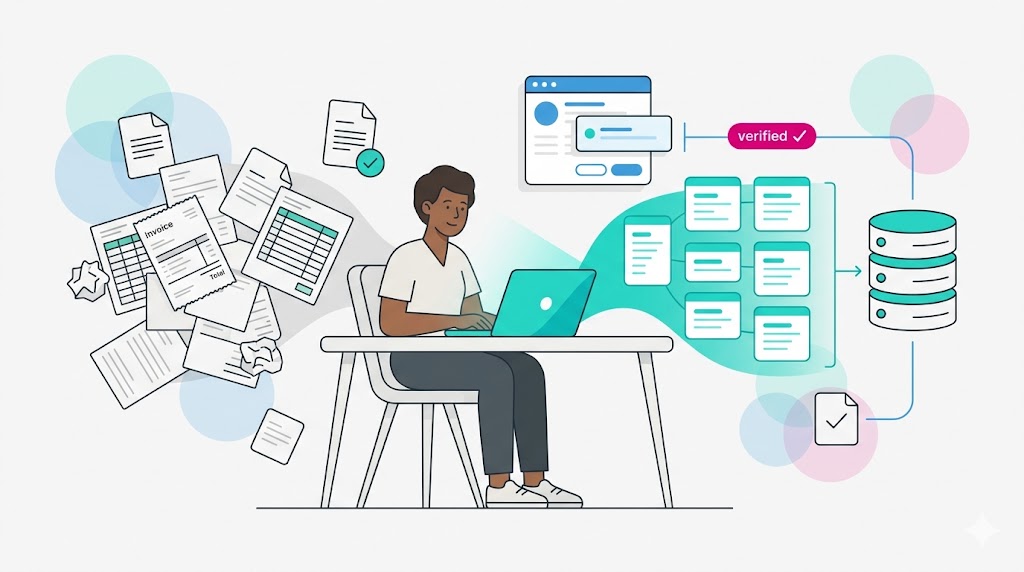
You started the company to build something. To close deals, design the product, see your clients’ faces light up when the thing you made actually works. Nobody opens a business because they dream of retyping invoice numbers off a crumpled PDF at 11pm.
And yet here you are. Or here your team is. Somebody is sitting in front of a spreadsheet, copying figures from one window to another, fighting the urge to check their phone, making the occasional typo that won’t surface until a client queries an invoice three weeks later. The work feels small. The cost of getting it wrong is not.
This is the quiet tax on growing businesses. The data piles up faster than anyone planned for — orders, leads, receipts, contact lists, CRM records, supplier catalogues — and someone has to get it all into the right system, in the right format, accurately. Usually that someone is you, or a person you’re paying far too much to be doing keyboard work.
A data entry virtual assistant fixes that. But “fix” can mean a lot of things, and the gap between the worst version of this arrangement and the best version is wider than most people realise. So let’s walk through exactly what a data entry VA is, what they actually do, where the real money leaks out when you get it wrong, and why the way you source one matters more than almost any other decision you’ll make about it.
What a Data Entry Virtual Assistant Actually Does
At the simplest level, a data entry virtual assistant is a remote professional who handles the input, organisation, and maintenance of your business data so you and your team don’t have to. They work from their own setup, log into your systems, and turn raw, messy, scattered information into clean, structured, usable records.
That covers a lot of ground. The day-to-day usually includes things like:
- Entering sales orders, invoices, and receipts into accounting or ERP software
- Updating and cleaning CRM records — fixing duplicate contacts, filling missing fields, tagging leads correctly
- Transcribing information from PDFs, scanned forms, business cards, or handwritten notes into spreadsheets or databases
- Building and maintaining product catalogues for e-commerce stores
- Compiling mailing lists and verifying email addresses
- Converting files between formats — PDF to Excel, image to text, paper to digital
- Doing light web research and logging the results in a structured sheet
- Quality-checking existing databases for errors, gaps, and inconsistencies
The throughline is consistency and accuracy under repetition. A good data entry VA does the same careful thing the four-hundredth time as they did the first, which is precisely the thing humans find hardest and precisely why offloading it to a dedicated, trained person beats squeezing it into the margins of someone else’s job.
It’s worth being clear about something here, because it shapes everything that follows. Data entry is often described — even by the people who do it — as tedious. One blunt small-business write-up on the subject put it about as plainly as anyone can, calling the work “boring, boring, boring” and arguing that the smartest move is simply to let someone who’s good at it take it off your plate. That’s not a knock on the work. It’s the whole point. The tedium is exactly the reason it should leave your desk and land with someone whose entire focus is doing it well.
Data entry doesn’t fail because people are careless. It fails because it’s repetitive, low-stimulation work wedged into the cracks of someone’s “real” job — and the human brain was never built for that.
The Hidden Cost of Doing It Yourself (Or Letting Your Team Do It)
Here’s where the numbers get uncomfortable.
Manual data entry has an error rate. That’s not a maybe — it’s a measured, repeatable fact. Across the research, the rule of thumb lands at roughly a 1% human error rate for straightforward data entry, climbing as high as 4% when there’s no verification step in the process at all. Studies of spreadsheet work specifically have found that even careful people average around 95% accuracy on small spreadsheets. One analysis comparing methods put human data entry accuracy somewhere between 96% and 99%, meaning that across 10,000 entries, a human team would typically make between 100 and 400 mistakes.
Sit with that for a second. If your customer service rep processes 1,000 orders, you can statistically expect around 10 of them to be wrong. Each of those becomes an investigation, a correction, an apology, and sometimes a lost customer.
And the errors don’t cost the same depending on when you catch them. There’s a well-known principle in quality management — the 1-10-100 rule — which holds that it costs roughly a dollar to prevent an error at the point of entry, ten dollars to correct it once it’s in the system, and a hundred dollars or more once it’s flowed downstream and started causing damage. One commonly cited estimate pegs the average cost of a single data entry error at $50 to $150, depending on how far it travels before someone notices. Now multiply that by fifty errors a month.
A misplaced decimal point isn’t a typo. It’s a customer you have to win back, an invoice you have to reissue, or — in one real case — a young man who got accidentally paid €20,000 and spent it in three weeks before anyone caught the mistake.
Then there’s the time cost, which is even larger and almost entirely invisible. Research on teams that handle information manually has found they spend somewhere between 15% and 50% of their working time managing data by hand. Half. When your operations person, your bookkeeper, or — worst of all — you are spending that much of the week pushing data around, real-time visibility into your own business becomes practically impossible, because the data is always behind.
So the “free” option of doing it yourself isn’t free. You’re paying for it in errors you haven’t found yet, in downstream cleanup, and in the highest-value hours of your most expensive people being spent on the lowest-value work in the building.
“But Can’t AI Just Do This Now?” — The Human in the Loop
This is the question on everyone’s mind in 2026, and it deserves a straight answer rather than a sales pitch in either direction.
Yes, automation has come a long way. Optical Character Recognition (OCR) and AI-powered document tools can read invoices, extract fields, and dump structured data into your systems at speeds no human can touch — anywhere from 10,000 to 15,000 keystrokes per hour for a human versus near-instant for software, with automated accuracy on clean, structured inputs reported as high as 99.9%. If your data arrives in tidy, predictable, machine-readable formats, automation should absolutely be doing the heavy lifting. Anyone telling you otherwise is selling you labour you don’t need.
But — and this is the part the automation marketing tends to skip — most real business data is not tidy. By various industry estimates, over 80% of enterprise data is unstructured: emailed PDFs, photographed receipts, handwritten forms, supplier price lists in twelve different layouts, contracts with tables and footnotes. And this is exactly where the machines stumble. OCR struggles badly with handwriting, faded scans, skewed images, multi-column layouts, and lookalike characters — confusing a lowercase “l” with the number “1,” or an “O” with a zero. Industry reporting suggests traditional OCR can misinterpret a meaningful share of characters in low-quality or complex documents, and that manual verification is still required on a large proportion of OCR-processed files.
In other words: automation handles the volume; humans handle the judgment, the exceptions, and the verification. The credible position in the industry now isn’t “automate everything” or “do it all by hand” — it’s a hybrid model, where software does the fast, repetitive lifting and a trained human checks the output, catches what the machine got wrong, and handles everything that doesn’t fit the template. As one data-services provider put it, for any sensitive or regulated data, adding a trained specialist to verify the output is “a requirement, not a choice.”
Automation is brilliant at doing the same thing a million times. It’s useless at noticing when the thing it’s doing is wrong. That noticing — that’s the human in the loop, and it’s the part you can’t afford to skip.
A good data entry VA isn’t competing with AI. They’re using it. The best ones bring the software to the table themselves, run your data through it, and then apply the human eye that turns 95%-accurate output into something you can actually trust. That combination — fast tools plus accountable human judgment — beats either one alone, every time.
The South African Advantage
If you’re going to hand your data to someone remote, where they sit matters more than people expect. And on this front, South Africa quietly outperforms most of the alternatives.
Start with time. South Africa runs on South African Standard Time, which lands it in an unusually convenient overlap with the UK, Europe, and the US East Coast. For a UK or European business, that means your VA is awake and working through your full business day — not asleep when you need them, not replying at 3am to a message you sent at lunch. The difference between a VA in your working hours and one twelve time zones away is the difference between real-time collaboration and a constant game of overnight email tag. You ask a question at 10am and have an answer by 10:15, not the next morning.
Then there’s language and culture. South African professionals are typically university-educated, articulate, and native or near-native English speakers, with a business culture closely aligned to British and European norms. For data entry specifically — where you’re trusting someone to read your customers’ names, addresses, and financial details and transcribe them faithfully — this matters enormously. There are no scripts, no awkward language barriers, no second-guessing whether the person understood the nuance of the instruction. They simply get it.
And finally, the part everyone wants to know: cost. South African talent offers genuine cost efficiency against UK, European, and US in-house rates — often substantially so — without the quality trade-off that “commodity offshore labour” usually implies. You’re not choosing between cost-effective and good. You’re getting professionals who write and think like your in-house team would, at a fraction of what a local hire would cost you once you’ve added salary, software, equipment, office space, and management overhead.
That combination — overlapping working hours, no language friction, real cost savings, genuine quality — is hard to find anywhere else on the map. It’s the reason a growing number of UK and European businesses have stopped looking domestically for this kind of support and started looking south.
Why “Where You Hire” Matters More Than “Who You Hire”
Now for the decision that quietly determines whether this whole thing works: how you source the VA in the first place.
There are essentially three ways to get a data entry VA, and they are not remotely equal.
The first is the freelance marketplace — your Upwork, Fiverr, and the like. You post a job, sift through dozens of bids, pick someone based on a profile and a rating, and hope. Sometimes it works. Often it doesn’t. The person you hired vanishes mid-project, or turns out to be juggling fifteen other clients, or simply isn’t as good as the profile suggested. There’s no backup if they get sick. There’s no quality control beyond your own checking. And critically, there’s nobody managing them but you — which means the time you were trying to buy back gets eaten up managing a freelancer instead.
The second is hiring directly — finding and employing someone yourself. Better continuity, but now you’re carrying recruitment, training, equipment, the cost of cover when they’re away, and the management load. For a function as foundational-but-tedious as data entry, that’s a lot of overhead to take on.
The third is the managed model, which is where VAConnect operates. This is the difference VAConnect describes as “Managed, Not Matched.” You’re not handed a name from a database and left to fend for yourself. You get a trained, vetted VA, plus the entire apparatus behind them — recruitment, onboarding, ongoing performance management, quality oversight, and backup cover if your VA is ever unavailable. One point of contact, output you can rely on, and none of the management burden landing back on your desk.
For data entry specifically — where accuracy and consistency are the entire value, and where a missing person mid-week can stall your operations — that managed layer isn’t a nice-to-have. It’s the thing standing between you and the exact problem you were trying to escape.
What Sets VAConnect Apart for Data Entry Work
VAConnect has been doing this since 2008, which in remote-staffing years is a very long time. Over those 17-plus years the company evolved deliberately from a simple placement model into a fully managed agency — built, in the founders’ own framing, by entrepreneurs for entrepreneurs. That history matters, because data entry done badly is invisible right up until it’s catastrophic, and the systems that prevent “badly” only come from years of refining them.
A few things are worth knowing specifically for data-entry buyers:
Every VAConnect VA is upskilled through VAVarsity, the company’s proprietary, continuously-running training platform, before they ever touch a client’s systems. For data work, that means verified competence with the tools — spreadsheets, CRMs, accounting software, document conversion — rather than a stranger learning on your dime.
Accountability is engineered in, not assumed. Programmes like VAPI and the company’s “Two-Way Happiness” approach exist to keep VAs motivated, accountable, and performing — which is exactly what you want for repetitive work where attention is the whole game. The company reports 98% client retention over 14 months, verified from VAConnect’s invoice records, which for you translates into continuity: the person who learned your data quirks in month one is still the person handling them in month twelve.
Security and confidentiality are handled formally. VAConnect maintains published NDA, data protection, and privacy/GDPR documentation — not an afterthought when your VA is going to be handling customer details, financial records, and other sensitive information all day. For UK and European clients especially, having a provider with a clear, documented compliance posture removes a real source of risk.
And the “invisible team” structure means you can scale. If your data volume spikes, you’re not back on a marketplace recruiting from scratch — you give one brief and get the output of multiple coordinated VAs through a single point of contact.
You didn’t build your business to manage a freelancer who manages your spreadsheets. The managed model exists so that the time you buy back stays bought back.
How to Know If You Need One Right Now
You probably don’t need a survey to answer this. A few honest questions usually settle it:
Are you, or someone whose time is worth real money, spending hours a week on data entry? Have you caught errors in your records that cost you — a wrong invoice, a duplicated customer, a missed lead because the CRM was a mess? Is your data always slightly out of date, so you can never quite trust your own dashboards? Are tasks like updating the catalogue or cleaning the contact list permanently at the bottom of the to-do list because nobody has time?
If you’re nodding, the maths has already made the decision for you. The cost of a dedicated data entry VA is almost always a fraction of what you’re currently losing to errors, cleanup, and the misallocation of your best people’s time. The only real question is how you source one — and that’s the question this whole guide has been pointing at.
The Bottom Line
Data entry is the kind of work that’s easy to underrate right up until it costs you a customer or a clean set of books. It’s repetitive, it’s error-prone in human hands, and it quietly consumes an astonishing share of the time you’d rather spend growing the business. Automation helps, but it can’t be trusted alone — the messy, unstructured reality of real business data still needs a human in the loop to verify, correct, and handle the exceptions.
A data entry virtual assistant gives you that human. And a South African data entry VA gives you one who works your hours and speaks your language. But the thing that decides whether you actually get your time back — rather than just trading one headache for another — is the managed model. Trained talent, quality oversight, backup cover, documented compliance, one point of contact. Managed, not matched.
The businesses pulling ahead aren’t the ones working harder on their data. They’re the ones who stopped touching it themselves and handed it to someone built to do it right.
Ready to take data entry off your plate for good? Explore VAConnect’s services or book a discovery call to find out exactly how much time — and money — a dedicated, managed data entry VA could give back to your business.
DIY vs Marketplace Hire vs VAConnect: The Real Comparison
| Factor | DIY / In-House | Generic Freelancer (Upwork/Fiverr) | VAConnect Data Entry VA |
|---|---|---|---|
| Accuracy / error control | 1–4% human error rate, no formal QA layer | Variable; quality depends entirely on the individual | Trained VAs + accountability programmes; human-in-the-loop verification |
| Time you get back | None — it stays on your desk | Partial, eaten up by managing the freelancer | Maximised — fully managed, minimal oversight needed |
| Cost (true total) | Highest-value hours on lowest-value work | Low headline rate, hidden cost in churn & rework | Cost-efficient SA talent, no recruitment/equipment/management overhead |
| Continuity & backup | You’re the single point of failure | None — if they vanish, you start over | Backup cover guaranteed; 98% client retention over 14 months, verified from VAConnect’s invoice records |
| Training | Self-taught, ad hoc | Whatever they happened to learn elsewhere | Continuous upskilling via VAVarsity before touching your systems |
| Timezone (UK/EU) | N/A | Often mismatched (Asia-based common) | SAST: live overlap with UK, EU and US East Coast hours |
| Language & culture fit | Native | Hit or miss | University-educated, native/near-native English, British-aligned |
| Data security / compliance | Informal | Rarely any NDA or GDPR posture | Published NDA, data protection & GDPR/privacy documentation |
| Management burden | All on you | All on you | Handled — one point of contact |
| Ability to scale | Hire & train from scratch | Re-recruit each time | “Invisible team” — one brief, output of many |