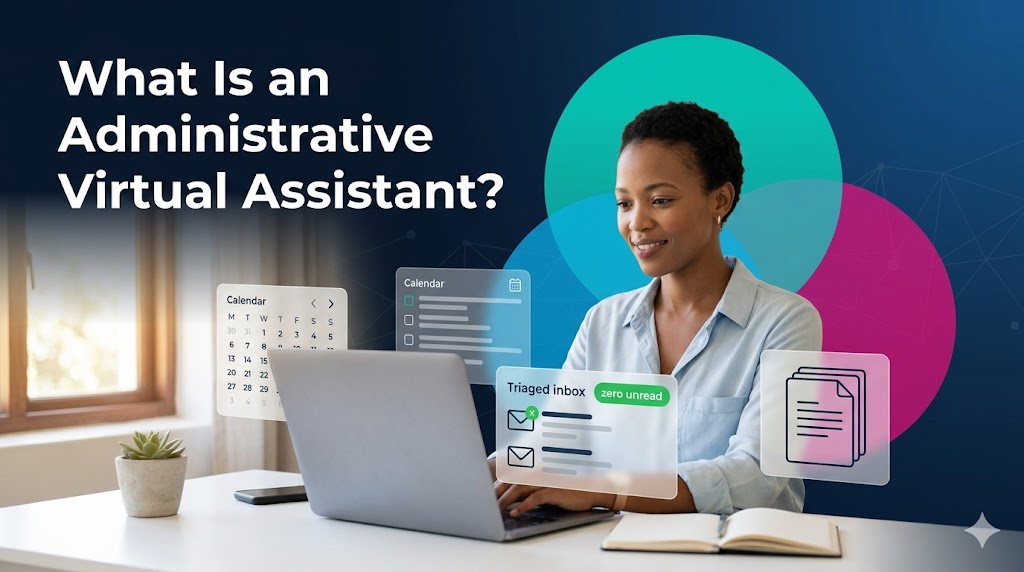
There’s a particular kind of exhaustion that has nothing to do with the actual work you set out to do. You sit down at 8 a.m. with a clear plan. By noon, you’ve answered forty-one emails, rescheduled two meetings because someone’s flight got moved, chased an invoice, booked a courier, filled in a spreadsheet that someone else should probably own, and watched your “important strategic thinking” block get eaten alive by a hundred small interruptions. The plan is still sitting there, untouched. And you’re tired anyway.
If that sounds familiar, you’re not disorganised and you’re not bad at your job. You’re just doing two jobs at once — the one that grows the business and the one that keeps the lights on administratively — and the second one is silently strangling the first.
This is the gap an administrative virtual assistant is built to close. Not by being a generic “extra pair of hands,” and not by being a chatbot that drafts your emails, but by being a trained remote professional who takes ownership of the operational machinery so you can get back to the work only you can do. In this guide we’ll walk through exactly what an administrative VA is, what they do, who actually needs one, what it costs you to keep doing it all yourself, and why the model you choose — solo freelancer, generic platform, or a managed partner like VAConnect — matters more than most business owners realise until it goes wrong.
What an Administrative Virtual Assistant Actually Is
An administrative virtual assistant is a remote professional who handles the recurring operational tasks that keep a business running: calendar and inbox management, document preparation, data entry, scheduling, basic bookkeeping support, client communication, travel coordination, and the endless small follow-ups that fall between the cracks. Industry definitions are consistent on this point — an administrative VA handles essential business operations like scheduling, inbox management, data entry, and document organisation so you stay focused on growth without the cost of an in-house hire.
The word “administrative” is doing a lot of quiet work here. It distinguishes this role from the more specialised VAs that have multiplied over the last few years — marketing VAs, sales VAs, executive VAs, paralegal VAs. The administrative VA is the foundation layer. They’re the one who makes sure the basics never slip: the meeting that doesn’t double-book, the report that’s formatted and ready before the deadline, the client email that gets a same-day reply instead of dying in an overstuffed inbox.
It helps to be precise about why this role exists in 2026 rather than 2006. The role has evolved well beyond basic clerical work; administrative support is still the single most outsourced VA function — by one 2025 industry count it accounted for roughly 34% of all delegated assignments, more than any other category. The reason is simple. Administrative work is the most universal pain in business. Every founder, every consultant, every agency owner, every clinic and law firm and e-commerce store has an inbox, a calendar, and a pile of documents. Almost none of them want to spend their best hours managing those things.
The most outsourced task in the entire virtual assistant industry isn’t anything glamorous. It’s administration — roughly a third of everything businesses hand off. The work everyone has, and almost no one wants to do themselves.
A useful way to think about it: a specialist VA helps you do a specific thing better. An administrative VA gives you back the time to do everything better. They’re the difference between a business that runs on its owner’s frantic energy and one that runs on systems.
What an Administrative Virtual Assistant Does All Day
The honest answer is “whatever is eating your time and doesn’t require you specifically to do it.” But that’s not very useful when you’re trying to decide whether to hire one, so let’s get concrete. Across the industry the core responsibilities cluster into a handful of areas.
Calendar and scheduling. This is usually the first thing people hand over and the first thing that transforms their week. A good administrative VA owns your calendar: scheduling appointments, confirming meetings, coordinating across time zones, preventing the double-bookings and overlaps that quietly drain your day, and managing the reschedules so you never have to do the awkward email tennis yourself.
Inbox management. Not just reading your email — running it. Sorting and triaging, flagging what genuinely needs you, drafting routine responses, applying labels and folders, and making sure nothing important sits unanswered for three days because it slipped below the fold. This matters more than people admit, and we’ll come back to just how much time the inbox actually steals.
Document preparation and file management. Drafting, editing, and formatting reports, presentations, agendas, and correspondence. Maintaining clean, version-controlled digital filing systems so the right document is findable in ten seconds rather than ten minutes. Keeping CRM records and databases up to date so the data you make decisions on is actually current.
Data entry and record-keeping. The unglamorous backbone: updating spreadsheets, logging entries into CRM systems, reconciling lists, and maintaining the databases that everything else depends on.
Coordination and follow-up. Recording meeting minutes, tracking action items, chasing the people who owe you things, conducting online research, compiling data, and handling the travel and logistics planning that turns a simple trip into a half-day administrative project. As one industry breakdown puts it, the common thread across every one of these tasks is the ability to absorb time-consuming administrative work so the business owner can focus on growth and strategy.
The list goes on — invoicing support, basic bookkeeping, customer enquiries, light social media scheduling — but you can see the shape of it. None of these tasks is hard. That’s exactly the problem. They’re not hard, they’re just relentless, and relentless is what burns people out.
The Hidden Maths: What Doing It Yourself Actually Costs
Here’s where the case for an administrative VA stops being a “nice to have” and starts looking like simple arithmetic. The cost of doing your own admin isn’t the time the tasks take. It’s the time they take plus everything they break around them.
Start with the inbox, because it’s the worst offender. McKinsey’s well-known finding is that knowledge workers spend around 28% of their working day reading and answering email. Other workplace studies put the figure even higher — one analysis found that 23% of the day disappears just dealing with low-value email, and that the average person spends roughly 2.5 hours a day managing their inbox, of which around 1.8 hours is communication that’s entirely irrelevant to them. Whichever number you trust, the conclusion is the same: a meaningful slice of every working day is gone before you’ve done anything that grows your business.
Then there’s the part most people never count: the cost of switching. Administrative work doesn’t arrive in a neat block. It interrupts. And interruptions are catastrophically expensive for focused work. A widely cited University of California, Irvine study found it takes an average of around 23 minutes to fully regain focus after a significant interruption. Harvard Business Review research estimates knowledge workers toggle between applications more than 1,200 times a day, and a synthesis of these findings concludes that context switching quietly consumes somewhere between 45 and 90 minutes of usable output every single day — not from one big disruption, but from hundreds of tiny recoveries.
A single interruption costs about 23 minutes of refocus time. The hidden tax of context-switching alone burns up to 90 minutes of real output a day. That’s not laziness — that’s the maths of trying to do focused work and admin in the same brain at the same time.
Stack those together and a picture emerges. When you handle your own administration, you’re not losing the 30 minutes it took to reschedule three meetings. You’re losing those 30 minutes plus the 23-minute refocus penalty each time the task yanked you out of deep work, plus the cognitive drain of holding all of it in your head. Research on heavy multitasking suggests it can temporarily reduce effective IQ by up to 10 points and is strongly associated with elevated stress and burnout — roughly 68% of employees reported experiencing burnout in a recent year, with inflexible, fragmented schedules making it markedly worse.
The flip side is the upside. Businesses that delegate this work consistently report reclaiming serious time. Providers and studies in the space commonly cite anywhere from 10 to 20-plus hours a week recovered once administration is properly handed off, and research on routine-task automation and delegation points to several hours per week freed and significant performance gains on the high-value work that’s left. That’s not a marginal efficiency. That’s the difference between a business that can grow and one that’s permanently maxed out at its founder’s personal capacity.
The Human in the Loop: Why AI Hasn’t Killed This Role
It would be reasonable, in 2026, to ask the obvious question: why hire a person to manage my inbox and calendar when AI can draft emails, summarise threads, and schedule meetings? It’s a fair question, and the honest answer is more interesting than either the AI evangelists or the AI sceptics will tell you.
AI is genuinely good at the mechanical layer of administration. It can draft a serviceable reply, transcribe a meeting, pull data into a spreadsheet, and suggest calendar slots. Around 40% of VAs themselves now use AI tools inside their workflows precisely because it speeds up the repetitive parts. Nobody serious is arguing you shouldn’t use these tools.
But administration isn’t really a mechanical job. It looks like one until you watch it go wrong. The value of a great administrative assistant lives almost entirely in judgement — the things that aren’t in the prompt. Which of these forty emails actually matters today, and which can wait until Thursday. That this client’s tone has shifted and the situation needs a careful human reply, not a cheerful template. That the “urgent” meeting request is from someone who always says urgent, while the genuinely time-sensitive one is buried and polite. That a supplier’s invoice is wrong and shouldn’t be paid. AI can generate text; it cannot reliably own an outcome, read a relationship, or notice the thing nobody told it to look for.
There’s also a quieter point about tone. When AI writes for a brand at scale, the output tends to converge on the same smooth, slightly generic register — and your clients can feel it. A human assistant who knows your business, your voice, and your customers writes communication that sounds like you, not like everyone. In a world where more and more outbound communication is automated, the businesses that still sound human have an advantage that’s getting more valuable, not less.
AI can draft the email. It can’t tell you which email matters, read the relationship behind it, or be accountable when the judgement call goes wrong. The mechanics got automated. The judgement didn’t.
This is exactly why the smartest model isn’t “AI instead of a person” or “a person instead of AI.” It’s a trained human using AI as a tool — keeping a human in the loop on every decision that involves judgement, tone, or accountability, while letting automation absorb the genuinely repetitive grind. That’s the model VAConnect builds around: its assistants are continuously upskilled through VAVarsity, the company’s free internal training platform, precisely so that the human layer stays sharp on the things that matter while the tools handle the things that don’t. The point of training a VA in 2026 isn’t to make them faster typists. It’s to make them better decision-makers in the gaps AI leaves wide open.
The South African Advantage: Why Location Is a Hidden Superpower
That mental model is outdated, and South Africa is the reason why.
Start with the time zone, because it’s the part people underestimate most. South Africa runs on South African Standard Time. That puts it just one or two hours ahead of the UK depending on the season, and inside most of the European working day. The practical effect is enormous: your South African administrative VA is online and working while you are. When you flag something at 10 a.m., it gets handled by lunchtime — not overnight, not “tomorrow your time.” For a role that’s fundamentally about real-time responsiveness — triaging today’s inbox, fixing today’s calendar clash — that overlap isn’t a nice-to-have. It’s the whole game. An assistant in a wildly different time zone can only ever manage your admin retrospectively. A South African one manages it live.
Then there’s language and culture. English is one of South Africa’s primary business languages, and South African professionals typically speak it with a neutral, internationally legible accent and a strong command of written business English. Industry data underlines how much this matters — roughly half of cross-border clients now name language fluency and cultural nuance as a key differentiator when choosing a VA. South Africa’s business culture is also closely aligned with British and European norms around professionalism, punctuality, and communication style, which means far less friction and far less “lost in translation” than businesses fear from offshore support.
And then, yes, the cost. South African talent delivers genuine first-world professional quality, Berlin, or New York. But the framing matters. This isn’t commodity labour — it’s a favourable exchange rate meeting a genuinely skilled, English-fluent, time-zone-aligned workforce. You’re not trading quality for price. You’re getting both, which is precisely the combination that’s been hard to find anywhere else. South Africa’s emergence as a serious VA hub — now hosting a measurable and growing share of the global VA workforce — is built on exactly this trifecta: overlap, fluency, and value.
Managed, Not Matched: Why How You Hire Decides Whether It Works
Here’s the part that trips up most first-time delegators. They get the idea — “I need an admin VA” — right, and then they get the model wrong, and the whole thing falls apart in month two.
There are broadly three ways to get administrative support, and they are not equivalent.
The first is DIY — you keep doing it yourself, maybe with some apps and automations bolted on. We’ve already covered why this is the most expensive option of all, because the cost is hidden in your lost focus and your missed growth rather than showing up on an invoice.
The second is the generic freelancer or platform route — you find someone on a global marketplace, you interview them, you hire them, and now you own a second job: managing them. You write the briefs. You build the training. You notice when quality slips. You scramble to find a replacement when they vanish or take on a bigger client. Platforms match you to a person and then step back. If it works, great. If it doesn’t — and a stark number of these arrangements quietly don’t — that’s your problem to solve, alone, again.
The third is the managed model, which is the distinction VAConnect is built around: “Managed, Not Matched.” You’re not handed a name and left to it. You get an assistant who has been vetted, trained, and is continuously supported by an agency that stays in the loop. There’s a real onboarding process — VAConnect starts with a strategy-first conversation about fit and what you actually need, not a CV dump. There’s ongoing training through VAVarsity. There’s an accountability and engagement layer (the company runs an internal programme, VAPI, focused on remote-team culture and accountability) so the relationship doesn’t quietly drift. And critically, there’s continuity: if something goes wrong, you have a company standing behind the role rather than a profile that’s gone dark.
“Matched” means you’re handed a stranger and wished good luck. “Managed” means someone is accountable for the outcome alongside you. For a role built entirely on trust and reliability, that difference is everything.
Founder Karen van Zyl built the model specifically to make South African talent a credible, reliable alternative to the global staffing market, with the structure to back it up — published NDA, data protection, and privacy policies included, which matters when you’re handing someone access to your inbox and client data.
The point isn’t that freelancers are bad people. Plenty are excellent. The point is that for a role whose entire value is reliability, continuity, and trust, the structure around the person determines whether you get those things consistently — or only until the day it breaks.
Who Actually Needs One — and How to Know You’re Ready
Not every business needs an administrative VA, so it’s worth being honest about the signals. You’re probably ready if: you regularly work past the point of usefulness on tasks that don’t require your specific expertise; things are starting to slip through the cracks — missed follow-ups, late replies, double-booked calls; you can’t remember the last time you had a genuinely uninterrupted block of focused work; or you’ve caught yourself thinking “I’d grow this business if I just had the time,” while spending that time on data entry.
The founders who benefit most tend to be the ones whose own time is worth dramatically more than the administrative work consuming it — consultants, agency owners, solo professionals, small-business owners, and executives whose calendars and inboxes have outgrown their capacity to manage them by hand. If an hour of your focused work is worth far more than an hour of admin, then every hour you spend on admin is a bad trade you’re making with yourself, repeatedly, all day.
The readiness test is simple. Spend one week writing down every task you do that someone else could do with the right brief and training. Total the hours. If the number frightens you — and it usually does — you have your answer, and you have your first delegation list.
The Bottom Line: The Gap Is Wider Than You Think
What’s genuinely striking, looking at the numbers, is how large the gap has become between businesses that have solved their administrative layer and those still grinding through it manually. This isn’t a small efficiency tweak. When you add the hours lost to the inbox, the 23-minute refocus penalty paid hundreds of times a week, the up-to-90-minutes of daily output that context-switching quietly eats, and the strategic work that simply never happens because there’s no room for it — the difference between a business with a great administrative VA and one without isn’t 10% or 20%. It’s the difference between a business that can scale and one that’s permanently capped at one exhausted person’s capacity.
The role itself is unglamorous. Nobody puts “got my calendar under control” on a pitch deck. But the businesses quietly pulling ahead are, more often than not, the ones that figured out the boring thing first: that you cannot build the future of a company while personally drowning in its present-day admin. An administrative virtual assistant — a trained human, using the best tools, in your time zone, backed by a structure that keeps them accountable — is how you stop drowning and start building.
The question isn’t really whether you can afford one. It’s whether you can afford to keep being your own.
DIY vs Marketplace Hire vs VAConnect: The Real Comparison
| Factor | DIY Coordination | Generic Freelancer / Platform | VAConnect Administrative VA |
|---|---|---|---|
| Who owns the work | You — on top of your real job | The freelancer, loosely | A trained, supported professional |
| Who manages the person | N/A (it’s you) | You — it becomes a second job | VAConnect (managed, not matched) |
| Time-zone overlap (UK/EU) | N/A | Often poor / overnight | SAST: live overlap with your working day |
| Onboarding | None | Minimal; you build it yourself | Strategy-first fit & needs session |
| Training | None | Whatever they arrived with | Continuous via VAVarsity |
| Quality consistency | Declines as you burn out | Variable; no safety net | Backed by systems & processes since 2008 |
| What happens if it breaks | You absorb it | You restart the search, alone | Agency provides continuity & cover |
| Accountability layer | None | None | VAPI engagement & accountability programme |
| Data protection | Ad hoc | Depends entirely on the individual | Published NDA, data protection & privacy policies |
| Use of AI tools | Up to you to set up | Inconsistent | Human-in-the-loop, AI-assisted, judgement-led |
| Real cost | Hidden — lost focus & lost growth | Low rate, high management overhead | First-world quality at favourable value |
| Best for | Almost no one, long-term | Risk-tolerant, one-off tasks | Owners who want reliability and to grow |
Ready to get your time back? VAConnect pairs you with a trained, managed administrative virtual assistant who works in your time zone and is backed by a real support structure — not just a profile and a wish of good luck. Explore VAConnect’s services or book a discovery call to map out exactly what you should delegate first.