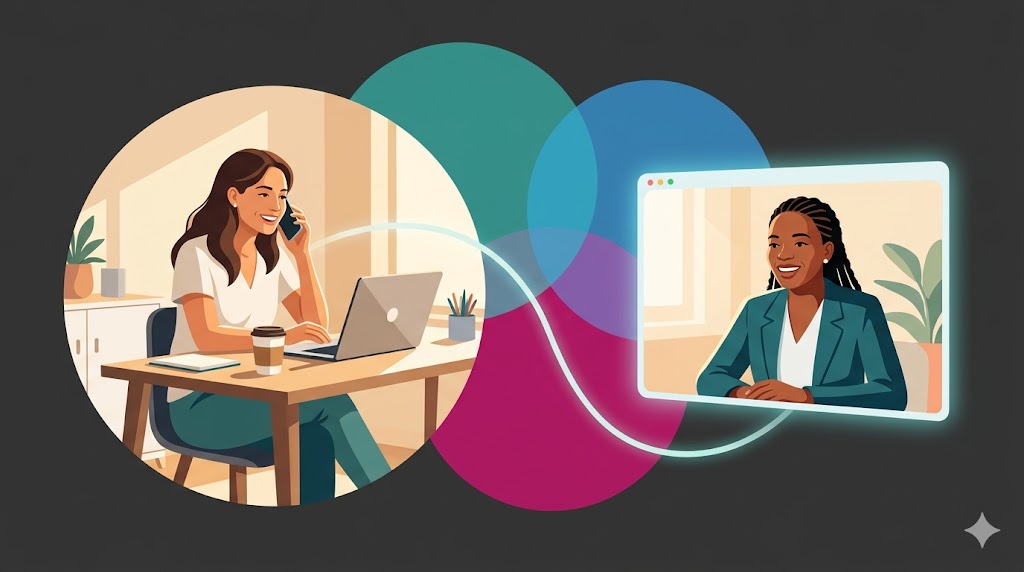
You hired the help. So why does it still feel like you’re doing two jobs?
Picture a founder in her first month with a remote assistant: she fires off a task at 11pm, wakes up to a clarifying question she hadn’t anticipated, answers it on her commute, then spends her lunch break re-explaining what she already explained the night before. By the time the work comes back, she has touched it four times. She is managing the manager, and it would have been faster to do it herself.
That’s the trap. Not bad assistants. Not laziness on either side. Just the slow, grinding friction of two people trying to coordinate across screens, time zones, and unspoken assumptions — and getting it slightly wrong over and over until the whole arrangement feels heavier than the problem it was supposed to solve.
Here’s the uncomfortable part. The assistant is rarely the variable that decides whether this works. The communication system around them is. Get that right and a remote VA can quietly run a chunk of your business. Get it wrong and you’ll churn through three of them in a year, each time blaming the person rather than the setup.
This is a guide to getting it right. Not motivational fluff — actual mechanics. How to brief, which channel to use for what, how to handle the time-zone gap, why over-communicating early saves you months, and where a real human in the loop beats any automation you could bolt on instead.
Why Communication Breaks Down Before the Work Does
Most delegation failures get diagnosed as performance problems. They’re almost always communication problems wearing a performance costume.
When you work alongside someone in an office, an enormous amount of information transfers without anyone trying. You overhear the tone of a client call. You see the assistant frown at a spreadsheet and wander over. You correct a misunderstanding in eight seconds because you happened to be standing there. None of that survives the jump to remote. The channel narrows to whatever you deliberately type, record, or say on a call — and suddenly everything you used to communicate by accident has to be communicated on purpose.
The research backs this up. A December 2024 review in the International Journal of Research and Innovation in Social Science examining online work communication strategies found that while digital tools make communication possible, they require deliberate training and support to actually work — and that leaning on them without that structure produces information overload that weakens team performance rather than helping it.
Digital tools don’t create alignment. They create the possibility of alignment — which you then have to build on purpose, every single day.
Cal Newport, who wrote A World Without Email, puts the cost in plain terms: the modern knowledge worker checks email or chat roughly once every six minutes, and the cognitive overhead of all that context-switching is, in his words, exhausting and makes people miserable. Now imagine that same fragmented back-and-forth, except one of the two people is in a different time zone and can’t tap you on the shoulder to resolve the confusion. The fragmentation doesn’t just annoy — it stretches a five-minute clarification into a full-day delay.
So before you blame the VA for “not getting it,” ask the harder question: did the system you built actually give them a way to get it?
Decide What Goes Where: Channels Are Not Interchangeable
The single biggest upgrade most people can make is also the most boring: deciding, in advance, which type of message lives in which channel. When everything dumps into one chat thread, urgent and trivial blur together, decisions get buried under banter, and your assistant has to guess what needs a response now versus next week.
A workable default looks like this. Use a project or task tool — Trello, Asana, ClickUp, Bitrix24, whatever — as the single source of truth for what needs doing. If a task isn’t in there, it doesn’t exist. Use chat (Slack, WhatsApp, Teams) for quick, low-stakes nudges and social glue, with the understanding that it’s not where decisions get recorded. Use email for anything external or anything you’ll need to find again in six months. And reserve live calls for the two things async genuinely can’t do: building the relationship and untangling a knot that’s too tangled to type.
That last category matters more than the productivity influencers admit. There’s a loud crowd online insisting you should delete every recurring meeting and go fully asynchronous. One remote-team lead pushed back on exactly that advice, arguing that async isn’t always the answer and that some teams, especially in fast-moving phases, simply work better with a regular live touchpoint. He’s right. The goal isn’t zero meetings. It’s zero pointless meetings — and a clear rule for which problems earn a call.
“This meeting could have been an email” has become the exasperated mantra of overloaded knowledge workers. The fix isn’t more meetings or fewer. It’s matching the message to the medium.
GitLab’s research on all-remote organizations found that 52% boosted productivity after defaulting to asynchronous work. But “default to async” is doing a lot of quiet work in that sentence. The teams that win aren’t the ones that ban meetings — they’re the ones who’ve made async the default and kept a small, sharp set of synchronous touchpoints for the moments that need them.
The Brief Is the Job: Write It Like You Mean It
If you take one thing from this entire piece, take this: the quality of the output is decided in the brief, before the assistant does a single minute of work.
A weak brief sounds like “can you sort out the newsletter.” A strong brief sounds like “Draft the March newsletter in our Mailchimp template — three sections (product update, customer story, one industry link), 400 words max, friendly-but-professional tone, due Thursday 2pm my time so I can review before it goes out Friday. Last month’s is linked as a reference. Flag me if you can’t find a customer story and I’ll send one.” The first version guarantees three rounds of clarifying questions. The second one can be executed cold.
The difference is that the second brief answers the questions before they’re asked: what, in what format, how long, what tone, by when, and what to do if blocked. That last element — the “if you get stuck, here’s what to do” instruction — is the one almost everyone forgets, and it’s the one that prevents your assistant from either freezing or guessing wrong while you’re asleep.
For anything involving a process you’ll repeat, record it once instead of typing it. A two-minute screen recording — narrating as you click through the actual task — transfers more usable detail than a thousand words of written instructions, and your assistant can replay it as many times as they need without re-asking you. Loom built an entire company on this insight, and the logic is simple: video carries tone, sequence, and context that bullet points strip out. Build a small library of these and your onboarding time for the next task, and the next assistant, drops sharply.
Working Across the Clock: Turn the Time Gap Into an Asset
The fear about hiring remotely across borders is that the time difference will slow everything down. Handled badly, it does. Handled well, it’s one of the biggest advantages you can buy.
The trick is to stop treating overlap hours and offline hours as the same thing. Your overlap window — the hours you’re both online — is precious and should be protected for the things that genuinely need both of you: the quick decision, the live walk-through, the relationship check-in. Everything else should be designed to flow without you. You brief at the end of your day; they execute during yours; you wake up to completed work and a short summary. Done right, the clock becomes a relay race instead of a traffic jam.
This is where geography stops being a logistics problem and starts being a strategy. Harvard Business School research published in September 2024 found that remote employees handling routine, non-collaborative tasks naturally shifted to asynchronous communication without any hit to their schedules — the loss of real-time chatter simply didn’t matter for that kind of work. The lesson: match the type of work to the amount of overlap it actually needs, and a wide time gap stops being a cost.
But there’s a floor below which async stops working and the gap turns back into friction. If your assistant is twelve hours out of phase, even the simplest “wait, which file did you mean?” costs you a full day. Which is exactly why where you hire from matters as much as how you communicate — and why one particular talent market keeps coming up.
The South African Advantage: Close Enough to Actually Talk
Here’s the thing that surprises business owners in the UK, Europe, and the US East Coast when they first look into it. South Africa sits in a near-perfect communication sweet spot, and most people have no idea.
The country runs on South African Standard Time. That means a substantial overlap with the UK and European working day — often most of it — and a workable window with the US East Coast. You’re not waiting twelve hours for a reply. You send a message at 10am London time and get an answer that morning. Live calls happen during civilised hours for both sides. The relay race works and you can still pick up the phone when you need to. VAConnect, which has built its model on exactly this geography, puts it simply: overlap with UK, European and US East Coast business hours, and no waiting until tomorrow for a decision you need today.
Then there’s language. English is a primary business language in South Africa, spoken with a neutral, easily understood accent. There’s no translation layer, no awkward phrasing in client-facing emails, no second-guessing tone on a call. For a role that is fundamentally about communication — drafting your emails, talking to your customers, representing your brand in writing — this is not a small detail. It’s the whole game.
“English is a primary business language. No translation layers.” For a role built on communication, hiring where the language is native isn’t a nice-to-have — it’s the difference between a VA who represents you well and one who needs everything proofread.
And the cultural fit lands in the same place: Western-aligned business norms, a familiar work ethic, and what VAConnect describes as a warm human touch rather than a scripted, transactional one. The cost savings are real — premium talent. It’s that it’s cheap and you can actually communicate, which is a far rarer combination than the price-first crowd assumes. Industry analysts have noted the same shift: outsourcing has moved well beyond back-office busywork into specialised, collaborative roles, and the regions winning that work are the ones offering cultural and time-zone alignment, not just low rates.
The Human in the Loop: Why You Can’t Automate the Relationship
There’s a tempting story going around that says you don’t need a person for any of this anymore. Plug in an AI tool, automate your inbox, let the machine schedule your meetings and draft your replies, and skip the messy human coordination entirely.
It’s a seductive pitch, and it’s wrong in a specific, costly way.
Automation is brilliant at the mechanical middle of a task — sorting, filtering, drafting a first pass, moving data from one place to another. It’s genuinely useful and you should absolutely use it. But the parts of a virtual assistant’s job that actually matter to your business are the parts that resist automation: reading the room on a tense client email, knowing that this particular customer needs a phone call rather than a templated reply, sensing that your Tuesday brief contradicts what you said Monday and asking about it before charging ahead. That’s judgment. That’s context. That’s the human in the loop — and it’s the difference between communication that builds relationships and communication that quietly corrodes them.
Consider what happens when communication itself breaks down between you and your assistant. An AI tool can’t notice that the working relationship is fraying. It can’t tell you that your briefs have been getting vaguer and the rework has been creeping up. It can’t have the slightly awkward conversation that resets expectations before resentment sets in. A person can — and the agencies that take this seriously build structures specifically to make sure it happens.
This is where VAConnect’s approach is worth examining, because they’ve systematised the thing most arrangements leave to chance. Their VAPI framework — what they call Two-Way Happiness — has both the client and the assistant provide structured feedback on a regular cadence. The point is to surface friction while it’s still small. Instead of a founder silently stewing for two months and then abruptly ending the engagement, the system catches the early signal — the vague briefs, the missed expectation, the drop in responsiveness — and prompts a fix. The company credits this framework with 98% client retention over 14 months, verified from VAConnect’s invoice records, and the mechanism is entirely human: scheduled feedback loops that replace awkward, avoided conversations with structured, expected ones.
Happiness measured, not assumed. Issues surface early, wins get recognised, and the relationship strengthens over time instead of quietly eroding until someone walks away.
No automation does that. A bot won’t tell you the partnership is in trouble. A well-run feedback system, staffed by people who care whether it works, will — and that early warning is worth more than any efficiency a tool can offer.
Building Trust Across a Screen: The Long Game
Everything above is technique. This last part is the foundation underneath it, and it’s the one that determines whether the techniques even get a chance to work.
A 2024 analysis of Trust Index survey data covering 1.3 million employees found that cooperation — people feeling they can genuinely count on each other — is the single strongest driver of discretionary effort, the willingness to go beyond the minimum. Employees who believe their colleagues will cooperate are over eight times more likely to put in that extra effort. And crucially, the research found that co-location had nothing to do with it. Trust travels fine across distance. It just has to be built deliberately, because none of the accidental office bonding is there to build it for you.
So build it on purpose. Be generous with context early — explain the why behind tasks, not just the what, so your assistant can make good calls when you’re not around. Respond to their questions promptly in the early weeks even when it’s inconvenient, because every fast, clear answer teaches them how you think and reduces the questions they’ll need to ask later. Acknowledge good work explicitly; remote workers get almost no ambient signal that they’re doing well, so silence reads as dissatisfaction. And when something goes wrong, treat it as a gap in your brief before you treat it as a failure on their part — because nine times out of ten, that’s what it is.
The front-loaded effort feels like a tax. It’s actually an investment with an absurd return. The first month is where you over-communicate, over-explain, and over-check — and the months after that are where you reap a quiet, capable assistant who needs a fraction of the input and delivers most of the output. Skip the investment and you’re stuck in month one forever, re-explaining the same things and wondering why remote help never seems to lighten the load.
What the Gap Actually Looks Like
When you line up the three common approaches side by side, the difference in communication overhead — the hidden tax you pay in your own time — is wider than most people expect.
| Dimension | DIY Coordination (You + Tools) | Generic Freelancer (Marketplace) | VAConnect (Managed VA) |
|---|---|---|---|
| Who builds the communication system | You, from scratch, by trial and error | You, plus whatever the freelancer happens to do | Done for you — structured onboarding and channels in place |
| Time-zone overlap with UK / Europe | N/A (it’s just you) | Pot luck — often 8–12 hrs out of phase | SAST: most of the UK day, live calls during business hours |
| Language & cultural fit | N/A | Variable; client-facing work often needs proofreading | Native English, neutral accent, Western business norms |
| Briefing burden after month one | 100% — it never leaves your plate | High and persistent; little process retention | Drops sharply; SOPs and recordings built once, reused |
| Relationship monitoring | None | None | VAPI Two-Way Happiness: structured feedback, early issue detection |
| What happens when it’s going wrong | You absorb it silently until it breaks | You churn the freelancer and restart | Surfaced early and fixed — 98% client retention over 14 months, verified from VAConnect’s invoice records |
| Backup if your person is unavailable | Work stops | Work stops | Pre-briefed backup cover |
| Real cost | Your time — the most expensive input you have | Low rate, high hidden coordination cost | Premium talent at a fraction of UK/US rates, system included |
The pattern is hard to miss. DIY keeps the entire communication burden on the one person whose time is worth the most — you. Generic freelancers move the labour off your plate but leave the system on it, so you end up paying in coordination what you saved in rate. The managed model is the only one of the three that treats communication itself as the product: the channels, the briefing structure, the time-zone fit, and the human feedback loop all come built in.
Which brings the whole thing back to where it started. Communicating well with a remote assistant isn’t a soft skill you either have or you don’t. It’s a system — channels, briefs, overlap hours, trust, and a human watching the relationship so it doesn’t quietly fall apart. You can build that system yourself over many frustrating months. Or you can start with one already built, staffed by people who’ve done it a few thousand times.
If you’d rather not learn this the hard way, see how VAConnect’s managed model handles the communication system for you — including the time-zone overlap, the native-English talent, and the Two-Way Happiness framework that catches problems before they cost you an assistant.
Sources: International Journal of Research and Innovation in Social Science (Dec 2024), online work communication strategies review; Cal Newport, “A World Without Email”; GitLab Remote Work Report (async productivity); Harvard Business School Working Knowledge (Sep 2024), Prithwiraj Choudhury on time zones and async work; Great Place To Work Trust Index analysis (2024); VAConnect (vaconnect.co.za) — VAPI / Two-Way Happiness framework, South African talent and time-zone positioning.