There’s a particular kind of silence that scares business owners more than any complaint. It’s the silence after a customer sends a question and hears nothing back. No reply for an hour. Then two. By the time someone gets around to the inbox, the customer has already left a one-star review, asked for a refund, or quietly bought from a competitor who answered in four minutes.
Most small and mid-sized businesses don’t lose customers because their product is bad. They lose them because nobody was there to respond. The founder is in a meeting. The one person who usually handles email is on leave. The live chat widget sits unmanned after 5pm. And the customer, who only wanted to know whether an order shipped, decides the company doesn’t care.
A customer service virtual assistant exists to close that gap. Not a chatbot. Not an autoresponder. A trained, remote human being whose entire job is to make sure your customers feel heard, helped, and held onto. In a market where 88% of consumers now expect faster response times than they did a year ago, that person is no longer a luxury. They’re the difference between a business that retains and one that leaks.
This guide explains exactly what a customer service VA does, what they cost, where they fit alongside AI tools, and why the way you hire one matters far more than most people realise.
What a Customer Service Virtual Assistant Actually Does
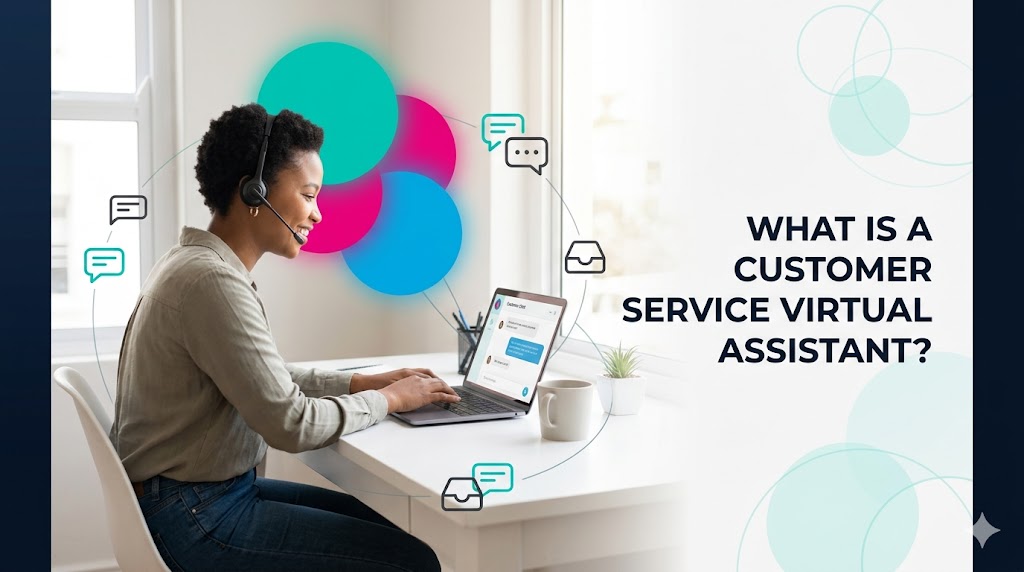
A customer service virtual assistant is a remote professional who manages the conversations between your business and the people who buy from it. They work from their own location, plug into your existing tools, and handle the daily flow of questions, complaints, and follow-ups that would otherwise pile up on your desk.
The work is broader than most people picture. It isn’t just answering “where’s my order.” A capable customer service VA typically owns a mix of the following:
Inbox and ticket management. Sorting, prioritising, and replying to incoming email and helpdesk tickets in platforms like Zendesk, Freshdesk, Gorgias, Help Scout, or Intercom. They tag, route, and close tickets, and they keep your first-response time low so nothing rots in a queue.
Live chat and messaging. Staffing the chat widget on your website, plus WhatsApp, Facebook Messenger, and Instagram DMs. This matters more every year. Live chat now leads channel preference at 41%, ahead of phone at 32%, and messaging volume is climbing while traditional voice calls slowly decline.
Order and account support. Processing returns, issuing refunds, tracking shipments, updating account details, and walking customers through whatever went wrong. For e-commerce and SaaS businesses, this is the bulk of the daily load.
Complaint handling and de-escalation. Taking the angry message and turning it into a resolved one. This is the part AI consistently fumbles and the part that decides whether a frustrated customer stays or churns.
Knowledge base and FAQ upkeep. Writing and updating help articles so that common questions get answered before they ever become tickets.
Feedback and review management. Responding to reviews, sending follow-up surveys, flagging recurring issues to you, and tracking satisfaction over time.
Cross-channel consistency. A customer who emails on Monday, chats on Tuesday, and DMs on Wednesday should feel like they’re talking to the same company that remembers them. A good customer service VA keeps notes, logs context, and makes sure the third conversation doesn’t start from scratch. That continuity is something a rotating cast of strangers or a memoryless bot simply can’t provide.
The good ones don’t just react. They watch for patterns, tell you that fourteen people asked the same question this week, and suggest you fix the product page instead of answering the same email forever. They notice that returns spiked after a packaging change, or that a particular plan generates triple the support load. That shift, from reactive ticket-closer to early-warning system, is where a customer service VA starts earning back far more than they cost. The best ones become a quiet source of product intelligence, feeding you the unfiltered truth about what your customers actually struggle with, long before it shows up in your sales figures.
A customer service VA’s real job isn’t closing tickets. It’s making sure your customers never feel like they’re talking to an empty building.
Why Businesses Are Hiring Customer Service VAs Right Now
Outsourcing customer support isn’t new, but the pressure driving it has changed shape. Three things are happening at once.
First, customers expect speed that in-house teams can’t sustain. Ninety percent of consumers say a quick response is critical, and 60% expect a resolution within 10 minutes. Hitting that with a single overworked employee and a founder who checks email between meetings is impossible. Coverage gaps are where loyalty dies. Long hold times remain the single biggest killer of customer satisfaction, no matter who is staffing the channel.
Second, support has become a measurable revenue lever, not a cost centre. Companies that outsource it well see real numbers move. Dedicated outsourced support teams have produced response times 35 to 50 percent faster than newly built in-house teams, and CSAT scores 15 to 25 percent higher, particularly in chat and email. Sixty-two percent of companies that outsource customer service report improved CSAT scores. When done badly, the same data shows cultural mismatch driving roughly 30% of the dissatisfaction, which is exactly why how you hire matters.
Third, the economics are compelling. For a founder doing the maths, that’s the equivalent of a full-time hire’s salary freed up to put back into product or marketing.
The category is enormous and growing. The outsourced customer care market was worth $77.12 billion in 2024 and is projected to reach $113.18 billion by 2030. Thirty-eight percent of businesses outsource customer service, making it the most outsourced function globally. The trend isn’t slowing. It’s specialising.
Customer Service VA vs Call Centre vs AI Chatbot
People conflate these three, and the confusion costs them. They’re not the same thing, and choosing the wrong one is a common, expensive mistake.
A call centre is built for volume. Hundreds of agents, scripted responses, metrics like average handle time. It works for enterprises fielding tens of thousands of identical queries. For a business doing a few hundred tickets a month, it’s overkill, impersonal, and your customers become a number in a queue.
An AI chatbot is built for speed and scale on simple questions. It never sleeps and costs little to run. But it has a ceiling, and customers hit it constantly. More on that below.
A customer service virtual assistant sits in the gap most businesses actually live in. One dedicated person, or a small managed team, who learns your product deeply, speaks in your brand’s voice, and handles the nuanced, emotional, judgment-heavy conversations that scripts and bots can’t. They’re flexible enough for a startup and personal enough that customers feel like they’re dealing with a real company that knows them.
The decision often comes down to volume. Below roughly 500 tickets a month, AI tools plus a dedicated VA cover most situations beautifully. Above that, a hybrid model, with AI catching the routine and humans owning everything complex, tends to win. The mistake is treating any one of these as a complete solution on its own.
The Human in the Loop: Why a Trained VA Beats Pure Automation
This is the section every business considering “just use AI for support” needs to read carefully, because the data on this has become impossible to ignore.
The sales pitch for AI customer service is seductive. Faster, cheaper, available at 3am, never calls in sick. And for tier-zero questions, things like “what are your hours” or “where’s my tracking number,” it genuinely works. AI-assisted agents handle around 33% more tickets per hour while maintaining higher satisfaction than non-assisted peers. Used as a tool that supports a human, AI is excellent.
Used as a replacement for one, it falls apart fast. And customers have made their feelings extremely clear.
The numbers are stark. A 2025 survey found 93.4% of consumers prefer interacting with a human over AI, and 88.8% think companies should always offer a human option. Seventy-eight percent say humans resolve problems faster, and 84% say humans are more accurate, which is striking given speed and accuracy were supposed to be AI’s headline strengths. Roughly 56% of all consumers say they’re often frustrated by AI customer-service chatbots, and nearly half (48%) don’t trust the information those bots give them.
The real-world holiday data tells the same story even more bluntly. In the 2025 holiday season, 78% of shoppers used AI for customer service, but only 29% said it improved their experience while 54% said human agents were still doing better. Fifty-five percent had to escalate an AI-handled issue to a human, and 45% said the AI failed to understand their problem.
93.4% of consumers prefer a human over AI for support. The technology got faster. Trust didn’t follow.
And the stakes of getting it wrong are brutal. Independent research cited across the industry suggests 70% of consumers would switch brands after just one frustrating AI experience. The Verizon CX Annual Insights Report found a 28-percentage-point satisfaction gap: 88% of customers were satisfied with human agents versus just 60% with AI interactions.
There’s a deeper reason for this, and it’s the thing automation can’t fake. When a customer is upset, the message they’re sending isn’t really “fix my order.” It’s “I trusted you and something went wrong, reassure me.” A trained human reads the tone, hears the real worry underneath the complaint, and responds to the person, not just the ticket. As one 2025 analysis put it, AI increased handling capacity and speed, but didn’t automatically improve satisfaction; brands that design human-guided support win because they convert speed into trust.
That’s the entire case for a human in the loop. AI is a force multiplier for a good support person. It is not a substitute for one. The smartest businesses use automation to clear the routine fifty percent so their human VA has the time and energy to be genuinely excellent on the fifty percent that decides whether a customer stays. A customer service virtual assistant is that human, and the quality of their training is what separates a relationship saved from a customer lost.
The South African Advantage
If you accept that the human matters, the next question is obvious: where do you find a great one without paying a premium that wipes out the cost savings? For businesses serving the UK, Europe, Australia, and increasingly North America, the answer keeps coming back to one country.
South Africa has quietly become one of the strongest customer service outsourcing destinations in the world, and the reasons are specific rather than vague.
A time zone that actually works. South Africa runs on South African Standard Time, only one or two hours ahead of the UK depending on the season, so a South African VA is working during your business hours, not the middle of your night. It sits close to European hours too. Australia is eight or nine hours ahead of South Africa, so there the live window is short and most work runs as a handover. Compare that to the Philippines or India, where the day-night flip means your “real-time” support is anything but. For live chat and messaging, where the whole point is immediacy, this is decisive.
English that needs no translation. English is an official language in South Africa, and agents demonstrate native-level proficiency that eliminates the accent and comprehension issues often associated with other offshore locations. South Africa ranks around 12th in the world for English proficiency, and the accent is widely described as neutral and easily understood by English speakers globally.
Cultural affinity, not just language. This is the part that’s hard to quantify but easy to feel. South African agents intuitively understand Western consumer expectations, humour, colloquialisms, and cultural references, which makes interactions smoother and more empathetic. Your customer doesn’t feel like they’re explaining themselves to a stranger. One analysis found this authentic cultural integration delivers 18% higher customer satisfaction than traditional offshore destinations.
Cost savings without the quality trade-off. And retention is better than the offshore average, which matters because every time an agent quits, your customers lose the person who knew their history. South African BPO turnover tends to run 15-20%, against 30-45% in some competing markets.
A South African customer service VA works your hours and speaks your customers’ language natively. The timezone alone is worth the move.
This is the talent pool VAConnect was built on. The combination of timezone, language, culture, and cost is exactly why a South African customer service VA tends to outperform both a cheaper offshore option and a far pricier local one.
How VAConnect Approaches Customer Service Support
Here’s where the difference between hiring a freelancer and partnering with a managed agency becomes concrete, because it directly affects whether your customer service actually improves.
VAConnect doesn’t run a freelancer marketplace where you browse profiles and gamble. Those aren’t decorative numbers. They tell you the system is built to keep clients and VAs together for the long haul, which is precisely what customer support needs.
The process starts with strategy, not a CV dump. The “Strategy First” approach means a discovery conversation about what your customers actually need before anyone is assigned. You’re then matched with a VA chosen for fit, including how well they suit your work culture, not just whoever was available. For customer service, where the VA becomes the voice of your brand, this matters enormously.
Then there’s the part most freelancer arrangements have no answer for: ongoing support of the person supporting you. VAVarsity, VAConnect’s continuous training platform, keeps VAs upskilled on the tools and soft skills your business needs, including the empathy and de-escalation abilities that separate a competent support agent from a great one. The VAPI Two-Way Happiness programme manages the satisfaction of both client and VA, which is the quiet engine behind that low turnover. A happy, supported VA stays, and a VA who stays keeps knowing your customers.
Founder Karen van Zyl built the model after running multiple businesses herself, which is why the whole thing is oriented around what an overstretched founder actually needs rather than what looks good in a sales deck. On the compliance side, VAConnect maintains published NDA, Data Protection, and Privacy & GDPR policies, which matters when your VA will be handling customer data, order details, and payment-adjacent information daily.
The point of all this isn’t bells and whistles. It’s that a managed model removes the failure modes that sink freelancer arrangements: the VA who vanishes, the one who was never trained on de-escalation, the data-handling that nobody documented, the customer who got a different person every time. For something as relationship-critical as customer service, that stability is the product.
What a Customer Service VA Costs and What You Get Back
The honest answer to “what does this cost” is: less than the alternative, in almost every direction.
The direct comparison is to a local in-house hire. A full-time customer service employee in the UK, Australia, or North America carries not just salary but payroll taxes, benefits, equipment, office space, recruitment costs, management overhead, and the risk of them leaving six months in. A managed South African customer service VA delivers comparable, frequently better and service.
But the salary saving is the least interesting part of the return. The bigger numbers are downstream:
Retention. If 70% of customers would leave after one bad experience, then every prevented bad experience is retained revenue. A responsive human handling complaints well is a churn-reduction machine.
Recovered founder time. Every hour you’re not personally answering “where’s my order” is an hour back for the work only you can do. For an entrepreneur, that hour is worth far more than the VA’s hourly rate.
Faster resolution, higher satisfaction. The 15-25% CSAT lift and 35-50% faster response times documented for dedicated outsourced teams translate directly into reviews, referrals, and repeat purchases.
The mistake businesses make is treating customer support as a cost to minimise. It’s an investment that compounds, because retained customers buy again, refer others, and cost a fraction of acquiring new ones. A customer service VA is one of the rare hires that pays for itself in churn prevented before you even count the salary you saved.
How to Know If You’re Ready for One
You’re ready for a customer service VA when any of these are true. Support emails are sitting unanswered for hours because there’s no dedicated person on them. You or a senior team member are spending real time on routine queries that don’t need your expertise. Your live chat or social channels go dark outside business hours. You’re getting complaints about slow responses, or worse, you’re getting silence followed by churn you can’t explain. You’re considering an AI-only solution and quietly worried it’ll frustrate the customers you’ve worked hard to win.
If you recognised your business in two or more of those, the gap is already costing you. The customers who left because nobody answered don’t usually tell you they’re leaving. They just stop coming back.
The good news is that fixing it doesn’t require building a department. It requires one well-chosen, well-trained, well-supported human in the right timezone, speaking your customers’ language, backed by a system designed to keep them. That’s the whole proposition.
Getting started is also less disruptive than most owners fear. A good onboarding doesn’t dump a VA into your inbox cold. It begins with a short handover of your common questions, your tone of voice, your refund and escalation rules, and the handful of edge cases that actually matter. Within a week or two, a capable customer service VA is handling the routine flow independently and flagging only the genuine judgment calls to you. The goal isn’t to add another person you have to manage. It’s to remove a category of work from your plate entirely, so that the inbox stops being something you dread and becomes something that quietly runs itself.
The Bottom Line
Customer service has quietly become the place businesses win or lose, and the gap between the ones who staff it properly and the ones who don’t has grown wider than most owners realise. On one side: companies with a trained human answering fast, in the right timezone, in the customer’s own language, turning complaints into loyalty. On the other: businesses leaning on an unmanned inbox and an AI bot that 93.4% of their customers would rather not deal with, watching customers leak away in silence.
A customer service virtual assistant is how you get on the right side of that gap without the cost and overhead of a local hire. And the way you hire one decides whether it works. A managed model, with proper matching, continuous training, accountability, and data protection built in, removes the risks that make freelancer arrangements collapse. The human in the loop is the entire point. AI can make that human faster. It cannot replace them, and the data showing customers fleeing AI-only support gets louder every quarter.
If your customers are waiting and no one’s answering, that silence is already a number on your churn report. A customer service VA is how you make it stop.
| Factor | DIY Coordination | Generic Freelancer | VAConnect Customer Service VA |
|---|---|---|---|
| Response speed | Slow — squeezed between other work | Variable — depends on their other clients | Fast — dedicated coverage in your hours |
| Timezone fit (UK/EU) | Whenever you’re free | Often offshore day/night flip | SAST, only 1–2 hours from the UK |
| English & cultural fit | Native but time-poor | Inconsistent, accent/comprehension risk | Native-level, neutral accent, Western cultural affinity |
| Training & de-escalation skill | None beyond your own | Rarely formalised | VAVarsity continuous training in tools + soft skills |
| Consistency / who answers | You, when you can | Different gig-to-gig, may vanish | Same dedicated VA, low turnover via VAPI |
| Cost vs local in-house hire | “Free” but costs your time | Cheap but unmanaged | 40–60% less, fully managed |
| Data protection / compliance | Ad hoc | Usually undocumented | Published NDA, Data Protection, Privacy & GDPR policies |
| Replacement if they leave | You absorb it | You start over | Agency handles cover and re-matching |
| Reads tone & saves relationships | When you have bandwidth | Hit or miss | Trained human in the loop, by design |
| Best for | Pre-revenue / very low volume | One-off, simple tasks | Businesses serious about retention |
Ready to stop the silence? Explore VAConnect’s customer service and support services or book a strategy-first discovery call with the team.